
Reviewed · FREEDOM TRAIL TOURS
Tour of the Freedom Trail: Faneuil Hall to Boston Common
Boston’s Freedom Trail is easiest to understand when someone connects the red-brick path to the people who argued, protested, fought, and died along it. This 90-minute walking tour does that well, using a costumed colonial guide and a route from Faneuil Hall to Boston Common.
I like the compact route and the strong storytelling. You cover the central part of the trail without spending half a day on your feet, and guides such as Dave, Adri, Benjamin, and Samuel Grey have been praised for humor, energy, and clear explanations. The main drawback is that a group can reach up to 35 people, so hearing every word may be difficult if you drift toward the back.
In This Review
- Key points at a glance
- Starting at Faneuil Hall at noon
- What the 90-minute route actually covers
- Old State House and the Boston Massacre site
- Old South Meeting House and the power of public argument
- Granary Burial Ground, a memorable pause
- Ending at Boston Common
- Guide quality is the key variable
- Group size, sound, and weather
- Is the $25 price good value?
- Who should book this walk?
- Should you book the Faneuil Hall to Boston Common tour?
- FAQ
- Where does the Freedom Trail tour start?
- What time does the tour begin?
- Where does the tour end?
- How long does the tour last?
- How many Freedom Trail sights are included?
- Which major sights are included?
- Are admission tickets included?
- How many people can join the tour?
- Can I cancel for a full refund?
Key points at a glance

- Faneuil Hall starting point: Meet at Faneuil Hall Marketplace at noon, then begin near one of Boston’s best-known colonial gathering places.
- About 11 of 16 Freedom Trail sights: The route includes the Old State House, Boston Massacre site, Old South Meeting House, Granary Burial Ground, and Boston Common.
- A 90-minute introduction: You get a focused look at central Boston rather than the full trail, which takes longer.
- Costumed interpretation: Your guide brings colonial characters and stories to the street, with some guides appearing as historical figures.
- Strong family appeal: The mix of facts, humor, and movement works well for children and adults.
- Small practical risks: The starting point can be confusing, and large groups may make it harder to hear.
Starting at Faneuil Hall at noon

The tour begins at Faneuil Hall Marketplace, Boston, Massachusetts 02109, with a listed start time of 12:00 p.m. This is a busy part of the city, so give yourself time to find the correct meeting place. One person missed the tour after asking a ticket booth connected with another company for directions, then could not locate the guide.
That problem is avoidable if you check the meeting instructions before leaving. The guide is described as being dressed in colonial clothing, but do not rely only on spotting a costumed person in a crowded area. Know that you are starting at Faneuil Hall Marketplace, not at the Boston Common Visitors Center.
Faneuil Hall is a fitting place to begin. The building is tied to public debate and civic life, so the setting immediately puts you in the world of town meetings, political arguments, and colonial protest. Your guide uses the surrounding streets as the classroom, rather than keeping you inside a museum.
The noon departure also makes this useful as a first major activity of the day. You finish around 1:30 p.m. at Boston Common, where you can continue sightseeing, find lunch, or use the nearby visitor facilities. Since the route is one way, you do not need to retrace your steps to return to Faneuil Hall.
More Freedom Trail walks in Boston:
- Boston: Freedom Trail History Small Group Walking Tour
★ 5.0 · 6,450 reviews - Boston Freedom Trail Walking Tour with Costumed Guide
★ 4.5 · 2,531 reviews - Boston Food & History: Pizza, North End & Freedom Trail
★ 5.0 · 1,772 reviews
What the 90-minute route actually covers
This is not the entire Freedom Trail. The full trail has 16 recognized sights, while this shorter outing covers about 11 of them. The tour description names five major points directly: the Old State House, the Boston Massacre site, Old South Meeting House, Granary Burial Ground, and Boston Common.
The operator has also described the route as covering 12 sights in less than a mile. Because the advertised wording varies between 11 and 12, I would treat the tour as an introduction to roughly three quarters of the central trail, not as a guarantee of a precise count.
That distinction matters. If you want to see every Freedom Trail location, inspect every building, and hear a full account of the city’s colonial and Revolutionary eras, this is too short. If you want a clear orientation with several major stops, the time limit is a strength.
The route keeps moving through historic streets, with stops for explanation and storytelling. You are not simply following a painted line while listening to a long lecture. The guide’s value comes from explaining why each place mattered and how the events fit together.
Old State House and the Boston Massacre site
The Old State House is one of the tour’s most important stops. It represents the colonial government and the political tensions that grew between local residents and British authority. From here, the story becomes less abstract. You are standing in the middle of the city where arguments over law, taxes, power, and representation played out in public.
Nearby, the Boston Massacre site brings the conflict into sharper focus. The event is often taught as a simple date in a textbook, but the physical setting helps you picture the crowd, soldiers, fear, and confusion that surrounded it. A good guide can explain how the incident was presented to the public and why it became such a powerful piece of Revolutionary propaganda.
This is where the tour benefits from a strong storyteller. Guides such as Benjamin and Adri have been praised for making facts easy to follow and for answering questions about both colonial Boston and later city history. You should expect the focus to remain on early American and colonial history, not on modern Boston.
That focus is useful if you are visiting the city to understand the Revolution. It may feel narrow if you hoped for a broad survey of Boston from the colonial period to today. The tour provider itself makes that distinction clear: this is a colonial and Revolutionary history walk.
Old South Meeting House and the power of public argument

The Old South Meeting House adds another layer to the story. It was a place where people gathered to debate public matters, and it helps explain how Boston’s political culture worked before the Revolution. The important point is not only the building itself, but also the role of meetings, speeches, and public pressure.
Your guide should help connect this stop to the wider chain of events. The Freedom Trail works best when you understand that the Revolution did not appear from nowhere. It grew through repeated disputes, public gatherings, angry pamphlets, military tension, and hard choices made by ordinary residents and political leaders.
A costumed guide can make this more immediate than a standard walking app. The guides are presented as colonial interpreters, and some use historical characters. One guide appeared as Mrs. de Lafayette, a quieter character who also discussed French involvement in the American cause. That style may appeal to you if you enjoy living-history performance, but it also means the tone can vary by guide.
Most of the reported guide praise centers on humor, energy, and storytelling. Dave, in particular, has been singled out for keeping adults and children involved. Still, one low-rated experience found a character guide too subdued and lacking energy. If you prefer a theatrical, lively walk, your experience may depend more on the individual guide than on the route itself.
More Boston Common walks:
- Haunted Boston Common & Beacon Hill Ghost Tour
★ 5.0 · 25 reviews - Freedom Trail: Boston Common, Old State House, Faneuil Hall
★ 5.0 · 24 reviews - Freedom Trail: Boston Common, Old State House, Faneuil Hall
★ 5.0 · 8 reviews
Granary Burial Ground, a memorable pause

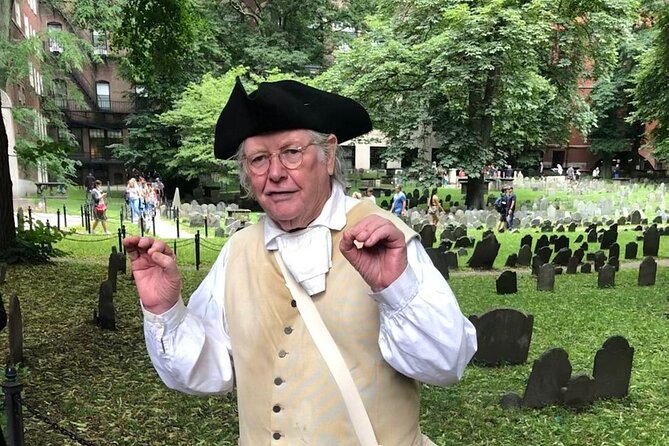
Granary Burial Ground is often the emotional highlight of this route. The cemetery beside Park Street Church gives the busy city a quieter mood and puts names and lives behind the political story. It is one thing to hear about the Revolution in streets full of modern traffic. It is another to stand among the graves connected with Boston’s early civic and political life.
The cemetery also gives the tour a change of pace. After several urban streets and landmark buildings, you have a chance to pause and consider the people involved. Your guide may explain why the burial ground matters and connect it to the larger story of early Boston.
Do not expect a long, silent cemetery visit. The tour lasts only 90 minutes, and the group must keep moving. If you want time to study individual markers or explore burial grounds at length, you will need to return on your own.
Still, this is a strong reason to choose the guided walk instead of simply tracing the Freedom Trail with a map. The guide can point out why the site matters and give the cemetery a place in the story rather than treating it as just another stop.
Ending at Boston Common
The walk ends at the Boston Common Visitors Center, 139 Tremont Street, Boston, Massachusetts 02111. That endpoint is practical. Boston Common is one of the city’s central open spaces, and the visitor center gives you a useful place to continue planning.
Ending here also makes the tour easy to pair with other activities. You can explore more of the Freedom Trail, visit nearby historic sites, or simply take a break after the walk. Since the tour ends at a different location from its starting point, you finish with a better sense of Boston’s central historic district.
The route is described as less than a mile, but do not mistake that for a completely effortless outing. You will be standing and walking for about an hour and a half. One person using a leg brace found the pace comfortable because the guide was attentive to slower walkers. That suggests the tour can work for a range of abilities, though you should be prepared for an outdoor walk with the group.
Service animals are allowed, and the tour is near public transportation. Most people can participate. Those details make it a practical choice for families, solo visitors, and mixed-age groups.
Guide quality is the key variable
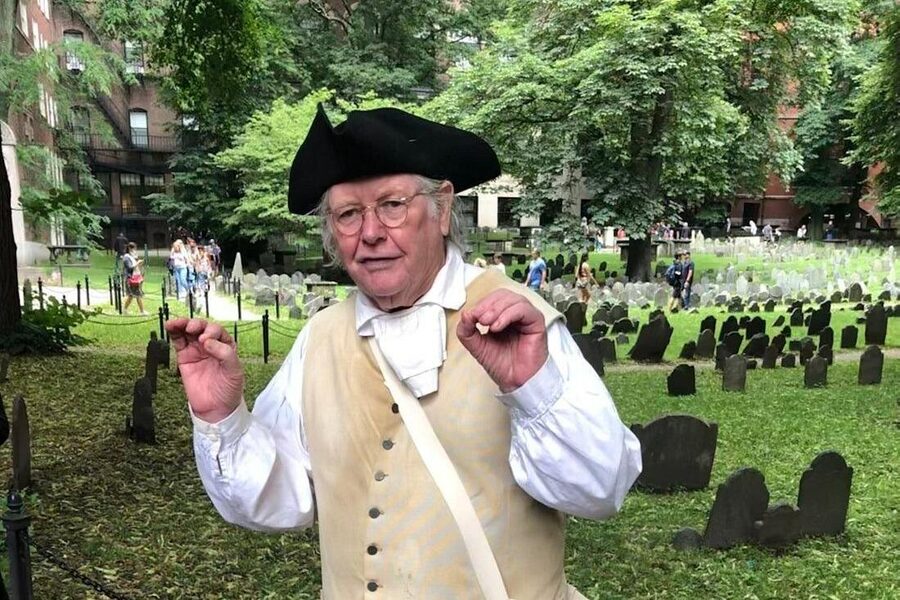
The strongest part of this experience is the guide. The company describes its interpreters as teachers, professors, reenactors, and storytellers. Names that have received especially positive attention include Dave, Adri, Benjamin, Jeff, and Samuel Grey.
Dave is described as lively, funny, and good with different age groups. Adri is praised for interesting facts and an easy sense of humor. Benjamin receives strong marks for the overall tour, while Jeff successfully took over a later departure after a last-minute guide illness. Samuel Grey was praised as a fantastic guide, although the group size made hearing difficult for one family.
This range matters because a walking tour is not a fixed museum exhibit. A high-energy guide can make the same street corner feel immediate. A quieter character performance may suit you if you prefer a calmer presentation, but it may not satisfy you if you want jokes, drama, and frequent interaction.
The overall rating is 4.4 out of 5 from 43 ratings. That is a good result, but it also hides the main weakness: the experience can vary. Most of the strong praise centers on guides who know their material, keep a good pace, and use humor without losing the historical point.
Group size, sound, and weather

The maximum group size is 35 people. That is not a tiny walking group. It is manageable on the street, but it can make the guide harder to hear, especially when traffic or city noise is nearby.
If you book, stay near the front. The company says guides use a microphone and asks anyone with hearing difficulty to remain close. That is sensible advice. Arrive early enough to position yourself well, especially if you are traveling with children or anyone who needs to hear clearly.
The tour operates outdoors and requires good weather. A rainy day does not automatically ruin it. One guide helped keep the group as dry as possible and showed people where to get umbrellas. Still, the provider may cancel for poor weather and offer another date or a full refund.
Wear shoes suited to city walking and bring weather protection. The supplied details do not promise indoor access at each sight, so plan for an outdoor experience. If rain would make the outing unpleasant for you, check the forecast before the 24-hour cancellation deadline.
Is the $25 price good value?
At $25 per person, this is priced as an accessible introduction rather than a full-day historical program. You are paying for a guide, a planned route, and context at several major locations. Admission tickets to individual sights are not included, so the value comes from the walking interpretation, not from entry to buildings.
I think the price is fair if you are new to Boston and want a compact overview. In 90 minutes, you get the basic shape of the Freedom Trail and finish close to other sights. You can then decide which places deserve a longer visit.
The value is weaker if you want deep coverage of all 16 sights. The shorter route skips some locations, and the tour does not include admission. A three-hour full Freedom Trail tour is available from the same provider at a different cost, so compare the two if the trail is your main reason for visiting Boston.
For families, the price can work well because the format avoids a long, exhausting lecture. Children ages 9 to 13 have been reported to enjoy the blend of stories and humor. The 90-minute length is short enough to hold attention, yet long enough to cover several important sites.
Who should book this walk?
I would choose this tour for a first visit to Boston, especially if you want early American history explained in plain language. It suits families, couples, solo visitors, and mixed-age groups who prefer a guided introduction to figuring out the red-brick path alone.
It is also useful if you have only a short window in the historic center. The route begins at Faneuil Hall and ends at Boston Common, so it helps you organize the rest of your day instead of returning you to the starting point.
You may want something else if you need a quiet, small-group experience, a complete tour of all 16 sights, or a strong focus on modern Boston. You should also consider a private tour if a group of up to 35 would make you uncomfortable. The provider says private options are available.
Book with realistic expectations. You are getting a lively overview, not a museum visit at every landmark. Your enjoyment will depend heavily on the guide assigned that day, so arrive ready to stay near the front and ask questions.
Should you book the Faneuil Hall to Boston Common tour?
Book it if you want a short, story-driven introduction to Boston’s colonial and Revolutionary past. The route includes several of the trail’s most important points, and the best guides, including Dave, Adri, Benjamin, Jeff, and Samuel Grey, bring energy and humor to the walk.
Skip it if your priority is a complete Freedom Trail experience or detailed access to every historic building. For most first-time visitors, though, $25 buys a useful orientation, a manageable walk, and a good starting point for exploring more of Boston on your own.
Free cancellation is available until 24 hours before the 12:00 p.m. start time. Changes or cancellations inside that window are not refunded, except when the provider cancels because of poor weather or an unmet minimum. That gives you a fair amount of flexibility, but check the meeting point carefully so you do not lose the tour through a simple location mistake.
FAQ
Where does the Freedom Trail tour start?
It starts at Faneuil Hall Marketplace in Boston, Massachusetts, at the listed meeting point.
What time does the tour begin?
The scheduled start time is 12:00 p.m.
Where does the tour end?
The walk ends at the Boston Common Visitors Center at 139 Tremont Street, Boston.
How long does the tour last?
The tour lasts approximately 1 hour and 30 minutes.
How many Freedom Trail sights are included?
The tour covers about 11 of the trail’s 16 sights. The provider has also described the route as covering 12 sights, so you should expect roughly 11 to 12 locations rather than the entire trail.
Which major sights are included?
Named stops include the Old State House, Boston Massacre site, Old South Meeting House, Granary Burial Ground, and Boston Common.
Are admission tickets included?
No. Admission tickets for sights are not included in the walking tour.
How many people can join the tour?
The maximum group size is 35 people.
Can I cancel for a full refund?
Yes. You can cancel at least 24 hours before the experience start time for a full refund. Cancellations and changes made less than 24 hours before the start are not refunded, unless the provider cancels because of poor weather or an unmet minimum number of participants.
Just added around Boston
- Day Trip from Boston: Explore Hammond Castle Museum★ 3.7 · 3 reviews
- Boston: WNDR Museum Entry Ticket★ 3.7 · 3 reviews
- The Boston Bash Scavenger Hunt★ 4.5 · 3 reviews
- Self-Guided Audio Tour of Boston North End★ 4.5 · 3 reviews
- Self Guided “The North End Pizza, Cannoli and Picnic” Solo Walking Tour★ 5.0 · 3 reviews
- Boston: Official Freedom Trail® Lantern Tour★ 4.7 · 3 reviews
- Boston: North End Walking Tour with Private Harbor Cruise★ 5.0 · 3 reviews
- Cambridge: Haunted Charles River Cruise★ 4.3 · 3 reviews
Freedom Trail Tours, compared.
Freedom Trail History Small Group Walking Tour
Read our review →
Boston Freedom Trail Walking Tour with Costumed Guide
Read our review →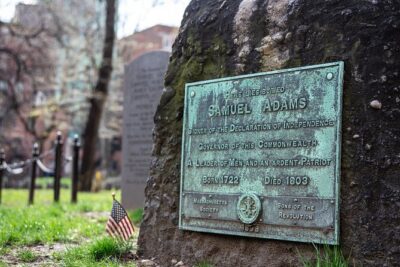
Boston Food & History: Pizza, North End & Freedom Trail
Read our review →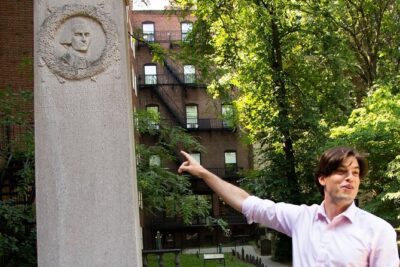
Boston’s Freedom Trail: A Revolutionary Walking Tour
Read our review →Freedom Trail History Small Group Walking Tour
Read our review →Boston’s Freedom Trail: A Revolutionary Walking Tour
Read our review →

Boston Freedom Trail History Pub Crawl Small-Group Tour
Read our review →Browse the lists this tour appears in