
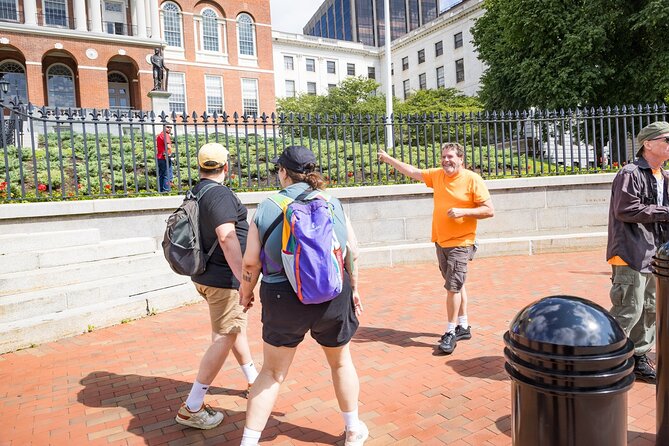
Reviewed · FREEDOM TRAIL TOURS
Freedom Trail: Boston Common, Old State House, Faneuil Hall
Boston’s Freedom Trail is history you can walk through, not just read about. In two hours, you move from Boston Common and its old colonial streets to the places where revolutionaries debated, died, and set independence in motion. Guide Brian brings plenty of humor, local color, and a real Boston accent to the route.
I like the efficient path and the way it links major sights without wasting time. I also like that the walk gives you room for photos and questions, while still covering the Boston Massacre site, Granary Burying Ground, Old South Meeting House, Old State House, and Faneuil Hall.
The main drawback is its brisk scope. You see many important places from the outside or in passing, so this is best for orientation and storytelling rather than long museum visits. Two hours on foot can also feel demanding in poor weather.
In This Review
- Key points to know before you book
- Starting at Boston Common and Park Street
- The golden dome and Park Street Church
- Granary Burying Ground and the people behind the slogans
- King’s Chapel and the colonial divide
- Old South Meeting House and the road to the Tea Party
- Old Corner Bookstore and Boston’s literary side
- Old State House and the Declaration of Independence
- The Boston Massacre site
- Faneuil Hall, the Cradle of Liberty
- What the $39 price gets you
- How Brian’s guiding style shapes the walk
- Who should take this Freedom Trail tour?
- Should you book the Boston Freedom Trail walk?
- FAQ
- How much does the Freedom Trail tour cost?
- How long does the tour last?
- Where does the tour begin?
- Where does the tour end?
- What sights are included?
- Is a guide included?
- Are food and drinks included?
- Is hotel pickup available?
- Is the tour wheelchair accessible?
- Can I cancel for a refund?
- Do I have to pay when I book?
Key points to know before you book
- Start at Boston Common: Meet outside Park Street T Station on the eastern edge of America’s oldest public park.
- Finish at Faneuil Hall: The route ends in a useful central spot, close to one of Boston’s best known historic marketplaces.
- Hear the Revolution where it happened: Old South Meeting House, the Old State House, and the Boston Massacre site all fit into one compact walk.
- Visit Granary Burying Ground: See the graves of Paul Revere, Samuel Adams, John Hancock, and Crispus Attucks.
- Expect a lively guide: Brian is praised for his humor, Boston accent, clear explanations, and ability to keep children interested.
- Good value for a short visit: At $39, the tour works well if you want Boston’s essential colonial story without spending a full day on museums.
Starting at Boston Common and Park Street
The walk begins outside Park Street T Station, beside Boston Common. That meeting point is easy to reach and gives you a useful first look at the city’s oldest public park before the historic buildings begin.
Founded in 1634, Boston Common has served many purposes over the centuries. British troops camped here during the Revolutionary War, and the park later hosted civil rights rallies. It is not simply a patch of grass at the start of the route. It helps you see how Boston’s public spaces have carried the city’s arguments, conflicts, and gatherings across time.
I like beginning here because it gives the tour room to breathe. You are not dropped straight into a list of dates. You first get a sense of Boston as a compact city where government, religion, protest, trade, and burial grounds all sit close together.
The route is wheelchair accessible, according to the activity details. Still, you should expect a two hour walk through an old urban center, with frequent stops and city streets underfoot.
More Freedom Trail walks in Boston:
- Boston: Freedom Trail History Small Group Walking Tour
★ 5.0 · 6,450 reviews - Boston Freedom Trail Walking Tour with Costumed Guide
★ 4.5 · 2,531 reviews - Boston Food & History: Pizza, North End & Freedom Trail
★ 5.0 · 1,772 reviews
The golden dome and Park Street Church
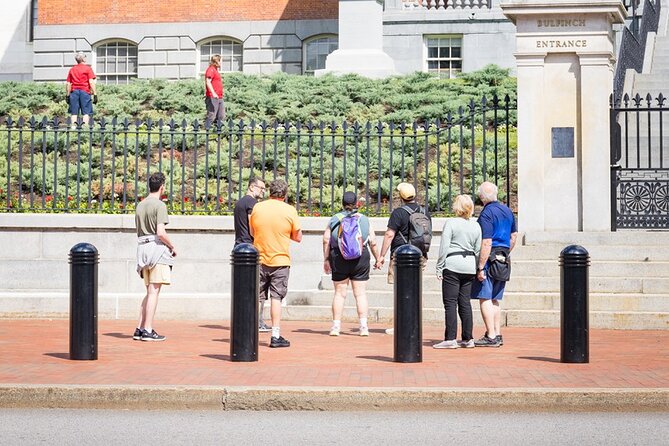
From Boston Common, the route brings you near the Massachusetts State House. Completed in 1798, the building is easy to recognize by its golden dome and remains the seat of Massachusetts government.
The State House adds an important layer to the tour. The Freedom Trail is not only about events before independence. It also shows how the new state built institutions after the Revolution. Your guide can connect the colonial disputes you have just heard about with the later work of governing Massachusetts.
Nearby Park Street Church dates from 1809. Its tall steeple became one of Boston’s familiar landmarks, but the church matters for more than its shape. It was the site of the first public anti-slavery address in the United States, giving the stop a link to a later fight for freedom.
This is one of the useful features of the route. The story does not end when the Declaration of Independence is read. Boston’s public arguments continued, and Park Street Church helps widen the frame beyond the Revolutionary War.
Granary Burying Ground and the people behind the slogans
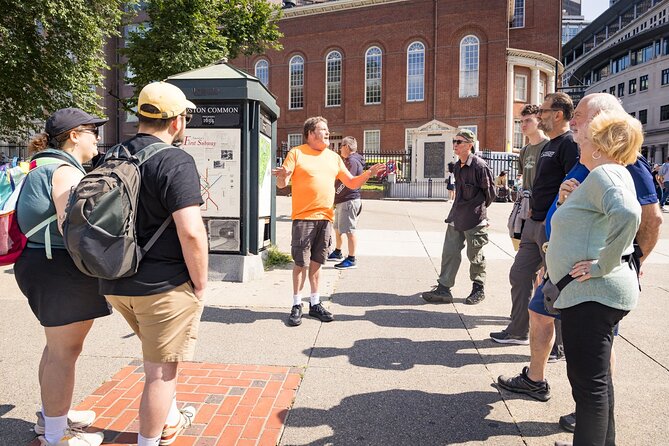
Granary Burying Ground is one of Boston’s oldest cemeteries and one of the most memorable stops. Its crowded stones put human names and lives behind the grand language of liberty.
Paul Revere, Samuel Adams, and John Hancock are buried here. You can also pay respects at the grave of Crispus Attucks, who was the first casualty of the Boston Massacre and a symbol of the struggle for freedom.
I find cemeteries especially useful on a history walk because they slow down the story. A speech or battle can feel abstract. A grave gives you a person, a date, and a physical place where the past is still visible.
Do not expect a long, quiet cemetery visit. This is a highlights walk, and the group continues through a busy downtown area. If you want to study every inscription, you will need to return on your own. The guide’s role here is to explain why these names matter and how they fit into Boston’s larger story.
King’s Chapel and the colonial divide
King’s Chapel, built in 1754, offers a look at Boston before the Revolution. Its Georgian design and age make it one of the city’s important early churches, but its political connections are just as interesting.
The church had ties to loyalist congregants during the Revolution. That detail matters because colonial Boston was not a simple gathering of patriots on one side and British soldiers on the other. People in the city held competing views about taxes, authority, trade, and the future of the colonies.
This stop helps you avoid a too-neat version of American independence. The road to revolution was full of disagreement, and the guide can use buildings such as King’s Chapel to show that Boston’s own population was divided.
The walk focuses on outdoor sights and explanations. If entering the church is important to you, check what the specific departure includes before booking, since the activity description does not promise interior visits at every stop.
More Boston Common walks:
- Tour of the Freedom Trail: Faneuil Hall to Boston Common
★ 4.5 · 43 reviews - Haunted Boston Common & Beacon Hill Ghost Tour
★ 5.0 · 25 reviews - Freedom Trail: Boston Common, Old State House, Faneuil Hall
★ 5.0 · 24 reviews
Old South Meeting House and the road to the Tea Party
Old South Meeting House is one of the route’s strongest stops. Built in 1729, it served as a major gathering place for colonists who were arguing for freedom and justice.
Plans for the Boston Tea Party were famously set into motion here. That makes the building more than an old church. It was a meeting room where people gathered, debated, and decided what to do next.
I like this part of the tour because it makes the Tea Party feel less like a single dramatic act and more like the result of public organizing. The building shows how protest depended on speeches, crowds, persuasion, and a shared sense of grievance.
If you are interested in the Tea Party ships and museum, this walk is not a substitute for that separate attraction. The Freedom Trail tour gives you the setting and the political context, while the dedicated museum experience offers a different, more interactive visit.
Old Corner Bookstore and Boston’s literary side
The Old Corner Bookstore shifts the story away from war and protest. In the 19th century, it was a hub for Boston’s literary world and published works by writers such as Louisa May Alcott.
This small stop is easy to overlook if you are focused only on the Revolution. That is precisely why it earns a place on the route. Boston’s past includes books, publishing, churches, government, and commerce, not only famous battles and speeches.
The building also helps you understand how much history is packed into the downtown streets. The tour does not move between isolated monuments. It passes old buildings that once served very different purposes as Boston changed from a strict Puritan settlement into a modern city.
As with several stops, the value comes from the guide’s explanation. Without context, the Old Corner Bookstore can look like an attractive old building. With context, it becomes part of Boston’s cultural story.
Old State House and the Declaration of Independence
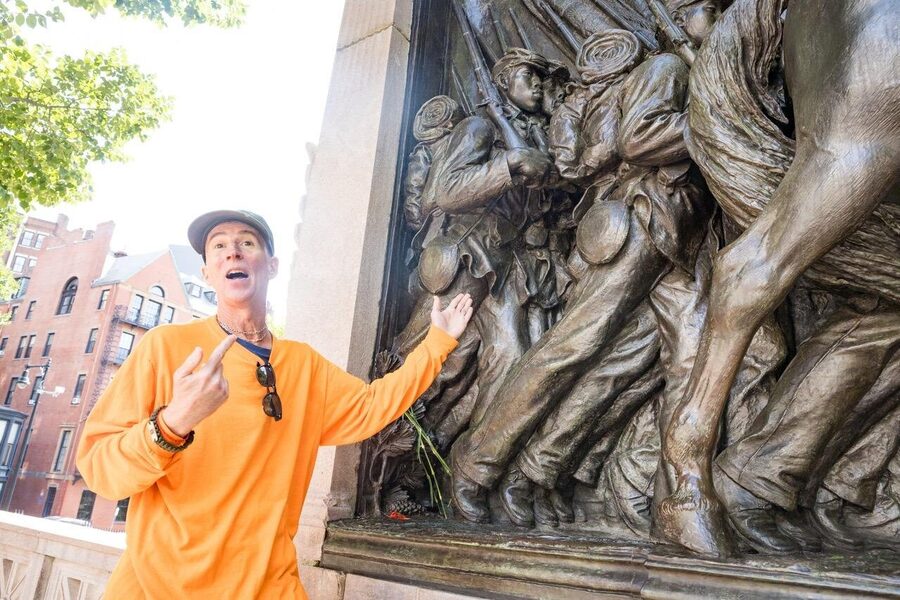
The Old State House dates from 1713 and was the seat of colonial government. Its balcony is linked to one of the most important public moments in Boston’s path toward independence: the Declaration of Independence was read there.
This is where the tour’s political story gathers force. At Old South Meeting House, people organized. At the Old State House, colonial government and public authority came into view. The balcony reading turned a document into a public event for the people of Boston.
The building also makes clear how close the major sites are. In a larger city, these moments might be scattered across several neighborhoods. In Boston, you can walk from one to the next in a short time, which makes a guided route especially useful.
You will likely stop outside and hear the story rather than spend a long period inside the museum. That is a strength if your time is limited, but a limitation if you want detailed exhibits about colonial government.
The Boston Massacre site
The Boston Massacre site marks the place where tensions between colonists and British soldiers erupted in 1770. The event became a powerful symbol in the campaign against British rule.
Your guide can help separate the physical location from the political meaning. The site is not a large battlefield or dramatic ruin. It is part of the modern street, and without explanation it could be easy to miss.
That contrast is useful. Boston’s most important events often happened in ordinary public places: meeting houses, streets, markets, and government buildings. You are walking through a living city, not a preserved colonial village.
The Boston Massacre also connects directly to the names at Granary Burying Ground, including Crispus Attucks. Seeing both locations during one walk gives the story a clearer human scale.
Faneuil Hall, the Cradle of Liberty
The tour ends at Faneuil Hall, known as the Cradle of Liberty. Built as a marketplace and meeting hall in 1742, it became a place for fiery speeches and arguments about independence.
Ending here makes sense. The route has moved through burial grounds, churches, government buildings, and the site of a violent clash. Faneuil Hall brings the story back to public debate, trade, and the power of people gathering in one room.
The end point is practical as well as historic. You finish in a central part of Boston, with the rest of downtown within reach. The tour does not include food or drinks, but Faneuil Hall’s market setting gives you a natural place to look for something afterward.
I would not confuse the end of the walk with the end of the site visit. If you want to spend more time around Faneuil Hall, explore its role in your own time after the guide departs.
What the $39 price gets you
The tour costs $39 per person. I consider that fair if you value a clear route and an expert storyteller, especially on a first visit or a short stay.
You can follow the Freedom Trail independently, but the trail’s red line and signs do not always provide the full political context. A guide can point out why a modest building matters, connect the stops, and answer practical questions about Boston along the way.
The value also depends on your preferred pace. At two hours, this is not a full museum day. You are paying for a focused introduction that covers many major sites in a short period, not for admission to every building.
Food, drinks, hotel pickup, and hotel drop-off are not included. The meeting point is outside Park Street T Station, and the walk ends at Faneuil Hall, so you handle your own transport to the start and onward plans after the finish.
The activity usually runs in the morning. You can reserve now and pay later, and cancellation is free up to 24 hours before the start for a full refund. Those terms are useful if your Boston plans may shift.
How Brian’s guiding style shapes the walk
The guide can make or break a history walk, and Brian receives especially strong praise for his approach. His Boston accent adds local flavor, but the more important point is his delivery. He uses humor, keeps the stories moving, and welcomes questions.
I would choose this tour for a mixed group because the guide’s energy seems to work for more than serious history fans. Parents reported that children stayed interested, and the pace allowed time for photos without making the walk feel slow.
The tour also suits someone who already knows American history. Brian includes details and trivia that can add new angles even when you recognize the main names and events.
No guide can control the weather, and this is still an outdoor walking tour. One positive feature is that Brian has kept his enthusiasm up even in difficult conditions, but you should dress for the forecast and be ready to walk for the full two hours.
Who should take this Freedom Trail tour?
I would recommend it most strongly to first time visitors, families, short stay visitors, and anyone who wants the main Freedom Trail story in one morning.
It is also a good choice if you want to start your Boston sightseeing with a useful orientation. Afterward, you can return to Granary Burying Ground, Old State House, Old South Meeting House, or Faneuil Hall for a closer look.
History fans should enjoy the connections between the sites, especially the links among the Boston Massacre, Crispus Attucks, the Tea Party planning, and the Declaration of Independence reading.
I would be more cautious if your main goal is extended time inside historic buildings. The route is designed to cover highlights efficiently. It is not a series of long interior tours, and no food or transport is built into the price.
Should you book the Boston Freedom Trail walk?
Book it if you want a lively, compact introduction to Boston’s revolutionary story. The route covers the city’s essential names and places, starts at an easy transit point, ends at Faneuil Hall, and costs a reasonable $39 for two hours with a licensed guide.
I especially like it for families and visitors with limited time. Brian’s humor, local voice, and willingness to answer questions add something an app or self guided map cannot easily provide.
Skip it only if you want to explore each historic building at length or prefer a completely self guided pace. For most people seeking a clear first look at Boston’s Freedom Trail, this is a practical and worthwhile choice.
FAQ
How much does the Freedom Trail tour cost?
The tour costs $39 per person.
How long does the tour last?
The walking tour lasts two hours and is usually available in the morning.
Where does the tour begin?
The meeting point is outside Park Street T Station on the eastern edge of Boston Common.
Where does the tour end?
The tour ends at Faneuil Hall.
What sights are included?
The route covers Boston Common, the Massachusetts State House, Park Street Church, Granary Burying Ground, King’s Chapel, Old South Meeting House, Old Corner Bookstore, the Old State House, the Boston Massacre site, and Faneuil Hall.
Is a guide included?
Yes. The experience includes a guided highlights tour with an expert licensed guide. The tour is conducted in English.
Are food and drinks included?
No. Food and drinks are not included.
Is hotel pickup available?
No. Hotel pickup and drop-off are not included. You make your own way to Park Street T Station for the start.
Is the tour wheelchair accessible?
Yes, the activity is listed as wheelchair accessible.
Can I cancel for a refund?
Yes. You can cancel up to 24 hours in advance for a full refund.
Do I have to pay when I book?
No. The reserve now and pay later option lets you hold a place without paying at the time of booking.
Just added around Boston
- Day Trip from Boston: Explore Hammond Castle Museum★ 3.7 · 3 reviews
- Boston: WNDR Museum Entry Ticket★ 3.7 · 3 reviews
- The Boston Bash Scavenger Hunt★ 4.5 · 3 reviews
- Self-Guided Audio Tour of Boston North End★ 4.5 · 3 reviews
- Boston: Official Freedom Trail® Lantern Tour★ 4.7 · 3 reviews
- Boston: North End Walking Tour with Private Harbor Cruise★ 5.0 · 3 reviews
- Self Guided “The North End Pizza, Cannoli and Picnic” Solo Walking Tour★ 5.0 · 3 reviews
- Cambridge: Haunted Charles River Cruise★ 4.3 · 3 reviews
Freedom Trail Tours, compared.
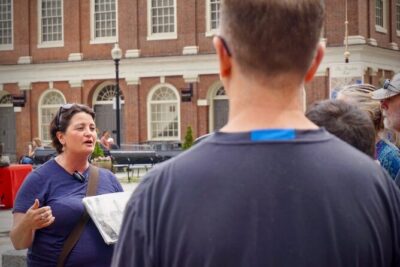
Freedom Trail History Small Group Walking Tour
Read our review →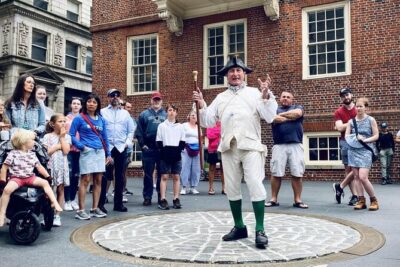
Boston Freedom Trail Walking Tour with Costumed Guide
Read our review →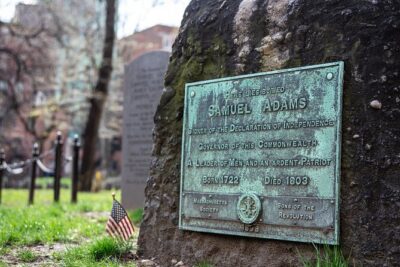
Boston Food & History: Pizza, North End & Freedom Trail
Read our review →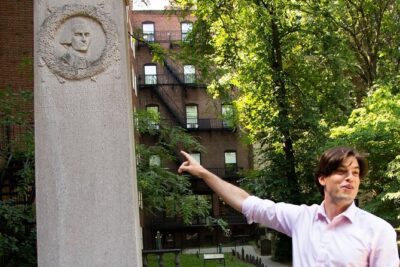
Boston’s Freedom Trail: A Revolutionary Walking Tour
Read our review →Freedom Trail History Small Group Walking Tour
Read our review →Boston’s Freedom Trail: A Revolutionary Walking Tour
Read our review →

Boston Freedom Trail History Pub Crawl Small-Group Tour
Read our review →Browse the lists this tour appears in