
Reviewed · FREEDOM TRAIL TOURS
Boston: Freedom Trail History Small Group Walking Tour
Boston’s Revolution-era story comes alive as you walk from Boston Common to the North End, following the red-brick route through the city’s oldest streets. The focus is tight and useful: the tense years from 1760 to 1775, when taxes, soldiers, newspapers, sermons, and street protests pushed Boston toward rebellion.
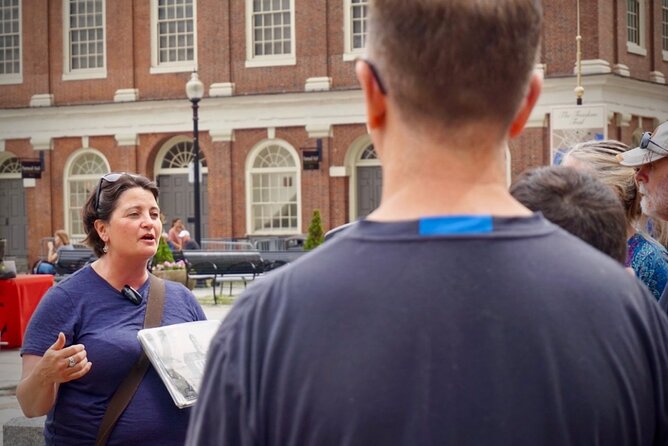
I like the small group limit of 16, which gives you a real chance to ask questions. I also like the way the tour covers all 16 official Freedom Trail landmarks rather than stopping at only the most famous ones. Guides such as Jon, Mark, Maura, and Alejandro are praised for strong storytelling and a clear command of the subject.
The main trade-off is simple: this is a long outdoor walk with a lot of standing. You see the buildings and sites from the street, but admission inside museums and churches is not included. In cold weather, dress seriously, though guides may use indoor or covered spots for short warm-up breaks.
In This Review
- Key points to know before booking
- Why this Freedom Trail walk works so well
- Starting at the Boston Foundation Monument
- Boston Common and the early city
- Granary Burying Ground and Boston’s famous names
- Meeting houses, the Old State House, and the Boston Massacre
- Faneuil Hall and the Cradle of Liberty
- North Square and Paul Revere’s neighborhood
- Old North Church and the final North End stops
- Finishing at Copp’s Hill Terrace
- How difficult is the 2.5-hour walk?
- Which guide style might suit you?
- Who should book this tour?
- Is the $35.10 price worthwhile?
- Should you book the Freedom Trail History Small Group Walking Tour?
- FAQ
- Where does the Boston Freedom Trail tour start?
- Where does the tour end?
- How long does the walking tour last?
- How many people are in each group?
- What language is the tour offered in?
- Does the tour cover all of the Freedom Trail landmarks?
- Are museum and church admissions included?
- Is Charlestown included?
- Is the tour wheelchair and stroller accessible?
- What happens if I need to cancel?
Key points to know before booking
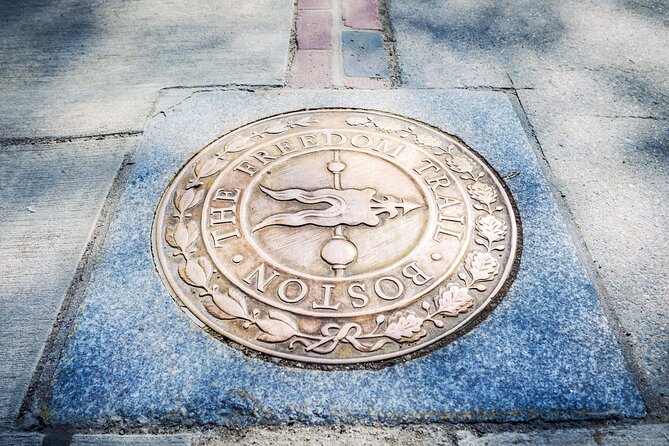
- A complete 2.5-hour route: Walk from Boston Common through downtown and the North End, ending at Copp’s Hill Terrace.
- All 16 official landmarks: The route includes major sites such as the Granary Burying Ground, Boston Massacre Site, Faneuil Hall, and Paul Revere’s home.
- History with a narrow focus: The guide concentrates on Boston from about 1760 to 1775, leading into the American Revolution.
- A small group of up to 16: The size works well for questions and conversation without feeling like a private tour.
- Outdoor sightseeing only: Museum and church admission is not part of the $35.10 price.
- Good access, but plenty of standing: The walk is wheelchair and stroller accessible, while people with standing difficulties should take care.
Why this Freedom Trail walk works so well
The Freedom Trail can look easy to follow on a map, but a line through downtown does not explain why each site matters. You can walk past the Old State House, the Granary Burying Ground, or the Old North Church and miss the connections between them.
That is where this tour earns its price. Your guide supplies the order, the context, and the human stories. The discussion centers on the years before the Revolution, so you are not simply hearing a list of dates. You are following a city under pressure as British policy, local politics, public protest, and military force collide.
I especially like the chronological approach. Guides including Jon have been praised for moving through events in a clear sequence, while Maura and Maz are noted for turning the material into lively stories. Mark and Alejandro are also praised for handling questions and adjusting the pace or location when winter weather becomes difficult.
At $35.10 per person, this is a fair price for 2.5 hours with a historian and a group capped at 16. You are paying for interpretation, not admission tickets. If you want to enter several historic buildings, you will need to pay separately, but the walk gives you a useful plan for deciding which interiors deserve your time afterward.
More Historic Tours in Boston
- Tour of Historic Fenway Park, America’s Most Beloved Ballpark
★ 4.5 · 3,013 reviews - Boston Food & History: Pizza, North End & Freedom Trail
★ 5.0 · 1,772 reviews - Boston: City Cruises Historical Sightseeing Cruise
★ 4.6 · 1,771 reviews
Starting at the Boston Foundation Monument
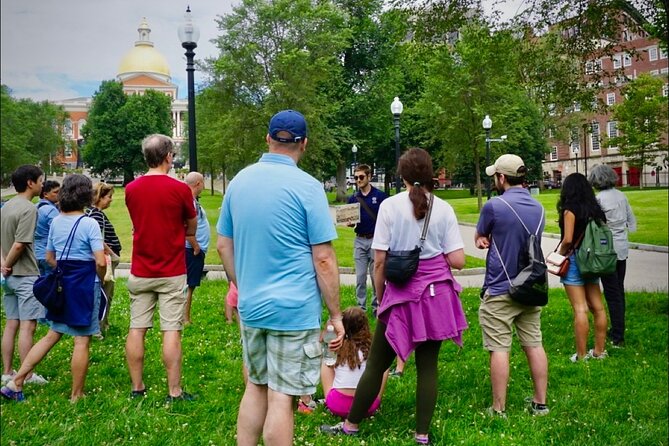
Meet inside Boston Common at the Boston Foundation Monument, near the park’s northern edge and opposite 50 Beacon Street. The granite memorial has a bronze relief showing two men shaking hands, recalling the Puritan arrival in 1630.
It is a sensible starting point. Boston Common is not just a pleasant green space. It is described as the oldest public land in the Americas and began as communal grazing land in 1634. Your guide uses the park to set up Boston’s early civic story before turning toward the Revolutionary period.
The opening portion also places you near the Massachusetts State House, whose dome and hilltop location help explain Boston’s nickname as the Hub of the Solar System. You will hear about the state government and the way political power gathered around this part of town.
Allow time to find the monument and check in. The meeting point is outdoors in the park, so do not arrive dressed as if you are walking straight into a museum.
Boston Common and the early city
The Boston Common section takes about 20 minutes. You get an introduction to the city’s public life, then move into the historic core.
Along the route, the guide points out churches, government buildings, old burial grounds, meeting houses, and former publishing sites. Several are not formal stops with a long pause, but they add useful layers to the walk. You may see an active church associated with Boston’s early religious life and the tallest building in 19th-century Boston, along with King’s Chapel and Boston’s oldest burying ground.
This part of the tour is valuable because it shows how tightly packed colonial Boston was. Religion, politics, trade, education, and burial grounds were all close together. You are not being shuttled between isolated monuments. You are walking through the city where those institutions actually shaped daily life.
Granary Burying Ground and Boston’s famous names
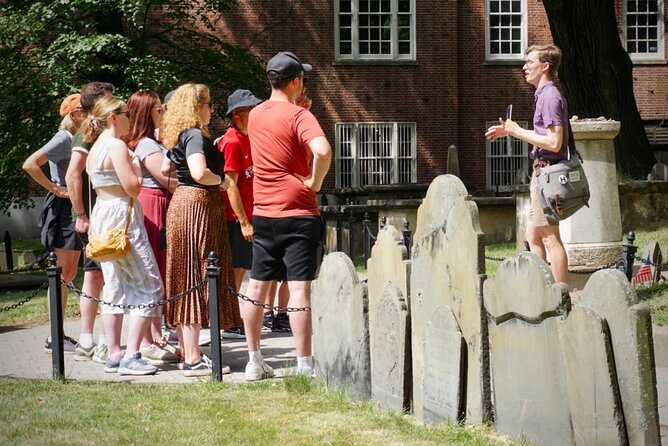
The Granary Burying Ground receives about 20 minutes. Founded in 1660, it is Boston’s third-oldest burying ground and holds the remains of major figures from the Revolutionary era.
The guide helps you read the site as more than a collection of old stones. This is where the city’s public memory takes shape. The cemetery is linked with Revolutionary Boston and with people whose names are familiar from American history.
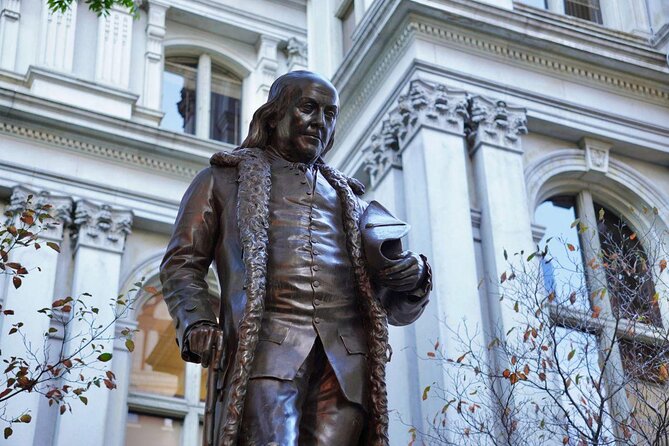
The route then leads toward the Statue of Benjamin Franklin, which marks the site of Boston Latin School, founded in 1635. It is identified as the oldest public school in the Americas. That connection matters because Franklin’s story is not only about a statue. It points to education, civic life, printing, and the formation of political ideas.
You also pass the center of Boston politics for more than a century and the former publishing house of Ticknor & Fields. These stops may appeal most to history fans who enjoy the machinery behind major events: who educated the city, who printed its arguments, and where political decisions were made.
More Walking Tours in Boston
- Harvard University Campus Guided Walking Tour
★ 4.5 · 3,632 reviews - Boston Freedom Trail Walking Tour with Costumed Guide
★ 4.5 · 2,531 reviews - The Full Revolutionary Story Epic Small Group Boston Walking Tour
★ 5.0 · 2,356 reviews - Boston’s Freedom Trail: A Revolutionary Walking Tour
★ 4.9 · 1,748 reviews
Meeting houses, the Old State House, and the Boston Massacre
The walk continues past Old South Meeting House, a Congregationalist meeting house dating to 1729 and the place associated with the 1773 Boston Tea Party. The building also offers one of the clearest reminders that religious spaces were political spaces in colonial Boston.
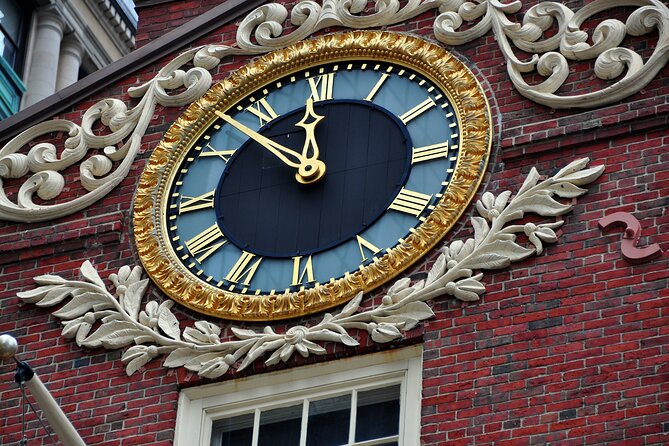
Next comes the Old State House, the colonial capitol of Massachusetts Bay Colony and the oldest public building in Boston, dating to 1713. Its position puts you at the center of government and public debate.
The Boston Massacre Site is one of the main pauses, with about 20 minutes devoted to the killing of five Bostonians by British soldiers in 1770. This is a point where a good guide matters. The event is often reduced to a slogan, but the setting and the competing accounts help you see why it inflamed public feeling.
A guide can also connect the massacre to the wider political work of Boston’s Sons of Liberty and the city’s leading political voices. The small-group format helps here. You can ask about the British soldiers, the crowd, the legal aftermath, or the way the incident was used in colonial newspapers and speeches.
Faneuil Hall and the Cradle of Liberty
Faneuil Hall takes about 10 minutes. Built in 1742, it hosted Boston town meetings and became known as the Cradle of Liberty.
The hall is a good example of how the Freedom Trail mixes architecture with action. A building can look quiet today, but town meetings held here helped make political disagreement public. The guide explains how Boston’s civic spaces gave people places to argue, organize, and challenge authority.
Nearby, the route passes the historic building that houses what is described as the oldest restaurant in the United States, founded in 1826. This is later than the Revolution, but it adds a useful reminder that the trail is also a walk through Boston’s continuing public life.
Faneuil Hall Marketplace can be busy, and this is one of the less quiet portions of the route. Your guide’s commentary helps keep the focus on the historic setting rather than on the shopping and food stalls around it.
North Square and Paul Revere’s neighborhood
The tour then shifts into the North End, one of the most atmospheric sections of the walk. North Square Park takes about 20 minutes and sits at the heart of the neighborhood.
Here, the scale changes. The streets feel more intimate than the broad spaces around Boston Common and the State House. The square helps you picture the North End as a working colonial neighborhood rather than a string of disconnected attractions.
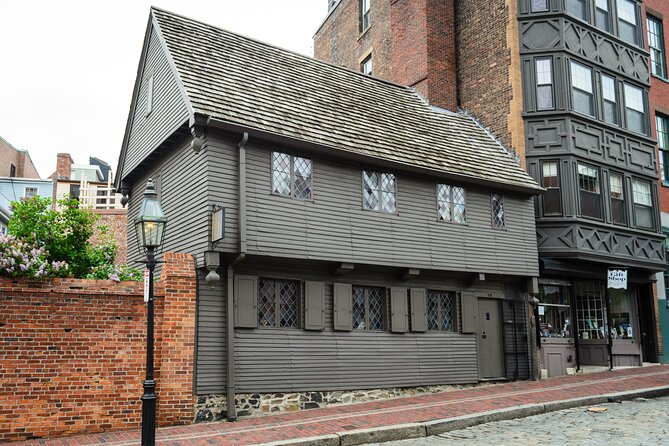
The Paul Revere House follows. Built in 1680, it was Revere’s home and is described as the oldest structure in Downtown Boston. The exterior is part of the walking tour, but entry inside is not included. If you want to see the rooms, household objects, and exhibits, plan a separate visit.
The Paul Revere Statue and the pedestrian space around it take about 20 minutes. This section covers the famous Midnight Ride of 1775, while also giving the guide room to explain the person behind the legend and the political crisis surrounding the ride.
That distinction is important. The tour’s strongest theme is not heroic myth alone. It is the chain of events that made the ride meaningful.
Old North Church and the final North End stops
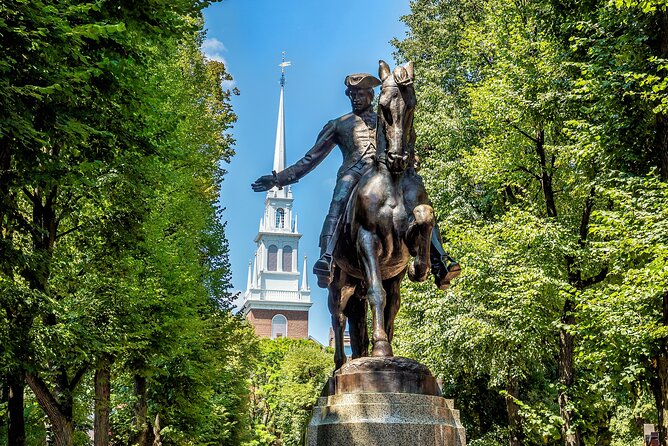
The route continues to the Old North Church, Boston’s oldest church, which held the signal lanterns connected with Paul Revere’s ride. The church dates to 1723 and is one of the most recognizable sites on the trail.
The tour passes the second-oldest burying ground in Boston as well. These stops make the final section feel dense with history, but they also require attention. You are seeing several sites in a compact area, and the guide has limited time to cover each one.
You do not enter the churches during this experience. That is the most common limitation to keep in mind if interiors are important to you. Old South Meeting House and Old North Church offer discounted admission with a Hub Town Tour ticket, according to the tour information, and King’s Chapel is expected to offer that discount soon. Check the current terms when booking or at the site.
Finishing at Copp’s Hill Terrace
The walk ends at Copp’s Hill Terrace after roughly 20 minutes in the final section. From here, you look across the Charles River toward two major landmarks: the U.S.S. Constitution, launched in 1797, and the Bunker Hill Monument, linked with the 1775 battle.
This is a strong ending because it widens the view. You have spent the tour in narrow streets and crowded civic spaces, then finish with a look toward Charlestown and the next part of Boston’s Revolutionary story.
Charlestown is not included in this tour. You will see the U.S.S. Constitution and Bunker Hill Monument from across the river, but visiting them requires a separate trip.
The end point is also practical. Copp’s Hill Terrace is close to Hanover Street, where you can find Italian restaurants, pastry shops, pizza, and other North End choices. I would treat the finish as a useful lunch or dinner opportunity rather than rushing away.
How difficult is the 2.5-hour walk?
The route is wheelchair and stroller accessible, and service animals are allowed. It is also near public transportation.
Still, accessibility does not mean effortless. You should expect about 2.5 hours outside, with repeated stops where you stand while listening. The tour is not recommended for anyone who has trouble standing for extended periods, and a moderate level of physical fitness is advised.
Wear shoes suited to city walking. Bring layers in winter, especially for wind. Several cold-weather accounts describe guides using indoor or covered spaces when possible, but this remains an outdoor tour. Cold days can make the walk feel long, while passionate guides can also make the time pass quickly.
Which guide style might suit you?
The provider uses multiple historians, so the exact personality varies. The strongest pattern is an emphasis on storytelling, quotes, chronology, and questions.
Jon is praised for a clear chronological presentation and a memorable final speech. Mark is described as friendly and well prepared even in frigid conditions. Maura and Maz are noted for turning the material into vivid stories, while Alejandro is praised for engaging with the group and finding warmer places to speak when possible.
Nick, Kiera, Cal, Cyrus, Meaghan, Amelia, Miles, and Will are also named as guides who bring strong subject knowledge and enthusiasm. You cannot choose among them based on the information provided, but the range of names suggests an experienced guide team rather than a single scripted presenter.
Who should book this tour?
I would choose this walk for a first Boston visit, especially if you want the city’s major historic sights put into one clear story. It is also a good fit for families with older children and teenagers who can manage the distance and standing. One family completed it with children aged 11 and 14, while a 20-year-old also found the city tour rewarding.
History fans will get the most from it, but you do not need to arrive as an expert. The guide supplies the framework. The small group gives you room to ask about details that interest you, from the Boston Massacre to the politics of the Sons of Liberty.
I would be more cautious if your main goal is visiting interiors, taking a relaxed stroll, or avoiding cold weather. You may prefer to use the route as a map, then return independently to the churches, burial grounds, and museums that catch your attention.
The experience is eligible for free cancellation up to 24 hours before the start time. Within 24 hours, the payment is not refunded. Poor weather or failure to meet the minimum group size can lead to a new date, another experience, or a full refund.
Is the $35.10 price worthwhile?
For $35.10, you receive a focused 2.5-hour walking tour, a small group of no more than 16, and coverage of all 16 official Freedom Trail landmarks. That is strong value if you want explanation rather than simply directions.
The price does not include entry to museums or churches, gratuity, or the Charlestown neighborhood. You should budget extra if you plan to go inside Old North Church, Old South Meeting House, Paul Revere House, or other sites along the way.
I see this as a good first-day activity. It gives you the city’s basic shape, shows you where the most important sites are, and helps you decide where to spend your independent time later.
Should you book the Freedom Trail History Small Group Walking Tour?
Book it if you want a serious, well-paced introduction to Boston’s Revolutionary story and are happy to spend 2.5 hours on foot. The combination of all 16 landmarks, a group capped at 16, and guides such as Jon, Maura, Mark, or Alejandro makes $35.10 a reasonable spend.
Skip it if you need indoor sightseeing, dislike standing, or want Charlestown and museum admissions included. For everyone else, especially first-time visitors, this is a practical way to understand Boston before exploring its historic buildings on your own.
FAQ
Where does the Boston Freedom Trail tour start?
It starts at the Boston Foundation Monument inside Boston Common, near the northern boundary of the park and opposite 50 Beacon Street, Boston, MA 02108.
Where does the tour end?
The tour ends at Copp’s Hill Terrace, 520 Commercial Street, Boston, MA 02109, in the North End.
How long does the walking tour last?
The tour lasts approximately 2 hours and 30 minutes.
How many people are in each group?
The maximum group size is 16 travelers.
What language is the tour offered in?
The tour is offered in English.
Does the tour cover all of the Freedom Trail landmarks?
Yes. The experience includes all 16 official historic landmarks on the Freedom Trail.
Are museum and church admissions included?
No. Admission inside museums and churches is not included in the tour price.
Is Charlestown included?
No. Charlestown is not included. The tour ends with views toward the U.S.S. Constitution and Bunker Hill Monument across the Charles River.
Is the tour wheelchair and stroller accessible?
Yes. The experience is wheelchair and stroller accessible. It is not recommended for people who have difficulty standing for extended periods.
What happens if I need to cancel?
You can receive a full refund if you cancel at least 24 hours before the start time. Cancellations or changes made within 24 hours are not refunded or accepted. If poor weather or insufficient numbers cause the tour to be canceled, you are offered another date or experience, or a full refund.
More Historical Tours in Boston
- History and Hauntings of Salem Guided Walking Tour
★ 5.0 · 14,564 reviews - City Cruises Boston Historic Sightseeing Harbor Cruise
★ 4.5 · 1,388 reviews - Boston’s North End Food Tour: Italian Flavors & Heritage Walk
★ 5.0 · 1,322 reviews - Boston Pizza Lovers Food and History Walking Food Tour
★ 4.5 · 1,082 reviews
More Freedom Trail Walks in Boston
- Boston: Freedom Trail History Small Group Walking Tour
★ 4.9 · 1,590 reviews - Boston’s Freedom Trail: A Revolutionary Walking Tour
★ 5.0 · 1,343 reviews - Freedom Trail Walking Tour 250
★ 4.5 · 1,118 reviews - Boston Freedom Trail History Pub Crawl Small-Group Tour
★ 5.0 · 996 reviews
Just added around Boston
- Day Trip from Boston: Explore Hammond Castle Museum★ 3.7 · 3 reviews
- Boston: WNDR Museum Entry Ticket★ 3.7 · 3 reviews
- The Boston Bash Scavenger Hunt★ 4.5 · 3 reviews
- Self-Guided Audio Tour of Boston North End★ 4.5 · 3 reviews
- Boston: Official Freedom Trail® Lantern Tour★ 4.7 · 3 reviews
- Boston: North End Walking Tour with Private Harbor Cruise★ 5.0 · 3 reviews
- Self Guided “The North End Pizza, Cannoli and Picnic” Solo Walking Tour★ 5.0 · 3 reviews
- Cambridge: Haunted Charles River Cruise★ 4.3 · 3 reviews
Freedom Trail Tours, compared.
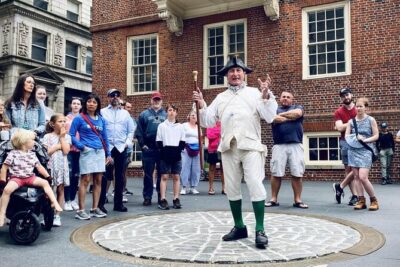
Boston Freedom Trail Walking Tour with Costumed Guide
Read our review →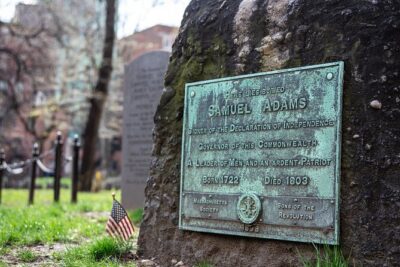
Boston Food & History: Pizza, North End & Freedom Trail
Read our review →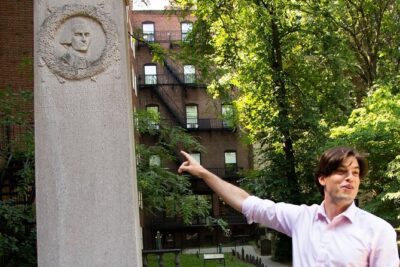
Boston’s Freedom Trail: A Revolutionary Walking Tour
Read our review →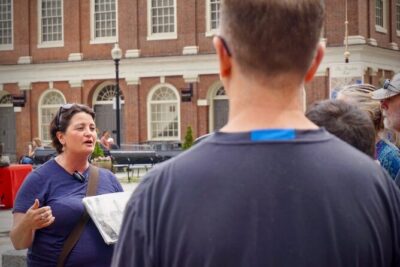
Freedom Trail History Small Group Walking Tour
Read our review →Boston’s Freedom Trail: A Revolutionary Walking Tour
Read our review →

Boston Freedom Trail History Pub Crawl Small-Group Tour
Read our review →
Entire Freedom Trail Walking Tour: Includes Bunker Hill and USS Constitution
Read our review →Browse the lists this tour appears in