
Reviewed · FREEDOM TRAIL TOURS
Boston’s Freedom Trail: A Revolutionary Walking Tour
Boston’s revolutionary story unfolds best on foot, and this tour takes you from The Embrace beside Boston Common through the old heart of town to Copp’s Hill Terrace. In about two and a half hours, you’ll connect famous names such as Paul Revere and John Hancock with lesser-known stories of abolition, women’s rights, immigration, education, and protest.
I like two things right away. First, the route covers all 16 official Freedom Trail sites, so you do not have to puzzle out the brick line and map on your own. Second, the guides make the past personal. Guides such as Alissa, Jim, Kenny, Julia, Alfred, and Charles R. have been praised for clear storytelling, humor, and the ability to answer detailed questions.
The catch is simple: this is a long walk at a brisk pace. Some people found it easy and well timed, while others struggled to keep up or hear every word in a large group. If you use a walking stick or need frequent pauses, this may feel demanding.
In This Review
- Key points before you book
- Starting beside The Embrace and Boston Common
- The State House and Boston’s changing public life
- Granary Burying Ground and King’s Chapel
- Old South Meeting House and the Boston Tea Party
- From a colonial apothecary to Ticknor & Fields
- Old State House and the Boston Massacre site
- Faneuil Hall, the Cradle of Liberty
- Paul Revere House and the North End
- Old North Church and the lantern signal
- Copp’s Hill, Bunker Hill, and USS Constitution views
- How much walking is involved?
- What makes the guides important?
- Is $31 a fair price?
- Who should book this Freedom Trail walk?
- Cancellation and weather details
- Should you book it?
- FAQ
- How long does the Boston Freedom Trail tour last?
- How much does the tour cost?
- Where does the tour begin?
- Where does the tour end?
- Does the tour visit all of the Freedom Trail sites?
- What language is the tour offered in?
- How large is the group?
- What level of fitness is required?
- Can I cancel for a refund?
Key points before you book
- All 16 official sites in one outing: The tour checks off the full Freedom Trail rather than focusing only on the best-known landmarks.
- A strong starting point: The Embrace offers a modern reflection on Martin Luther King Jr. and Coretta Scott King before the route turns to colonial Boston.
- A full sweep of Boston history: Expect revolution, religion, slavery and abolition, publishing, immigration, women’s rights, and civic protest.
- A northbound route: You begin near Boston Common and finish in the North End at Copp’s Hill Terrace.
- A compact but active schedule: The walk lasts about 2 hours 30 minutes and can cover several miles.
- A small maximum group: The tour accepts up to 25 people, though some groups may still find it hard to hear outdoors.
Starting beside The Embrace and Boston Common
The tour begins at The Embrace, the large statue honoring Martin Luther King Jr. and Coretta Scott King. It sits near the Boston Common Visitor Information Center at 139 Tremont Street, a useful central meeting point for anyone arriving by public transportation.
This opening is more than a convenient place to gather. It reminds you that Boston’s civic story did not end with the American Revolution. The tour connects the founding era with later struggles for civil rights and social change, giving you a broader view than a simple parade of colonial heroes.
You spend about 10 minutes here before heading toward the Massachusetts State House. Wear shoes with good support from the start. The route includes paved streets, historic squares, and cemetery paths, and the total distance adds up.
More Walking Tours in Boston
- Boston: Freedom Trail History Small Group Walking Tour
★ 5.0 · 6,450 reviews - Harvard University Campus Guided Walking Tour
★ 4.5 · 3,632 reviews - Boston Freedom Trail Walking Tour with Costumed Guide
★ 4.5 · 2,531 reviews
The State House and Boston’s changing public life

The Massachusetts State House is easy to recognize by its golden dome. The building dates from the late 18th century, with Samuel Adams laying the cornerstone in 1795.
Your guide uses the building to explain how Massachusetts government developed after independence. This is one of the more useful early stops because it shifts the story from rebellion to the difficult work of running a new state.
The tour also makes room for a red brick church built in 1809. Its congregation included abolitionists, and the interior hosted forceful anti-slavery speeches. This stop widens the focus beyond the Revolution and shows that Boston’s reform tradition continued long after the fighting ended.
That broader coverage is one reason I think this walk works well for first-time visitors. You get the famous names, but you also see how Boston became a center for arguments about freedom and citizenship.
Granary Burying Ground and King’s Chapel
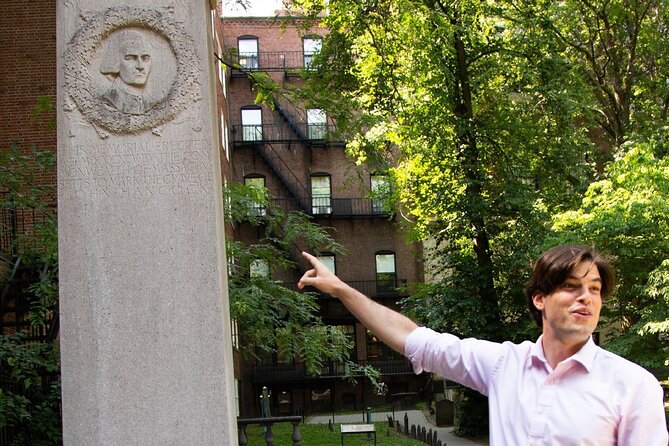
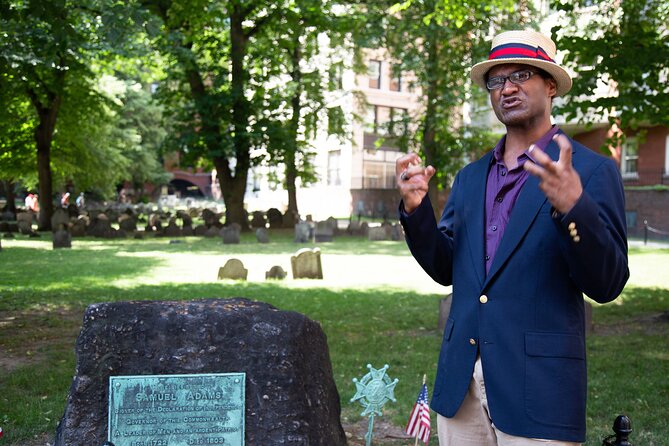
Granary Burying Ground dates to 1660 and contains the graves of several major Patriot figures, including John Hancock, Paul Revere, and Samuel Adams. The cemetery is compact but dense with stories.
This is a stop where a guide adds real value. On your own, you can read names on weathered stones, but it is harder to understand why each person mattered or how their lives connected. Expect the guide to point out specific graves and add family and political context.
The cemetery can also slow the route. One guide may spend more time here than another, and that affects the pace later. If you want every detail, listen closely. If you are more interested in the overall walk, you may prefer a shorter cemetery talk.
Nearby, King’s Chapel was built in 1754 as Boston’s first Anglican church. Its stone construction, adjoining burying ground, and underground crypts open another window onto colonial life. The building also shows that Boston was never a single-minded community. Puritans, Anglicans, merchants, laborers, immigrants, and political factions all shaped the town.
Old South Meeting House and the Boston Tea Party
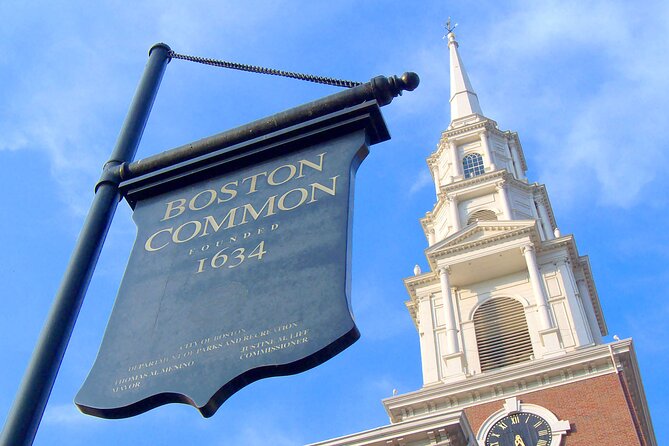
Old South Meeting House, built in 1729, is a Puritan meeting house and the place where the meeting connected with the Boston Tea Party began. The key word here is meeting. The tour helps you picture how a public gathering inside a religious building could become a political force.
This is not just a stop about tea thrown into Boston Harbor. It is about crowd action, persuasion, and the way colonial residents organized against British policy. The guide explains how the protest began and places it within the rising conflict between Boston and the British government.
The time here may feel brief compared with what you could learn inside the building. The focus is the Freedom Trail story, not a long museum visit, so you should not expect an extended indoor presentation or a detailed reconstruction of every event that evening.
More Freedom Trail walks in Boston:
- Boston Food & History: Pizza, North End & Freedom Trail
★ 5.0 · 1,772 reviews - Boston’s Freedom Trail: A Revolutionary Walking Tour
★ 4.9 · 1,748 reviews - Boston: Freedom Trail History Small Group Walking Tour
★ 4.9 · 1,590 reviews - Freedom Trail Walking Tour 250
★ 4.5 · 1,118 reviews
From a colonial apothecary to Ticknor & Fields
One of the route’s less obvious stops is a brick building dating to 1718. It began as the home of a colonial apothecary and later housed the 19th-century publishing firm Ticknor & Fields.
This is a pleasant change of pace. The tour is not only about battles and political speeches. It also traces Boston’s role in American literature and publishing, including the major writers connected with the company.
I like this kind of stop because it helps you see Boston as a working city rather than a stage set for the Revolution. Medicine, books, trade, religion, and government all occupied the same crowded streets.
Old State House and the Boston Massacre site
The Old State House dates to 1713 and is marked by the British Lion and Unicorn. During the colonial period, it served as the center of British government in Massachusetts.
Your guide describes the arguments and confrontations that took place here. The building gives the political dispute a physical setting. Officials governed from inside, while angry colonists gathered outside and challenged their authority.
A short walk brings you to the circular marker for the Boston Massacre site. On March 5, 1770, British soldiers fired into a crowd, killing five colonists. The guide reconstructs the sequence of events and explains why the incident became such a powerful piece of Patriot propaganda.
This is one of the most useful places to slow down and listen. The event is often reduced to a single dramatic label, but the moment-by-moment account shows how confusion, fear, military occupation, and political messaging turned a street clash into a national cause.
Faneuil Hall, the Cradle of Liberty
Faneuil Hall began in 1743 as a marketplace. Its upstairs meeting hall became more important, earning the nickname Cradle of Liberty because of the forceful speeches delivered there.
The stop shows how commerce and politics overlapped. People came to buy and sell goods, then gathered nearby to debate taxes, rights, and government. That connection still feels practical today: public life often grows out of ordinary places where people already meet.
You will hear about speeches delivered inside the hall and the role of public debate in Boston’s political culture. The building can be crowded, and outdoor sound is not always perfect, so staying close to the guide matters.
The company caps groups at 25 people, which is more manageable than a giant city tour. Still, one outdoor group found that a guide was difficult to hear when not facing everyone. If hearing every sentence matters to you, stand near the front and avoid drifting to the edges.
Paul Revere House and the North End
The Paul Revere House is a wooden home dating to 1680 and the oldest building in Boston. Paul Revere lived here with his family, and the house helps bring his famous midnight ride back to ordinary domestic life.
You learn about Revere not only as a messenger, but also as a family man and a participant in the wider political crisis. The house itself is small and old, so the exterior tells much of the story during a walking tour. Do not expect an extended private visit unless the tour specifically includes entry at your departure time.
The surrounding North End gives the route a different feel from the civic buildings near Boston Common. The streets narrow, the buildings feel closer together, and the walk becomes more neighborhood-based. This part of the route is especially useful for connecting the Revolution to the daily lives of tradespeople and families.
Old North Church and the lantern signal
Old North Church dates to 1723 and is famous for the two lanterns displayed in its steeple on the eve of the Revolution. The signal warned that British troops were moving by sea rather than land.
The guide explains how the signal was arranged and why it mattered to Paul Revere’s warning system. The story is short, memorable, and easy to picture, which makes it one of the tour’s strongest moments.
Historic churches sometimes have construction work or heavy crowds, and the route may need to adjust around them. That does not remove the value of the stop, but it can limit your view or shorten the time spent near the building.
Copp’s Hill, Bunker Hill, and USS Constitution views
The final portion takes you to Copp’s Hill Burying Ground, established in 1660. During the Battle of Bunker Hill, British forces placed cannon in the cemetery. Your guide discusses the battle and points out notable people buried there.
From Copp’s Hill Terrace, you can view the 221-foot Bunker Hill Monument across the water. The monument marks the site where colonial militia held hastily built defenses and repelled two British attacks before retreating.
The tour ends at Copp’s Hill Terrace, listed at 520 Commercial Street, with the practical street location also given as 7 Jackson Avenue in Boston’s North End. From here, you can see the masts and rigging of USS Constitution in Charlestown. Known as Old Ironsides, the ship won battles in the War of 1812 and is the oldest warship still afloat anywhere in the world.
This ending works well because it gives you a final view rather than simply stopping beside another doorway. You finish with a sense of the harbor, the battle across the water, and the military world that shaped Boston’s early years.
How much walking is involved?
The tour lasts about 2 hours 30 minutes and covers several miles, according to the experience details and direct descriptions from people who completed it. There are short stretches between many stops, but the route is continuous and the pace can be quick.
I would rate it as suitable for people with moderate physical fitness. Comfortable walking shoes are essential. Rain does not automatically ruin the experience, and guides have led the walk in wet weather, but the tour requires good weather and may be moved or canceled if conditions are poor.
If you walk slowly, use a walking stick, or need frequent rests, consider how much ground you want to cover in one sitting. The guide may be able to keep a group together, but this is not designed as a leisurely, stop-and-start stroll.
What makes the guides important?
The route is easy to find and the brick trail is visible in much of downtown Boston. The guide is still the main reason to book instead of walking alone.
A good guide turns dates and buildings into connected stories. Kenny has been especially praised for handling detailed questions and niche topics, while Jim has been noted for clear explanations and a steady pace. Alissa is known for mixing humor with strong historical detail, and Julia has been praised for making the route feel manageable. Alfred, Sam, Noah, Charles R., Stewart, Kathy, Eliot, and Rob Crean have also been singled out for energy, clarity, and storytelling.
Of course, guide quality can vary from one departure to another. The strong pattern is that this company expects guides to bring context, not merely point at buildings. You should still stay close, especially in crowded areas, because the guide may not always be facing the whole group.
Is $31 a fair price?
At $31 per person, this is a reasonable price for a 2.5-hour guided walk covering the complete official trail. You are paying for the route planning, historical explanation, and the chance to ask questions while moving through Boston’s oldest areas.
The value is strongest if you are visiting Boston for the first time or want a clear overview before exploring museums and interiors on your own. A self-guided walk costs less, but it demands more preparation and usually gives you less context at each site.
The price is less attractive if you want long visits inside buildings. The itinerary focuses on seeing the sites and hearing their stories, not on spending extended time at every attraction. Think of it as an orientation walk with real historical depth, not a series of full museum tours.
Mobile tickets make arrival simple, and confirmation is provided at booking. The tour is offered in English, allows service animals, and meets near public transportation.
Who should book this Freedom Trail walk?
I would choose this tour for first-time Boston visitors, families with older children, history fans, and anyone who wants the main route explained without doing homework first. It also suits people who enjoy connecting political events with buildings, neighborhoods, and everyday life.
Families should know that the guide’s storytelling can hold teenagers’ attention, especially when the guide uses humor and vivid scenes. Still, the distance and pace may be tiring for young children or anyone who cannot walk steadily for several hours.
The tour is also a good fit for solo visitors. Guides have been praised for welcoming questions and making the history easy to follow. Couples and small groups may benefit from standing near the guide so they can hear clearly.
Cancellation and weather details
You can cancel for a full refund up to 24 hours before the scheduled start time. Changes or cancellations made less than 24 hours ahead are not accepted for a refund.
Because the experience requires good weather, a weather cancellation gives you the choice of another date or a full refund. Check the forecast before you set aside the morning or afternoon, and dress for an exposed outdoor walk.
Should you book it?
Yes, if you want Boston’s Freedom Trail to feel like a connected story rather than 16 separate markers. The route covers the essential sites, adds useful context about abolition and reform, and finishes with strong views toward Bunker Hill and USS Constitution.
Book it with realistic expectations. You will walk several miles, keep moving, and sometimes need to work to hear the guide. For $31, the experience offers solid value, especially with a strong storyteller such as Alissa, Jim, Kenny, Julia, or Charles R. If you need a slow pace or long indoor visits, explore the trail independently and choose fewer sites instead.
FAQ
How long does the Boston Freedom Trail tour last?
The tour lasts approximately 2 hours 30 minutes.
How much does the tour cost?
The listed price is $31 per person.
Where does the tour begin?
The meeting point is The Embrace at 139 Tremont Street, next to the Boston Common Visitor Information Center.
Where does the tour end?
The tour ends at Copp’s Hill Terrace in Boston’s North End, with views toward Bunker Hill Monument and USS Constitution.
Does the tour visit all of the Freedom Trail sites?
The tour is designed to cover all 16 official sites of Boston’s Freedom Trail.
What language is the tour offered in?
The tour is offered in English.
How large is the group?
The maximum group size is 25 people.
What level of fitness is required?
A moderate level of physical fitness is recommended. The route involves several miles of walking and can move at a brisk pace.
Can I cancel for a refund?
Yes. You can cancel at least 24 hours before the start time for a full refund. If poor weather cancels the experience, you will be offered another date or a full refund.
Just added around Boston
- Day Trip from Boston: Explore Hammond Castle Museum★ 3.7 · 3 reviews
- Boston: WNDR Museum Entry Ticket★ 3.7 · 3 reviews
- The Boston Bash Scavenger Hunt★ 4.5 · 3 reviews
- Self-Guided Audio Tour of Boston North End★ 4.5 · 3 reviews
- Boston: Official Freedom Trail® Lantern Tour★ 4.7 · 3 reviews
- Boston: North End Walking Tour with Private Harbor Cruise★ 5.0 · 3 reviews
- Self Guided “The North End Pizza, Cannoli and Picnic” Solo Walking Tour★ 5.0 · 3 reviews
- Cambridge: Haunted Charles River Cruise★ 4.3 · 3 reviews
Freedom Trail Tours, compared.
Freedom Trail History Small Group Walking Tour
Read our review →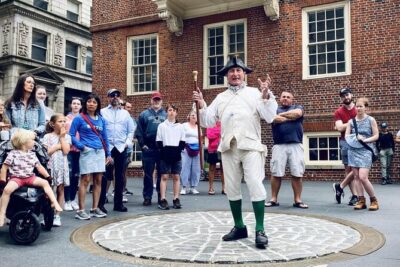
Boston Freedom Trail Walking Tour with Costumed Guide
Read our review →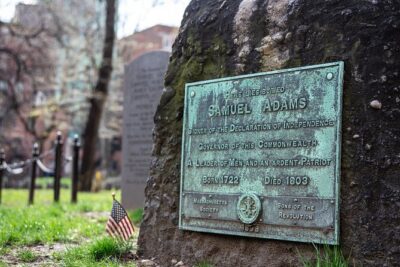
Boston Food & History: Pizza, North End & Freedom Trail
Read our review →
Boston’s Freedom Trail: A Revolutionary Walking Tour
Read our review →Freedom Trail History Small Group Walking Tour
Read our review →

Boston Freedom Trail History Pub Crawl Small-Group Tour
Read our review →
Entire Freedom Trail Walking Tour: Includes Bunker Hill and USS Constitution
Read our review →Browse the lists this tour appears in