

Reviewed · WALKING TOURS IN BOSTON
PRIVATE Authentic Revolutionary Boston Walking Tour
Boston’s Revolutionary story gets much more interesting when you move past the familiar slogans. This private walking tour connects public protest, religious conflict, slavery, and political power across seven central sites, showing that the Revolution was not just a tidy march toward independence.
I like the private format, since your guide can adjust the story to your group rather than deliver a fixed speech. I also like the modern angle: the tour asks how ideas of freedom worked in real life, including for people left out of the founding story. The main catch is that museum admission is not included, and several stops are viewed only from outside.
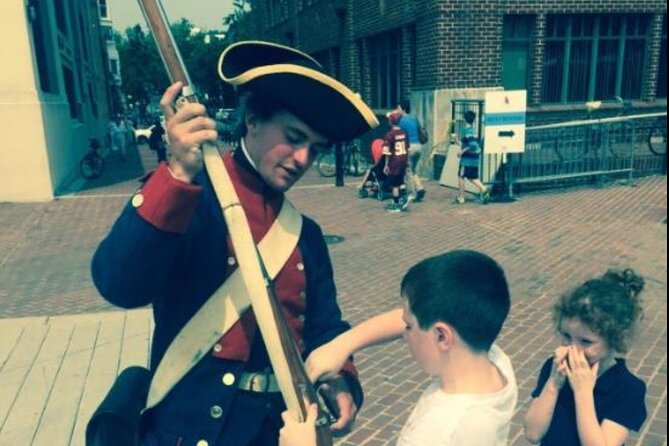
Adam, one of the guides, brings extra theater to the walk with a British military outfit and a quick sense of humor. The route lasts about 90 minutes to two hours, costs $75 per person, and begins at the Boston Common Visitors Center before ending near Haymarket, with the finish customizable for a private booking.
In This Review
- Key points to know before you book
- A Revolution walk with more than the usual slogans
- Boston Common sets the civic tone
- Granary Burying Ground reveals who counted
- King’s Chapel brings the wider world into Boston
- Old South Meeting House and the making of a protest
- Old State House puts the Boston Massacre in context
- Faneuil Hall connects politics, trade, and force
- Old North Church faces the Revolution’s hardest contradiction
- What $75 buys you
- Adam’s style and the private advantage
- Booking, weather, and who should choose it
- FAQ
- How long does the private Boston walking tour last?
- Where does the tour begin?
- Where does the tour end?
- Is this a private tour?
- Are museum admission tickets included?
- What is the price?
- Can I cancel for a full refund?
- Should you book Authentic Revolutionary Boston Tours?
Key points to know before you book

- The route links seven major sites: Boston Common, Granary Burying Ground, King’s Chapel, Old South Meeting House, Old State House, Faneuil Hall, and Old North Church.
- Your group gets a private guide: This is useful for families, school-age children, wheelchair users, and anyone with a special interest in Boston’s past.
- Adam may guide in historical costume: His British military outfit adds character without replacing the serious historical content.
- The tour looks beyond famous men and famous dates: Expect discussion of radical demographics, international connections, slavery, citizenship, and competing ideas of liberty.
- Several interiors cost extra: King’s Chapel, Old South Meeting House, Old State House, and Old North Church require separate tickets if you want to go inside.
- The meeting point is central and easy to reach: Start at the Boston Common Visitors Center, 139 Tremont Street, and finish at Haymarket unless your private group arranges another endpoint.
A Revolution walk with more than the usual slogans

Many Boston tours follow the familiar Freedom Trail script: tax protests, tea in the harbor, shots fired, independence won. This experience takes a wider view. It treats the city as a place where arguments about power, religion, race, commerce, and liberty were already colliding long before the war began.
That approach matters because the Revolution was full of contradictions. People demanded freedom while slavery continued. Patriots challenged British authority while some local leaders defended old social hierarchies. Churches, burial grounds, meeting halls, and marketplaces were not just scenery. They were places where people gathered, argued, worshiped, traded, and made political choices.
You receive a private experience rather than joining a large public group. That gives you room to ask questions and request more attention to a topic that matters to you. You might want more on military events, women, Black Bostonians, religion, architecture, or the meaning of citizenship today. The tour is built to respond to those interests.
The guides also aim to connect historical events with modern civic life. This is not a political lecture, but it does encourage you to think about how public decisions are made and who gets heard. For families and younger visitors, that can make the past feel less like a list of dates.
More Walking Tours in Boston
- Boston: Freedom Trail History Small Group Walking Tour
★ 5.0 · 6,450 reviews - Harvard University Campus Guided Walking Tour
★ 4.5 · 3,632 reviews - Boston Freedom Trail Walking Tour with Costumed Guide
★ 4.5 · 2,531 reviews
Boston Common sets the civic tone
The tour begins at the Boston Common Visitors Center, at 139 Tremont Street. Boston Common is the oldest public park in the United States, and it gives the walk a fitting opening: this was public ground, used for gatherings, military activity, punishment, recreation, and political life.
You spend about 15 minutes here. That is enough time to understand why the Common matters without using up the whole walk before reaching the buildings along the route. Your guide can frame Boston as a place where ordinary people entered public life through meetings, demonstrations, and shared urban spaces.
I like beginning here because it keeps the focus on people, not just monuments. A park can seem peaceful today, but its history includes the pressure of crowds and the authority of government. This is also a practical place to get your bearings before moving into the denser streets.
The starting point is easy to find, and the area is near public transportation. The tour runs daily from 10:00 a.m. to 10:00 p.m. during the stated operating period, but you should confirm your chosen time when booking.
Granary Burying Ground reveals who counted
A short walk brings you to Granary Burying Ground, where the planned stop lasts about 10 minutes. The cemetery is one of Boston’s oldest, but the point here is not simply to identify famous graves.
Your guide looks at the cemetery’s demographics and the less obvious people represented there. That can shift your view of the Revolution from a story centered on prominent white men to a more complicated account of the people who lived, worked, worshiped, served, and died in the city.
The stop is especially useful if you want social history rather than a parade of names. A burial ground can show class, religion, family structure, and public memory in ways that a battlefield date cannot. It also raises a simple question: whose life gets remembered, and why?
The grounds are free to visit. Since cemetery paths and historic streets can be uneven, tell the guide about mobility needs when arranging the private booking. One wheelchair user received help navigating historic Boston with this guide, which suggests the private setup can be useful, though you should discuss your group’s exact needs in advance.
King’s Chapel brings the wider world into Boston
The eight-minute stop at King’s Chapel looks at more than the church’s stone exterior. The guide uses it to show the international and religious dimensions of the Revolution in Boston.
That is a worthwhile correction to the idea that the conflict was only a local quarrel between Boston residents and Britain. Churches carried ties to the wider Atlantic world, and religious identity shaped loyalties, authority, and public debate. King’s Chapel helps place Boston inside those larger connections.
You pause outside during this tour. Entering the chapel requires a separate private ticket with the museum, so add that cost if you want to see the interior. The short outdoor stop works well for a quick overview, but visitors who care about architecture or religious history may find the extra admission worthwhile.
The private format gives your guide room to explain why a church belongs in a Revolution tour. That is one of the strengths of the experience: buildings are treated as evidence, not just backdrops for photographs.
Same city, a very different afternoon:
- History and Hauntings of Salem Guided Walking Tour
★ 5.0 · 14,564 reviews - Boston Duck Boat Sightseeing City Tour with Cruise Along Charles River
★ 4.5 · 9,378 reviews - Boston Hop-On Hop-Off Trolley Tour with 13 Stops
★ 4.5 · 5,576 reviews - Boston: City Cruises Whale Watching Cruise
★ 4.5 · 4,710 reviews
Old South Meeting House and the making of a protest

Old South Meeting House receives about 10 minutes. It is often introduced as the place associated with the Boston Tea Party, but the larger point is the building’s role as a meeting space where public opinion could gather and harden.
That distinction is important. The Tea Party did not appear from nowhere. It followed debate, organizing, anger about taxation, and a growing belief that British policies threatened local political control. A meeting hall gives you a better sense of how collective action took shape.
You discuss the building from outside. Entry requires a separate ticket, so decide in advance if you want to add the interior. If you are short on time, the exterior explanation may be enough. If you enjoy historic rooms and civic architecture, the inside can add useful scale to the story.
I especially like this stop for groups with children or teenagers because it gives a clear example of how a crowd becomes a political force. Your guide can also adjust the level of detail, which is easier on a private tour than in a large group with a fixed pace.
Old State House puts the Boston Massacre in context

The Old State House is another short stop, about eight minutes, with discussion focused on the Boston Massacre and the museum located inside. The adjacent intersection is central to the story, but the guide’s treatment goes beyond the standard image of innocent colonists versus cruel soldiers.
The event had competing accounts, legal consequences, and a powerful role in colonial propaganda. The Old State House is a good place to ask how evidence gets used during a political crisis. Who controls the story? How do images and speeches shape public anger? What happens when a courtroom event becomes a rallying symbol?
You speak outside during the walking tour. A separate private ticket is needed to enter the Old State House. If you want the museum’s fuller treatment of the event and its legacy, plan for extra time and money beyond the $75 tour price.
This is one reason the tour’s emphasis on critical thinking feels practical rather than decorative. You are not asked to memorize a single approved version of the past. You are encouraged to examine how people at the time made arguments, and how later generations remembered them.
Faneuil Hall connects politics, trade, and force

The five-minute stop at Faneuil Hall is brief, but the subject is broad. Faneuil Hall served as a Revolutionary meeting place, a marketplace, and a British armory. Those overlapping roles show how commerce, political organizing, and military power occupied the same urban center.
The stop helps explain why Boston’s political life was never separate from business. Goods, taxes, imported products, local merchants, public meetings, and British authority all met in the same streets. You get a compact lesson in how a city’s economy can feed political conflict.
Faneuil Hall is free to visit from the route’s perspective, though the tour’s exact treatment is outside-focused. The short timing also keeps the walk moving toward the North End. If Faneuil Hall is a major priority for you, ask about spending more time here when arranging the private tour.
This stop works well as a bridge between the earlier meetings and the later discussion of empire and liberty. It reminds you that revolutions are organized in real places, and those places are often shops, halls, docks, and markets rather than grand government buildings.
Old North Church faces the Revolution’s hardest contradiction

The final listed stop is Old North Church, with about eight minutes of outside discussion. The church is famous for the lantern signal associated with Paul Revere’s midnight ride, but the tour also addresses the contradiction between freedom and bondage.
That makes the stop more than a familiar photo opportunity. The same era that produced powerful language about liberty also depended on systems that denied liberty to others. A serious account of Old North Church should allow both facts to remain in view.
You need a separate ticket to enter the church itself. The outdoor discussion is enough to connect the lantern story with the larger questions, but the interior may interest you if religious buildings and Revolutionary symbolism are high on your list.
The route ends at Haymarket, 100 Hanover Street, though the endpoint can be changed for a private booking based on your interests and logistics. That flexibility is useful if you want to continue exploring the North End, return to your hotel, or connect with another part of central Boston.
What $75 buys you
At $75 per person, this tour costs more than joining a basic public walking group. The value depends on how much you use the private format.
For a couple, family, or small group with focused interests, the price can make sense. You are paying for a guide who can change the emphasis, answer your questions, and keep the pace suited to your group. You are also paying for a point of view that brings together public memory, overlooked people, religion, international ties, and civic responsibility.
The price does not cover entry to King’s Chapel, Old South Meeting House, Old State House, or Old North Church. That keeps the base cost clear, but it means you need to budget separately for interiors. The tour itself is largely an outdoor experience, so you should not book it expecting one combined ticket to all the museums.
The walk takes about 90 minutes to two hours. That is long enough for a useful introduction without consuming an entire day. If you add museum visits, allow extra time beyond the stated tour length.
Adam’s style and the private advantage
Adam is identified as one of the guides, and his approach combines preparation, humor, and historical dress. The British military outfit gives the walk a bit of fun, especially for families, but the useful part is his ability to explain the city’s past with confidence and detail.
A guide who can help with a wheelchair through historic Boston is a real practical benefit. Still, private does not mean every surface becomes easy. Historic streets and burial grounds can present physical challenges, so explain your needs before the start and ask for route adjustments.
The tour also includes a small but helpful service: guides know where the cleanest bathrooms are in the city. That may sound minor, but on a two-hour walking tour, it can save time and worry, particularly for families.
The experience has a 5.0 rating from 38 reviews, with 100 percent recommending it. Those numbers suggest consistent satisfaction, especially with the guide’s preparation, humor, historical costume, and willingness to help with mobility. I would still judge the tour by its format: it is best for people who want interpretation and conversation, not only a quick checklist of landmarks.
Booking, weather, and who should choose it
You receive confirmation when you book, and the tour accepts service animals. It operates near public transportation, and most people can participate. Since it is a private activity, only your own group takes part.
The experience requires good weather. If poor weather causes cancellation, you are offered another date or a full refund. You can cancel for a full refund up to 24 hours before the start time. Inside that window, changes are not accepted and the payment is not refunded, so keep an eye on the forecast.
I would choose this tour if you want Boston’s Revolution explained through competing viewpoints and real civic questions. It is a strong fit for families, history fans, teachers, students, private groups, and visitors who dislike scripted group tours.
I would choose something else if you mainly want to enter every building along the Freedom Trail in one outing. Since several interiors cost extra and the tour pauses outside, a self-guided museum day may suit you better.
FAQ
How long does the private Boston walking tour last?
The experience lasts approximately one hour and 30 minutes to two hours.
Where does the tour begin?
It begins at the Boston Common Visitors Center, 139 Tremont Street, Boston, Massachusetts 02111.
Where does the tour end?
The listed endpoint is Haymarket at 100 Hanover Street, Boston. Private bookings can customize the endpoint based on your interests and visit logistics.
Is this a private tour?
Yes. Only your group participates in the activity.
Are museum admission tickets included?
No. The tour discusses King’s Chapel, Old South Meeting House, Old State House, and Old North Church from outside. Entry to those sites requires separate tickets.
What is the price?
The listed price is $75 per person. Separate admission costs may apply if you choose to enter the museums and historic sites along the route.
Can I cancel for a full refund?
Yes. You must cancel at least 24 hours before the experience start time for a full refund. Cancellations or changes within 24 hours are not refunded, and poor-weather cancellations offer a new date or full refund.
Should you book Authentic Revolutionary Boston Tours?
Book it if you want a private, thoughtful walk that treats Boston’s Revolution as a debate about freedom, power, religion, race, and citizenship, not just a chain of famous events. Adam’s historical costume and humor add personality, while the flexible format lets you shape the discussion around your group.
Before paying, decide if outside commentary is enough for you. If it is, $75 buys a focused introduction with a guide who can adapt to your interests. If you want several museum interiors, add their separate ticket costs and extra time, then this tour becomes the opening chapter of a longer day in historic Boston.
Just added around Boston
- Day Trip from Boston: Explore Hammond Castle Museum★ 3.7 · 3 reviews
- Boston: WNDR Museum Entry Ticket★ 3.7 · 3 reviews
- The Boston Bash Scavenger Hunt★ 4.5 · 3 reviews
- Self-Guided Audio Tour of Boston North End★ 4.5 · 3 reviews
- Boston: Official Freedom Trail® Lantern Tour★ 4.7 · 3 reviews
- Boston: North End Walking Tour with Private Harbor Cruise★ 5.0 · 3 reviews
- Self Guided “The North End Pizza, Cannoli and Picnic” Solo Walking Tour★ 5.0 · 3 reviews
- Cambridge: Haunted Charles River Cruise★ 4.3 · 3 reviews
Walking Tours in Boston, compared.
Freedom Trail History Small Group Walking Tour
Read our review →
Harvard University Campus Guided Walking Tour
Read our review →
Boston Freedom Trail Walking Tour with Costumed Guide
Read our review →
The Full Revolutionary Story Epic Small Group Boston Walking Tour
Read our review →
Boston’s Freedom Trail: A Revolutionary Walking Tour
Read our review →Freedom Trail History Small Group Walking Tour
Read our review →Boston’s Freedom Trail: A Revolutionary Walking Tour
Read our review →
Boston’s North End Food Tour: Italian Flavors & Heritage Walk
Read our review →Browse the lists this tour appears in