
Reviewed · FREEDOM TRAIL TOURS
Freedom Trail: Small Group or Private 2 Hour Walking Tour
Boston’s Freedom Trail is easy to follow, but the story is far less simple than the red line suggests. This two-hour walk connects Boston’s downtown and North End with the arguments, rumors, images, and political choices that pushed a colony toward revolt.
I like the focus on lesser-known details behind familiar events, especially the Boston Tea Party, the 5 March 1770 confrontation called the Boston Massacre, and Paul Revere’s work as a messenger. I also like the small format: a private group of up to two can ask questions and set the pace. The possible drawback is that two hours gives you an introduction rather than a complete tour of Boston’s Revolutionary era, and one booking had a serious meeting problem, so arriving 10 minutes early matters.
In This Review
- Key Points
- Why This Freedom Trail Walk Is About Arguments, Not Just Buildings
- Starting at One Beacon Street and King’s Chapel
- The Boston Tea Party, With the Politics Left In
- The Boston Massacre and the Power of a Word
- Paul Revere as Messenger and Image Maker
- Colonial Printing and the Making of Public Feeling
- Walking From Downtown Into the North End
- What the Small Private Format Changes
- The $20 Price and What You Receive
- Who Will Get the Most From This Tour
- Practical Advice Before You Set Out
- Should You Book the Freedom Trail Walk?
- FAQ
- Where does the tour begin?
- Where does the tour finish?
- How long does the tour last?
- How much does the tour cost?
- Is this a private tour?
- What language is the tour conducted in?
- What historical subjects are covered?
- Is the tour wheelchair accessible?
- How early should I arrive?
- Can I cancel for a refund?
Key Points
- Revolutionary Boston beyond the famous names: Examine how the Tea Party, the Boston Massacre, Paul Revere, and colonial printing shaped public opinion.
- A downtown-to-North End route: Begin near One Beacon Street and finish at Copps Hill Terrace after two hours on foot.
- Private groups of up to two: A good setup for travelers who want direct conversation rather than a large crowd.
- History tied to social change: Learn how Boston changed through economic, environmental, and social pressures.
- Strong guide-led storytelling: Guides Chad, Tressa, and John received particular praise for clear explanations, humor, and bringing the past to life.
- Practical flexibility: The tour is offered in English, is wheelchair accessible, and allows cancellation up to 24 hours before departure.
Why This Freedom Trail Walk Is About Arguments, Not Just Buildings
The best thing about this tour is its attention to cause and effect. You are not simply shown old buildings and handed a list of dates. You are asked to consider how ordinary people understood events as they unfolded, how printed material stirred anger, and how a city became a center of resistance during the 1760s and 1770s.
That matters because Revolutionary Boston can become a parade of famous labels. Tea Party. Massacre. Paul Revere. The labels are useful, but they can also flatten the story. This walk promises to slow down and examine what happened behind those names, including why people used certain words and images to influence public feeling.
You will also hear about Boston’s broader transformation through economic, environmental, and social change. That wider frame helps explain why political conflict found such fertile ground here. The tour links national events to a changing city, rather than treating the American Revolution as something that appeared out of nowhere.
More Walking Tours in Boston
- Boston: Freedom Trail History Small Group Walking Tour
★ 5.0 · 6,450 reviews - Harvard University Campus Guided Walking Tour
★ 4.5 · 3,632 reviews - Boston Freedom Trail Walking Tour with Costumed Guide
★ 4.5 · 2,531 reviews
Starting at One Beacon Street and King’s Chapel
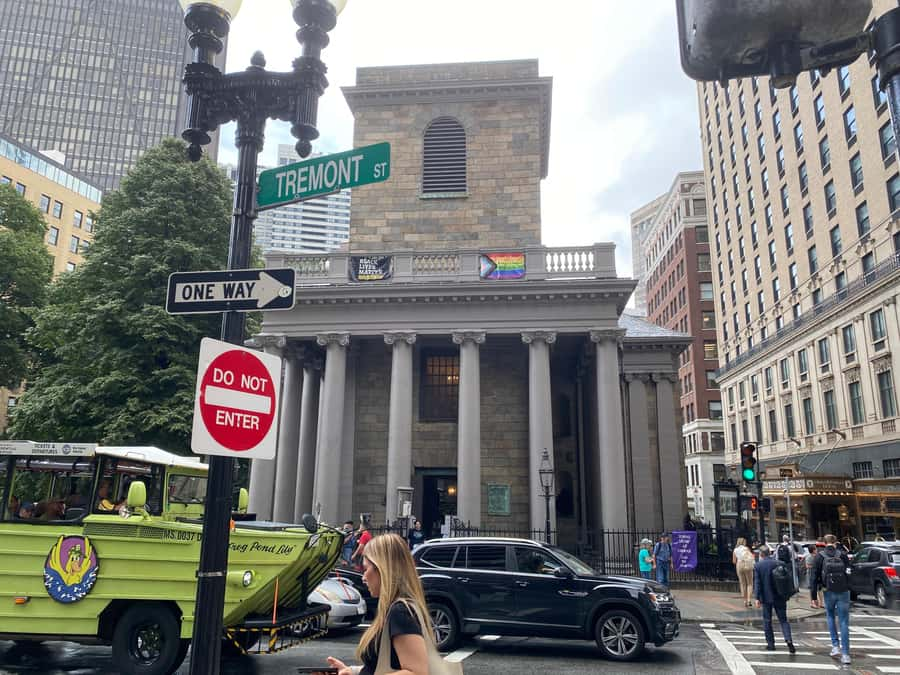
The meeting point is at the corner of Tremont and Beacon streets, across from King’s Chapel, near One Beacon Street. This is a central starting place for a walking tour of historic downtown, but the exact meeting location is important enough to plan for carefully.
Arrive at least 10 minutes before your scheduled departure. One booking ended badly because the participant arrived and could not find anyone, so do not cut this close. The supplied information does not describe a guide holding a particular sign or wearing a specific uniform. If you have trouble identifying the group, use the booking details before leaving your hotel.
From this starting point, your guide sets the tone by placing Boston in the period before independence. The value of beginning here is not simply convenience. The downtown setting lets you start with the city as a working political center, where streets, meeting places, businesses, printed material, and public arguments all helped shape events.
The tour is conducted in English. If you want a slow, highly visual introduction to Boston, two hours on foot is a reasonable length. You get enough time to build a story without committing to a half-day history program.
The Boston Tea Party, With the Politics Left In
The Boston Tea Party is one of the clearest examples of an event that has become larger than its original setting. Most people know the broad outline: colonists protested British taxation and threw tea into Boston Harbor. The useful part of this walk is the promise to explain the details behind the action.
Your guide can help you see the Tea Party as a political message, not merely an act of destruction. The event had an audience. It was meant to show opposition, force a response, and make a local dispute impossible to ignore. That makes the story more useful for understanding how protest worked in colonial Boston.
I appreciate that the tour does not treat the event as a simple good-versus-bad tale. You can listen to the circumstances, the motives, and the consequences, then decide how you understand the act. The tour’s focus on the roots of American democracy also gives this episode a larger purpose: democratic politics often grows out of disagreement, pressure, and public persuasion, not quiet consensus.
Do not expect a full harbor excursion or a separate visit to a Tea Party museum from the information provided. This is a walking tour of downtown and the North End, with the Tea Party explained as part of a wider story about rebellion.
The Boston Massacre and the Power of a Word
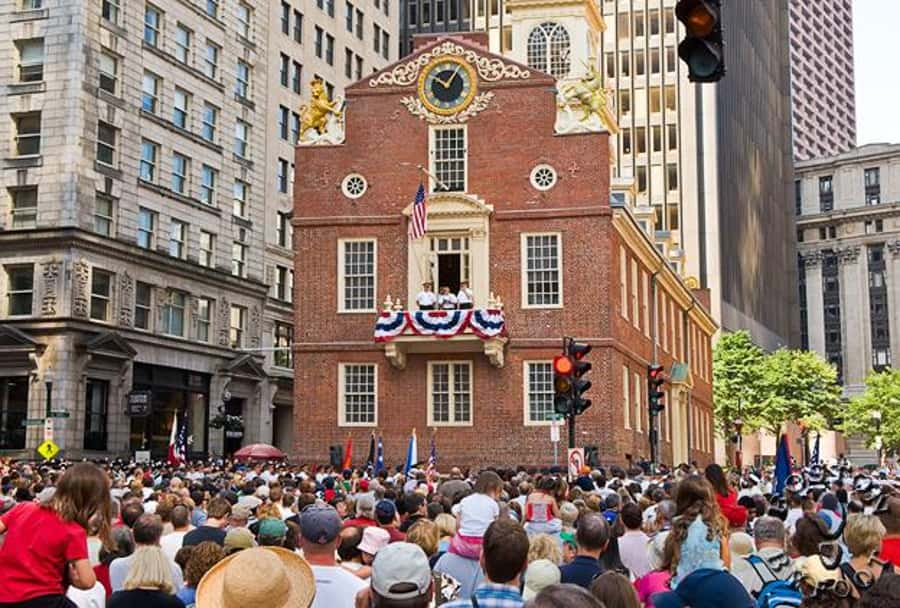
The events of 5 March 1770 raise a different problem. The name Boston Massacre is already an interpretation. Your guide invites you to decide for yourself if the word massacre fits what happened.
That question is one of the tour’s strongest teaching tools. It shows how historical language can shape memory while events are still fresh. The name was not a neutral label, and the way people described the confrontation affected how others responded to it.
This is also where the tour’s attention to the colonial press becomes especially useful. Boston’s printers produced words and images that could turn a local clash into a symbol. You will learn how those materials stirred the emotions of colonists and helped build opposition to British authority.
For you, the practical benefit is a clearer sense of how political communication worked before modern mass media. Printed accounts, images, and public discussion could travel well beyond the place where an event happened. The guide’s job is to connect those tools to the growing resistance, and that connection is more revealing than memorizing another date.
More Freedom Trail walks in Boston:
- Boston Food & History: Pizza, North End & Freedom Trail
★ 5.0 · 1,772 reviews - Boston’s Freedom Trail: A Revolutionary Walking Tour
★ 4.9 · 1,748 reviews - Boston: Freedom Trail History Small Group Walking Tour
★ 4.9 · 1,590 reviews - Boston’s Freedom Trail: A Revolutionary Walking Tour
★ 5.0 · 1,343 reviews
Paul Revere as Messenger and Image Maker
Paul Revere is often reduced to one famous midnight ride. This walk looks at why he was such an effective messenger, which makes the story more interesting.
The key point is communication. Revere understood how to move information, how to reach the right people, and how to use public attention. His work was not limited to one night or one dramatic warning. The tour places him within Boston’s networks of printing, political organizing, and rumor.
That broader view helps correct the usual portrait of Revere as a lone hero racing through the dark. You will hear about the methods and setting that made his message effective. The result is a more practical understanding of how people organized before telephones, radio, or social media.
This section should suit both serious history readers and first-time visitors. One guide, John, was especially praised for explaining what happened and where it happened while adding a sense of humor. That combination matters on a walking tour. Dates and names are easier to remember when the guide can give them shape without turning the subject into a lecture.
Colonial Printing and the Making of Public Feeling
The tour’s discussion of Boston’s presses may be its most distinctive feature. Many Freedom Trail walks concentrate on military conflict and famous patriots. This one also asks how printed words and images changed the way people felt about events.
That is a smart angle because political movements need stories. A printed account could present colonists as victims, British troops as oppressors, or a local dispute as proof of a much larger problem. The exact wording and imagery could push people toward anger, sympathy, or action.
You will not simply hear that propaganda existed. The stated focus is on how Boston’s presses stirred emotions in a generation of colonial Americans. That connects the physical city to the battle for public opinion.
I would pay close attention here, even if you think you already know the Revolution. This part can help you read the better-known events differently. The Tea Party and Boston Massacre were not only things that happened. They were also events people described, displayed, repeated, and used.
Walking From Downtown Into the North End
The route moves from historic downtown toward the North End and finishes at Copps Hill Terrace. The change in setting gives the walk a natural sense of movement, although the supplied information does not list every stop along the way.
You should expect a continuous guided walk rather than a series of long indoor visits. The tour description emphasizes buildings and sites connected to the years leading up to the Revolution. Your guide will use those places to explain people and events, so the experience depends on listening as much as looking.
The North End finish is useful if you want to continue exploring Boston after the tour. Still, do not assume the guide will return you to One Beacon Street. The stated endpoint is Copps Hill Terrace, so plan your afternoon from there.
Two hours also means the guide must choose carefully. You will get a focused account of Boston’s road to rebellion, not every chapter of the city’s past. That is a fair trade if you want a strong introduction. If your priority is entering many historic interiors or covering the entire Freedom Trail in detail, this format may feel brief.
What the Small Private Format Changes
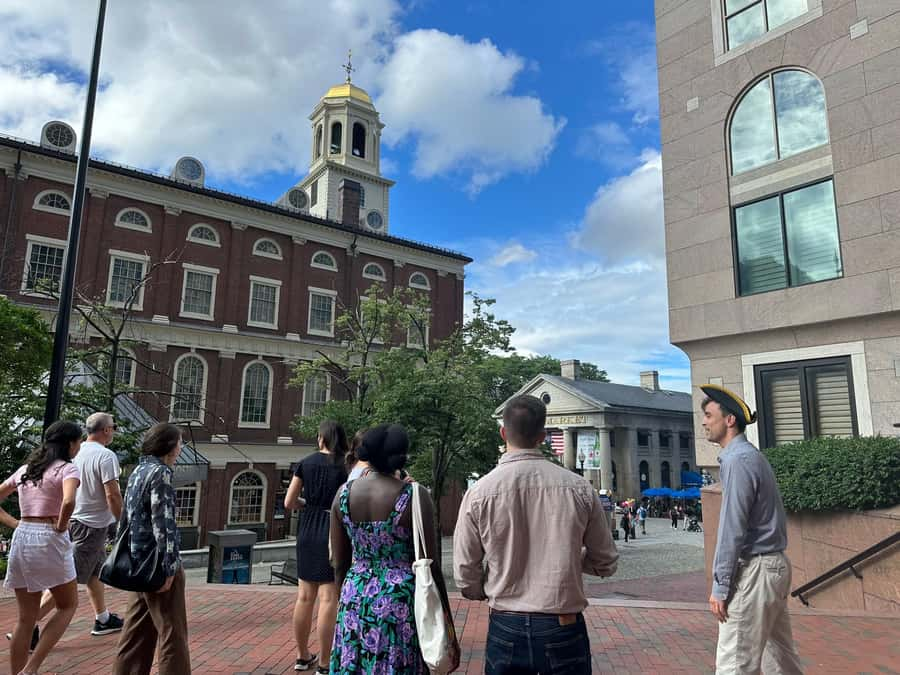
The private option is designed for groups of up to two. That is a particularly good match for a couple, a parent and child, or two friends who want to ask questions without worrying about a large group.
A small group can make complicated subjects easier to discuss. You can pause over the difference between an event and the way it was remembered. You can ask why Revere mattered, how the press influenced people, or how economic and social change fed political conflict.
The tradeoff is simple: a small private tour is intimate, but it may not have the energy of a larger group. At the stated price of $20 per person, it offers good value if you want direct guide time and a focused history lesson. For two people, the cost buys a personal introduction to central Boston rather than just a map and a set of plaques.
The exact guide can vary. Chad was praised for insight, Tressa for friendly storytelling, and John for clear explanations and humor. You cannot request a particular style based on this information, but those comments suggest that the guide’s personality will shape the experience.
The $20 Price and What You Receive
At $20 per person, the tour is priced as an accessible way to add context to a self-guided Freedom Trail walk. You receive a private guided walking tour, lasting two hours, with an English-speaking live guide.
The value is strongest if you want interpretation. Boston’s historic center is free to walk through, but the meaning of its sites is not always obvious. A guide can connect the places to political arguments, the colonial press, and the changing city.
The price is less compelling if you only want to see landmarks quickly or take photographs. You are paying for explanation and conversation, not transportation, food, admission to a separate attraction, or a full-day program. Those inclusions are not listed, so plan on a walking experience only.
A 4.1 rating from five recorded ratings suggests a generally positive but not flawless record. Four ratings awarded five stars, praising the guides’ insight, friendliness, knowledge, humor, and ability to bring the stories to life. One one-star rating came from someone who did not participate after arriving and finding no one. That makes punctual arrival and careful meeting-point planning especially important.
Who Will Get the Most From This Tour
I would choose this tour if you want to understand how Boston became a center of rebellion, rather than simply collect photos of Revolutionary sites.
It suits:
- First-time visitors who want a clear introduction to the Freedom Trail
- History buffs interested in the causes behind famous events
- Novices who prefer stories and explanations to a dense museum visit
- Couples or pairs who value a private format
- Readers interested in propaganda, printing, and political communication
- Visitors who want a two-hour activity that fits around other Boston plans
Families may also find the format useful, though the supplied details do not give a recommended minimum age or a specific approach for children. If you are traveling with young children, consider their comfort with two hours of walking and historical discussion.
The tour is wheelchair accessible, which removes one common concern about old-city walking routes. Still, no specific information is provided about surfaces, slopes, restroom stops, or seating. If those details matter for your group, ask before booking.
Practical Advice Before You Set Out
Wear comfortable shoes and dress for an outdoor walk. The duration is two hours, and the route runs through downtown and the North End. The information does not specify a rest stop, so plan accordingly.
Arrive 10 minutes early at the Tremont and Beacon streets corner across from King’s Chapel. This is the most important practical tip because one participant reported being unable to find the group after arriving.
Check the available starting times when booking. The tour runs in English, and private groups are available. You can cancel up to 24 hours before departure for a full refund, and reserve now while paying later, which is useful if your Boston schedule is still changing.
Because the finish is at Copps Hill Terrace, avoid planning a tight appointment back near One Beacon Street immediately afterward. You may want time to orient yourself before continuing through the North End or heading elsewhere.
Should You Book the Freedom Trail Walk?
Book it if you want a focused, guide-led explanation of Boston’s Revolutionary period and like the idea of questioning familiar stories. The best reasons are the attention to the Tea Party, the Boston Massacre’s loaded name, Paul Revere’s communication work, and the colonial press.
The private format is especially appealing for two people. At $20 each, it is a sensible purchase when you value direct conversation and a clear route through downtown and the North End.
Skip it if you want a much longer tour, a complete survey of every Freedom Trail stop, or a program centered on indoor admissions. Also take the meeting point seriously. Arrive early, confirm the location, and make sure you know that the walk finishes at Copps Hill Terrace.
FAQ
Where does the tour begin?
It begins at One Beacon Street, at the corner of Tremont and Beacon streets across from King’s Chapel.
Where does the tour finish?
The walk finishes at Copps Hill Terrace.
How long does the tour last?
The guided walking tour lasts two hours.
How much does the tour cost?
The stated price is $20 per person.
Is this a private tour?
Private groups are available, and the private walking tour is designed for groups of up to two people.
What language is the tour conducted in?
The live tour guide speaks English.
What historical subjects are covered?
You will learn about Boston before the American Revolution, including the Boston Tea Party, the events of 5 March 1770 known as the Boston Massacre, Paul Revere’s role as a messenger, colonial printing, and the roots of American democracy.
Is the tour wheelchair accessible?
Yes, the activity is listed as wheelchair accessible.
How early should I arrive?
You should arrive 10 minutes before the scheduled departure.
Can I cancel for a refund?
Yes. You can cancel up to 24 hours in advance for a full refund. You can also reserve now and pay later.
More 2-Hour Experiences in Boston
- 2-Hour Beacon Hill True Crime Expert Guided Tour
★ 5.0 · 182 reviews - 2 Hour North End ‘Little Italy’ Walking Tour
★ 4.5 · 125 reviews - Boston: 2-Hour Historic Walking Tour
★ 4.7 · 88 reviews - 2 Hour Boston Segway Tour
★ 5.0 · 77 reviews
Just added around Boston
- Day Trip from Boston: Explore Hammond Castle Museum★ 3.7 · 3 reviews
- Boston: WNDR Museum Entry Ticket★ 3.7 · 3 reviews
- The Boston Bash Scavenger Hunt★ 4.5 · 3 reviews
- Self-Guided Audio Tour of Boston North End★ 4.5 · 3 reviews
- Boston: Official Freedom Trail® Lantern Tour★ 4.7 · 3 reviews
- Boston: North End Walking Tour with Private Harbor Cruise★ 5.0 · 3 reviews
- Self Guided “The North End Pizza, Cannoli and Picnic” Solo Walking Tour★ 5.0 · 3 reviews
- Cambridge: Haunted Charles River Cruise★ 4.3 · 3 reviews
Freedom Trail Tours, compared.
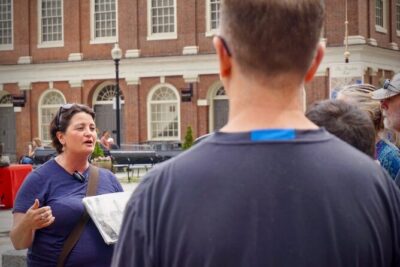
Freedom Trail History Small Group Walking Tour
Read our review →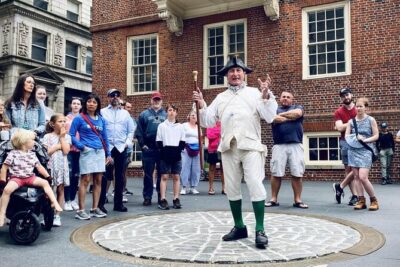
Boston Freedom Trail Walking Tour with Costumed Guide
Read our review →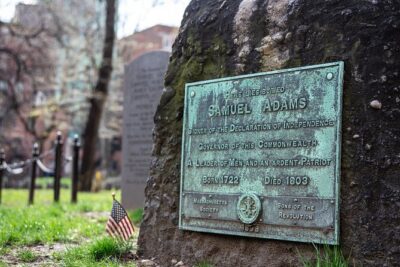
Boston Food & History: Pizza, North End & Freedom Trail
Read our review →
Boston’s Freedom Trail: A Revolutionary Walking Tour
Read our review →Freedom Trail History Small Group Walking Tour
Read our review →Boston’s Freedom Trail: A Revolutionary Walking Tour
Read our review →

Boston Freedom Trail History Pub Crawl Small-Group Tour
Read our review →Browse the lists this tour appears in