

Reviewed · FREEDOM TRAIL TOURS
Entire Freedom Trail Walking Tour: Includes Bunker Hill and USS Constitution
Boston’s Freedom Trail makes the most sense when you follow it as one connected story. This four-hour walk begins at the Massachusetts State House and ends across the water at the USS Constitution, taking in the places where arguments over taxes, law, religion, and military power turned into revolution. Guide Mark uses maps, humor, and plenty of context to connect the famous names with the cause-and-effect behind the conflict.
I especially like the full route. Many Boston walks cover only the downtown section, but this one continues to Bunker Hill and Old Ironsides. I also like the small additions, including the Blackstone Block and Ebenezer Hancock House, which add people and events often skipped in a basic introduction to Boston. The main thing to consider is the length: 2.8 miles may sound modest, but four hours on city sidewalks can mean close to 10,000 steps.
In This Review
- Key points to know before you book
- Why the complete Freedom Trail is worth four hours
- From the State House to Granary Burying Ground
- King’s Chapel and the roots of colonial conflict
- Old South Meeting House and the road to the Boston Tea Party
- Faneuil Hall and the voices of protest
- The Blackstone Block and Ebenezer Hancock House
- Paul Revere House and Old North Church
- Copp’s Hill and the Battle of Bunker Hill
- USS Constitution and the finish at Old Ironsides
- Pace, group size, and practical planning
- Who will get the most from this tour
- Should you book the Entire Freedom Trail Walking Tour?
- FAQ
- How long is the Entire Freedom Trail Walking Tour?
- What time does the tour start?
- Where does the tour begin?
- Where does the tour end?
- Is admission to the historic buildings included?
- Does the tour include Bunker Hill and USS Constitution?
- How many people can join the tour?
- What happens if the weather is poor?
Key points to know before you book
- The complete 2.8-mile route: You walk from Beacon Hill through downtown Boston and across to Charlestown.
- A story-led tour: Mark links each stop to the next, showing how political disputes became open rebellion.
- Small group size: The tour accepts no more than 16 people, a useful limit for a busy city walk.
- Bunker Hill and Old Ironsides included: You do not have to arrange a second tour to reach these important Revolutionary sites.
- Exterior visits are the norm: Admission to building interiors is not included, so plan for extra costs if you want to go inside.
- Comfortable pace, serious walking: The route is mostly flat, but you need moderate physical fitness and good shoes.
Why the complete Freedom Trail is worth four hours
At $79 per person, this is not the cheapest way to walk Boston’s red-brick trail. You can follow the painted line on your own for free. The value here is the interpretation: Mark spends time explaining why each site mattered, how the people involved fit together, and what the usual schoolbook version may leave out.
That difference matters in Boston. The trail passes many buildings that look modest from the street. Without a guide, you may see a church, a graveyard, or an old brick building without grasping how a court case, sermon, protest, or military decision changed the course of events.
The small group limit helps. A maximum of 16 people is large enough to create a pleasant group but small enough for questions and a more personal pace. Several comments about the tour point to Mark’s ability to keep the group together in a busy city, answer questions, and make sure people are comfortable.
You should also expect a real history lesson, not a quick photo stop at fourteen landmarks. Mark has prepared his own material and uses maps to make geography and military movements easier to understand. His style is described as down to earth, funny, and free of theatrical storytelling. That should appeal to you if you want substance without a costumed performance.
More Walking Tours in Boston
- Boston: Freedom Trail History Small Group Walking Tour
★ 5.0 · 6,450 reviews - Harvard University Campus Guided Walking Tour
★ 4.5 · 3,632 reviews - Boston Freedom Trail Walking Tour with Costumed Guide
★ 4.5 · 2,531 reviews
From the State House to Granary Burying Ground
Meet at 10 a.m. near Beacon Street and Park Street. The first stop is the Massachusetts State House, where you see the current seat of Massachusetts government and learn about the earlier buildings that served the same purpose. The present structure was designed by Charles Bulfinch, an important figure in early American architecture.
The stop is brief, about ten minutes, and the interior is not included. That is a pattern for much of the tour. You receive an explanation of the building’s role and appearance, but you should not assume that the walk includes entry tickets.
At Park Street Church, the focus shifts from government to religion and reform. When it was built, the church was the tallest building in the country. Its connection to the Abolition Movement gives the stop a broader frame than the Revolutionary period alone, while the nickname Brimstone Corner points to both fiery sermons and an unusual former use of the church cellar.
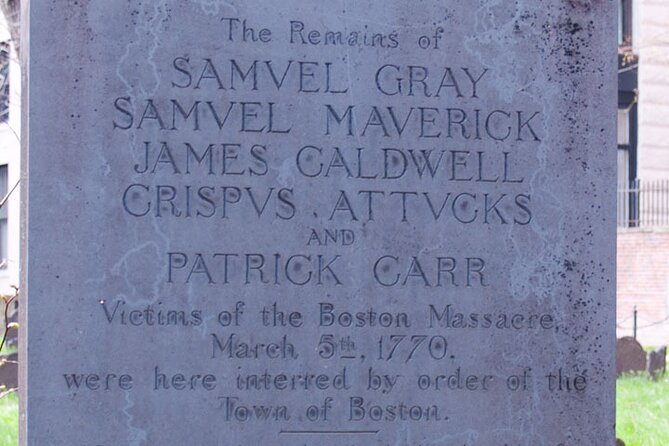
Granary Burying Ground is one of the most useful early stops because names that can feel abstract in a textbook become tied to a real place. Samuel Adams, Paul Revere, John Hancock, and victims of the Boston Massacre are buried here. Mark gives a short introduction to the people and their roles, rather than leaving you to decipher old gravestones on your own.
The burying ground is free to enter, and this is one of the places where the tour’s slower pace pays off. You can take pictures and listen without needing to rush through a long list of names.
King’s Chapel and the roots of colonial conflict
King’s Chapel brings an earlier religious and political dispute into the story. The 1749 Anglican church was connected to a conflict that began when the king took land in Boston in the 1680s to place an unwanted church there.
That detail helps you see that resentment toward British authority did not appear suddenly in 1775. Arguments over who controlled land, religion, courts, and local government had been building for generations. The chapel’s interior is not included, so the stop works best for you if you are interested in the story attached to the building rather than a formal architectural visit.
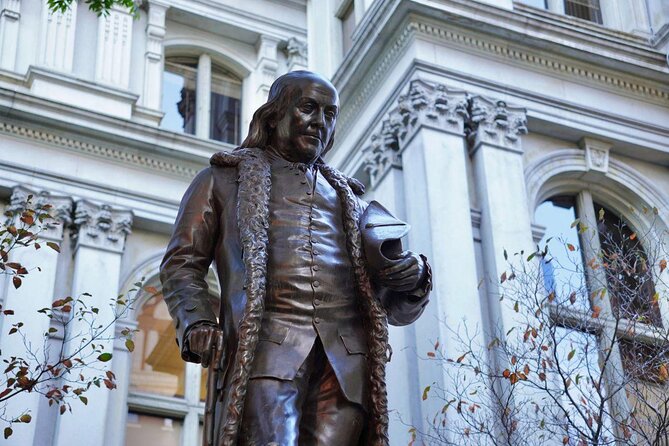
At Old City Hall, you see a statue of Benjamin Franklin and a marker connected to the oldest still-operating school in the colony. This is a short stop, but it adds civic and educational threads to the tour.
I appreciate this kind of variety. The walk is not only a parade of Revolutionary War monuments. It also shows the institutions and public spaces that shaped daily life in colonial Boston.
Old South Meeting House and the road to the Boston Tea Party

Old South Meeting House is where the political story gathers force. Colonial meeting halls were places to hear preachers and politicians, and this Puritan meeting house became especially important when Samuel Adams used it to launch the Boston Tea Party.
The guide explains why that event mattered beyond the famous image of tea being thrown into the harbor. It pushed the dispute with Britain toward a point where compromise became harder. The interior is not part of the $79 tour, so you will need a separate admission if you want to explore the building inside.
Next comes the Old State House, once the center of British government in Massachusetts. Here, the tour covers a court battle in 1761 that exposed the colonial concern over legal rights and government power. The building is also tied to the Boston Massacre in 1770.
This is a good example of where a guide adds real value. The common version says innocent citizens were gunned down in cold blood. The fuller question is what happened in the tense confrontation, how the soldiers were defended, and how the event was used politically. Mark presents the dispute in a way that encourages you to examine the evidence rather than accept a simple slogan.
More Freedom Trail walks in Boston:
- Boston Food & History: Pizza, North End & Freedom Trail
★ 5.0 · 1,772 reviews - Boston’s Freedom Trail: A Revolutionary Walking Tour
★ 4.9 · 1,748 reviews - Boston: Freedom Trail History Small Group Walking Tour
★ 4.9 · 1,590 reviews - Boston’s Freedom Trail: A Revolutionary Walking Tour
★ 5.0 · 1,343 reviews
Faneuil Hall and the voices of protest
Faneuil Hall Marketplace provides a lively change of setting and a chance to consider how public speech helped shape political action. Samuel Adams spoke here about taxation and representation, while Frederick Douglass later used the hall as an abolitionist speaker.
The site is free to visit, though interior admission details are separate from the tour. The guide’s job here is not simply to point out the building. It is to show how public meeting places gave speakers a way to influence ordinary people.
That wider view is one of the tour’s strongest features. The walk includes women’s contributions to the period, lesser-known figures, and people whose names do not always appear in a standard American history class. If you want only the most famous stories about Paul Revere and George Washington, you may find the detail more than you need. If you like connecting the major events to the people around them, you will appreciate the extra context.
The Blackstone Block and Ebenezer Hancock House
The Blackstone Block is one of the tour’s more unusual sections. It includes the former offices of the Massachusetts Spy, a place referred to as the Headquarters of the Revolution because it was a bar, and the home of Ebenezer Hancock, John Hancock’s brother.
Ebenezer Hancock’s house has a particularly useful connection to the international side of the Revolution. Money sent by the French to support the American cause was stored there. That detail reminds you that the conflict was not simply a local quarrel between Boston residents and British troops. Financial and military support from abroad became important to the American effort.
This section also illustrates why a guide can be more useful than the painted trail alone. Some locations are easy to miss, and the buildings may not announce their importance. Mark points out the details that sit just beyond the standard route and explains how they fit into the larger account.
Paul Revere House and Old North Church
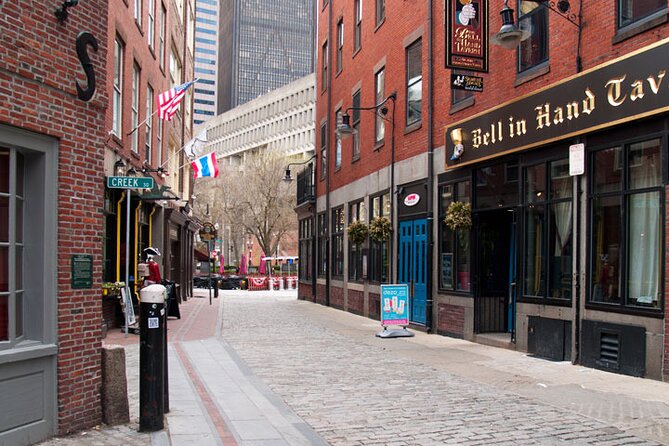
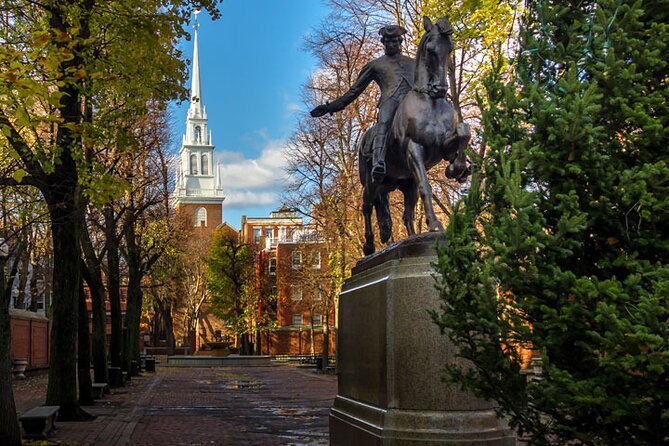
The Paul Revere House is one of Boston’s oldest surviving homes. Revere purchased the 1680 Post-Medieval house in 1770, and he raised sixteen children there with two wives.
The stop lasts only about five minutes, and entry is not included. You will learn about the house and Revere’s family life from outside, with the option of paying separately if you want to tour the interior.
Old North Church carries the story into the military crisis of 1775. Patriots used the church to signal across the narrow waters to Charlestown that British regulars were moving toward Cambridge on their way to Lexington and Concord.
This is a place where geography matters. The signal is easier to understand when you are actually moving through the connected Boston and Charlestown area. The guide uses the setting to explain how information traveled and how quickly local tensions became an armed conflict.
Copp’s Hill and the Battle of Bunker Hill
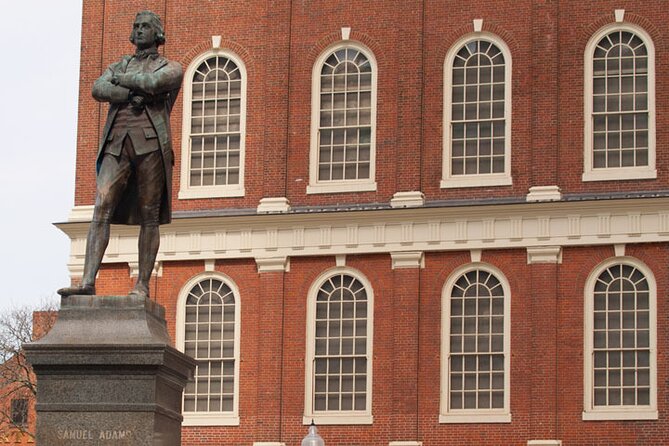
Copp’s Hill Burying Ground offers a short stop with a strong view into the Battle of Bunker Hill. Mark explains the geography of the battle and points out a grave marker with its own story.
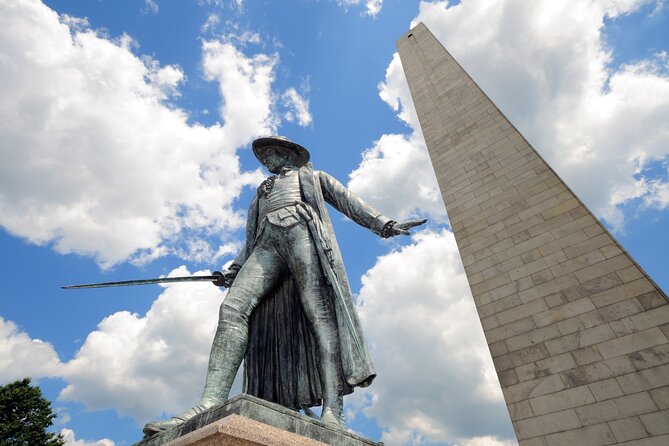
You then continue to Bunker Hill Monument, the place where the tour addresses a common historical mix-up: the battle was fought on Breed’s Hill, not Bunker Hill. The British won the ground, but their losses were about three times those of the Patriots.
The monument stop is free, and it gives the military story a physical setting. You can better understand the cost of the British attack and why the battle encouraged the colonial forces even in defeat.
This part also marks the practical challenge of the route. By now you have spent several hours on your feet, and the walk across Boston’s streets has accumulated. People who enjoy walking generally find the pace manageable, including some older participants, but you should not treat this as a short sightseeing loop.
USS Constitution and the finish at Old Ironsides
The final stop is the USS Constitution in the Charlestown Navy Yard. Known as Old Ironsides, it is the oldest commissioned warship in the world and served the United States Navy in American and foreign waters.
The tour ends at the USS Constitution Museum, Building 22, in Charlestown. The ship and museum are separate attractions with their own interior access arrangements, and admission to interiors is not included in the walking tour. You can use the tour’s ending point to continue your visit, but allow extra time and check the applicable admission details before booking if going aboard is essential to you.
Ending here is a major advantage. You finish with one of Boston’s most important surviving naval symbols rather than having to find your way across the harbor area on your own. It also gives the story a satisfying final chapter, moving from protests and burial grounds to the military force that helped the new nation survive.
Pace, group size, and practical planning
Wear comfortable shoes. The route covers about 2.8 miles, and the full outing takes approximately four hours. Some people estimate the walk at roughly 10,000 steps, so the distance is more demanding than the mileage alone suggests.
The tour requires a moderate level of physical fitness. The pace is described as mostly flat and manageable, but you still need to walk through a busy urban area for most of the morning. Bring water, especially since the tour is long and outdoor conditions can change.
The experience is offered in English and uses a mobile ticket. Service animals are allowed, and the meeting point is near public transportation. The start is at Beacon Street near Park Street, while the finish is at the USS Constitution Museum in Charlestown, so plan your day around ending in a different part of Boston.
A maximum of 16 people keeps the group from becoming unwieldy. Mark also has a reputation for helping people find the start when parking or directions become confusing, but you should still arrive with time to spare. Boston’s streets and landmarks can make a first meeting point harder to spot than expected.
The tour depends on good weather. If poor weather forces cancellation, you receive the choice of another date or a full refund. You can cancel for a full refund up to 24 hours before the start time, but changes or cancellations inside that window are not accepted.
Who will get the most from this tour
I would choose this walk if you are visiting Boston for the first time and want the Freedom Trail explained as one story. It is particularly well suited to history buffs, couples, families with teenagers, and anyone who prefers a guide who can answer questions rather than recite a short script.
It can also work well for older walkers who are comfortable covering several miles at a steady pace. The route is mostly flat, but the duration remains the key issue.
For children under 12, I would use some judgment. The subject is detailed, and even the guide notes that younger children should be serious history fans to get the most from four hours. Teenagers with an interest in the Revolution are a better fit.
The tour is less suitable if you want to spend a long time inside each church, house, museum, or ship. Since interior admissions are excluded, this is primarily an outdoor walking and interpretation experience. You can add indoor visits afterward, but that requires extra time and money.
Should you book the Entire Freedom Trail Walking Tour?
Book it if you want the complete route, a small group, and a connected explanation of Boston’s Revolutionary story. The inclusion of Bunker Hill and USS Constitution makes the $79 price easier to justify than a short downtown-only walk, especially if you would otherwise need to arrange separate transport and sightseeing.
Skip it if four hours on foot sounds tiring or if your main goal is touring interiors. You can follow the trail independently at little cost, then choose the buildings you most want to enter.
For most first-time visitors who value clear history, Mark’s personal style, maps, humor, and extra stops make this a strong use of a Boston morning. Just wear good shoes, bring water, and remember that Old Ironsides is the finish, not the beginning.
FAQ
How long is the Entire Freedom Trail Walking Tour?
The tour lasts approximately four hours and covers the full 2.8-mile, or 4-kilometer, Freedom Trail route from Boston to Charlestown.
What time does the tour start?
The tour starts at 10 a.m.
Where does the tour begin?
The meeting point is near Beacon Street and Park Street in Boston, Massachusetts.
Where does the tour end?
The tour ends at the USS Constitution Museum, Building 22, in the Charlestown Navy Yard.
Is admission to the historic buildings included?
No. Admission to interiors is not included. The walking tour covers the sites and their history, while entry to buildings requires separate arrangements or payment where applicable.
Does the tour include Bunker Hill and USS Constitution?
Yes. The route includes Bunker Hill Monument and ends at the USS Constitution, also known as Old Ironsides.
How many people can join the tour?
The tour has a maximum group size of 16 people.
What happens if the weather is poor?
The experience requires good weather. If it is canceled because of poor weather, you are offered another date or a full refund. You may also cancel up to 24 hours before the start time for a full refund.
Just added around Boston
- Day Trip from Boston: Explore Hammond Castle Museum★ 3.7 · 3 reviews
- Boston: WNDR Museum Entry Ticket★ 3.7 · 3 reviews
- The Boston Bash Scavenger Hunt★ 4.5 · 3 reviews
- Self-Guided Audio Tour of Boston North End★ 4.5 · 3 reviews
- Self Guided “The North End Pizza, Cannoli and Picnic” Solo Walking Tour★ 5.0 · 3 reviews
- Boston: Official Freedom Trail® Lantern Tour★ 4.7 · 3 reviews
- Boston: North End Walking Tour with Private Harbor Cruise★ 5.0 · 3 reviews
- Cambridge: Haunted Charles River Cruise★ 4.3 · 3 reviews
Freedom Trail Tours, compared.
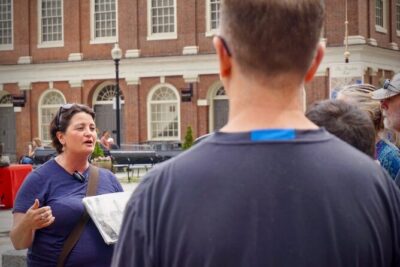
Freedom Trail History Small Group Walking Tour
Read our review →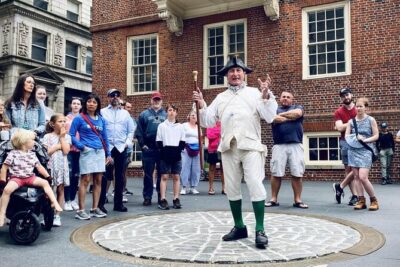
Boston Freedom Trail Walking Tour with Costumed Guide
Read our review →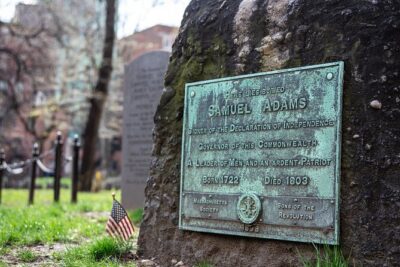
Boston Food & History: Pizza, North End & Freedom Trail
Read our review →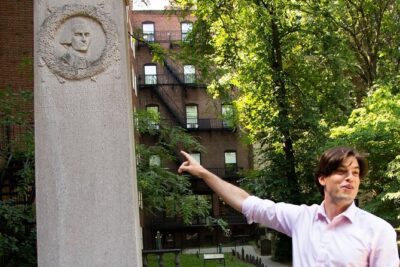
Boston’s Freedom Trail: A Revolutionary Walking Tour
Read our review →Freedom Trail History Small Group Walking Tour
Read our review →Boston’s Freedom Trail: A Revolutionary Walking Tour
Read our review →

Boston Freedom Trail History Pub Crawl Small-Group Tour
Read our review →Browse the lists this tour appears in