

Reviewed · FREEDOM TRAIL TOURS
Boston: Freedom Trail History and Architecture Walking Tour
Boston’s Freedom Trail is at its best when the city’s scattered landmarks begin to make sense as one story. This 70-minute walk links Faneuil Hall and Boston Common, taking you past colonial meeting places, churches, government buildings, cemeteries, and memorials in the heart of downtown.
Two things I especially like are the architecture focus, which helps you notice how Boston changed over time, and the local perspective. Guide Allan, named by one highly positive booking, was personable, patient, and ready for questions from teenagers and adults alike. The main consideration is the pace: 70 minutes gives you a useful introduction, not a full visit inside every landmark.
In This Review
- Key Points To Know Before You Book
- Starting At State And Congress Streets
- Faneuil Hall And The City’s Public Life
- The Old State House And Boston Massacre Site
- King’s Chapel And The Old South Meeting House
- Granary Cemetery And The Old Corner Bookstore
- Old City Hall, The Irish Famine Memorial, And Changing Boston
- Finishing At Boston Common
- What The Guide Adds To The Walk
- Is $30 A Fair Price?
- Who Should Book This Freedom Trail Walk?
- Practical Tips For A Better Morning
- Should You Book It?
- FAQ
- How long is the Boston Freedom Trail walking tour?
- What is the price?
- Where does the tour meet?
- Where does the tour finish?
- What language is the tour conducted in?
- Which landmarks are included?
- What is included in the price?
Key Points To Know Before You Book
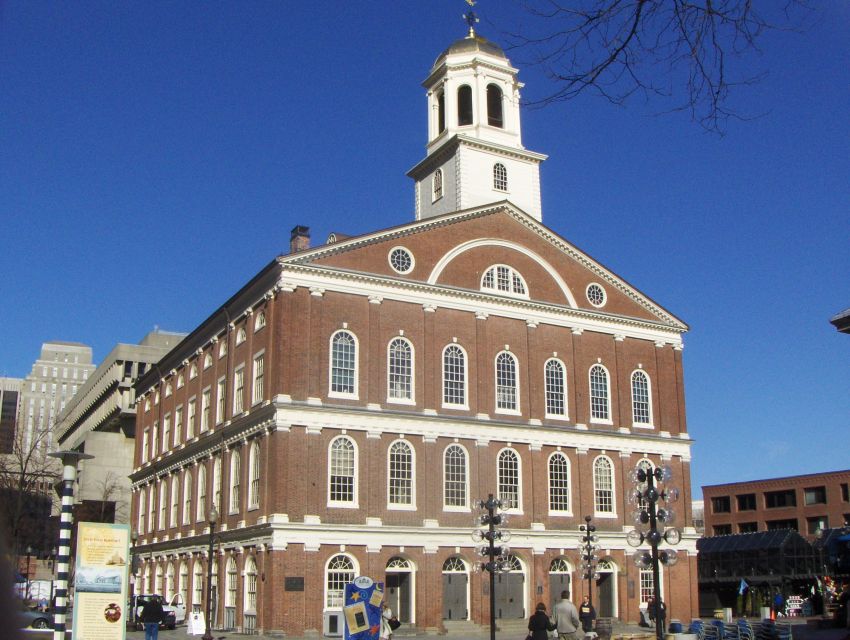
- Faneuil Hall to Boston Common: The route crosses central Boston and links major Freedom Trail landmarks in a compact walk.
- Architecture alongside history: You’ll hear how Boston developed from its early settlement through the modern city, while seeing buildings from different periods.
- A guide-led introduction: The experience is conducted in English by a professional local guide, with Allan specifically praised for his friendly manner and patience.
- Many landmarks in one short tour: Expect the Old and New State Houses, King’s Chapel, Old South Meeting House, Granary Cemetery, Boston Common, and more.
- A good first-morning orientation: The tour helps you decide which sites deserve a longer visit later in your trip.
- Simple pricing and flexible booking: At $30 per person, the cost is reasonable for a 70-minute guided walk, with cancellation allowed up to 24 hours before departure.
Starting At State And Congress Streets
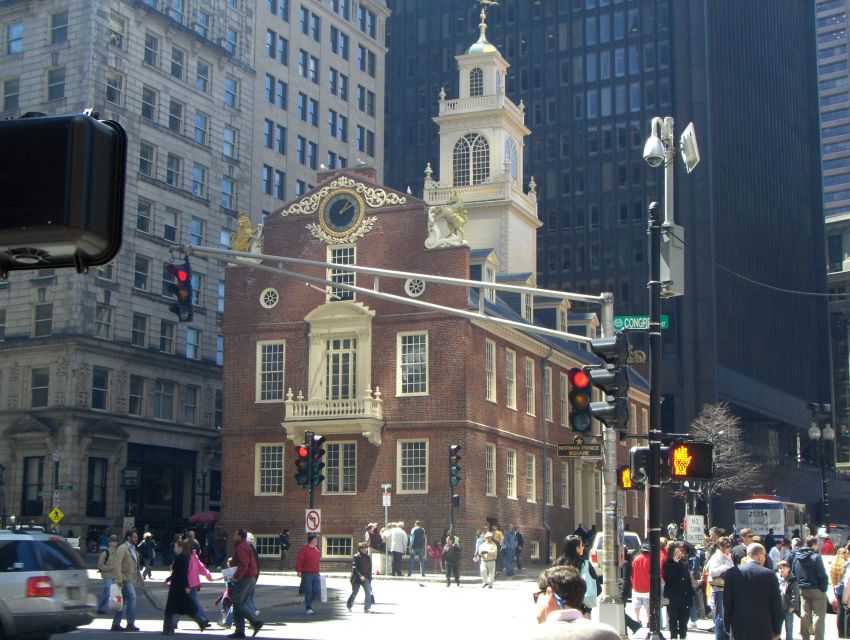
The meeting point is on the northwest corner of State and Congress Streets, outside 28 State Street, by Citizens Bank. It is across the street from the Old State House.
That location puts you right in the middle of the action, but it also means you should pay close attention to the address. This is not a meeting point at Boston Common or inside Faneuil Hall. If you arrive early, the Old State House gives you a clear landmark to use while finding the guide.
The tour begins in the area where Boston’s old commercial and political centers meet the modern downtown. That is useful context from the first few minutes. You are not simply following a painted line through the city. You are seeing how streets, buildings, and civic spaces were layered over time.
I like this starting point because it gives the walk a strong sense of place. State Street, Congress Street, and the streets around Faneuil Hall are busy parts of Boston, yet historic buildings remain close together. The contrast between old brick, formal civic architecture, and newer downtown structures is one of the central themes of the walk.
More Historic Tours in Boston
- Boston: Freedom Trail History Small Group Walking Tour
★ 5.0 · 6,450 reviews - Tour of Historic Fenway Park, America’s Most Beloved Ballpark
★ 4.5 · 3,013 reviews - Boston Food & History: Pizza, North End & Freedom Trail
★ 5.0 · 1,772 reviews
Faneuil Hall And The City’s Public Life
Faneuil Hall is one of the major landmarks on the route. It is closely tied to Boston’s public life, and it helps explain why this part of the city became such an important gathering place.
Your guide uses the building and surrounding streets to put Boston’s early development into context. The value here is not just learning a date or a famous name. You begin to see how commerce, politics, and public debate took place in the same compact part of town.
The tour does not list admission to the sites, so think of this as an outdoor history walk rather than a series of interior visits. That is not a weakness if you want orientation first. You can note the places that interest you and return later with more time.
Faneuil Hall also works well as an early stop because it connects the Freedom Trail to Boston as a living city. Food, shops, offices, and foot traffic surround these old landmarks. The past is not separated from daily life here. It is part of the same street scene.
The Old State House And Boston Massacre Site
Across from the meeting point, the Old State House gives you one of the clearest examples of Boston’s political history. The building is easy to recognize, and its position among taller modern structures makes the city’s changes over time especially clear.
Nearby, the Boston Massacre Site marks one of the best-known flashpoints in the years before the American Revolution. A short stop here can carry a lot of historical weight, so the guide’s explanation matters. The tour is designed to connect the site to the wider story instead of treating it as an isolated marker.
This is where the walk’s short length becomes both a strength and a limit. You get a clear explanation of why the location matters, but you should not expect a long lecture at each stop. The route covers many sites, so the guide must keep the story moving.
For first-time visitors, that brisk approach can be helpful. Boston has an unusual number of historic places packed into a small area, and it is easy to lose the larger story while chasing individual buildings. This tour keeps returning to the main thread: how Boston grew, argued, rebuilt, and changed.
King’s Chapel And The Old South Meeting House
King’s Chapel adds another layer to Boston’s early civic and religious life. Its presence along the route helps show how important churches were to the city’s early organization and public identity.
The Old South Meeting House offers a different connection to the revolutionary period. Together, these stops show that Boston’s story was shaped not only by government buildings, but also by religious communities and public gatherings.
I find this section especially useful for visitors who want more than a list of Revolutionary War sites. The architecture helps you read the city. Formal churches, meetinghouses, civic buildings, and commercial structures each reveal something about the people who used them.
The tour’s architecture theme also helps prevent the walk from becoming a string of famous names. You are encouraged to notice how buildings fit into the streets around them and how old structures now share space with later additions. Boston can look visually untidy in places, but that mixture is part of what makes the downtown interesting.
More Walking Tours in Boston
- Harvard University Campus Guided Walking Tour
★ 4.5 · 3,632 reviews - Boston Freedom Trail Walking Tour with Costumed Guide
★ 4.5 · 2,531 reviews - The Full Revolutionary Story Epic Small Group Boston Walking Tour
★ 5.0 · 2,356 reviews - Boston’s Freedom Trail: A Revolutionary Walking Tour
★ 4.9 · 1,748 reviews
Granary Cemetery And The Old Corner Bookstore
The Old Granary Cemetery is one of the route’s most atmospheric landmarks. A cemetery in the center of a modern city creates an immediate sense of the distance between Boston’s early years and its current pace.
The stop also gives the guide a chance to discuss the people and events tied to Boston’s past. The cemetery is not just an old enclosure beside a busy street. It is part of the city’s record, preserved while the streets around it changed.
The Old Corner Bookstore adds a commercial and literary note to the walk. Its inclusion broadens the tour beyond strictly political history. Boston’s identity grew through books, business, religion, immigration, civic debate, and public gatherings, and this sequence of stops helps make that point.
You will also encounter the First Schoolhouse Site, another reminder that the Freedom Trail is not only about grand buildings. Smaller markers can point to institutions that shaped everyday life. These details are easy to miss when exploring alone, especially if you are focused only on the most famous red-brick landmarks.
Old City Hall, The Irish Famine Memorial, And Changing Boston
Old City Hall brings the route into a later period of Boston’s development. Its architecture helps show how the city’s public buildings changed as Boston became larger and more established.
The Irish Famine Memorial shifts the story again, connecting Boston’s past to immigration and community memory. Its place along a downtown walking route is a reminder that the city’s history did not end with the Revolution.
This combination is one of the tour’s best features. You are not being shown a frozen colonial town. You are seeing a city with several historical layers, from early settlement to political conflict, civic growth, immigration, and the modern downtown.
The guide’s role is important here because the buildings and memorials do not always explain their connections on their own. A local guide can help you understand why a particular site matters and how it fits the larger story of Boston.
Finishing At Boston Common
The walk ends at Boston Common, giving you a natural finish in one of the city’s best-known public spaces. After the close streets and dense architecture downtown, the Common provides a change of pace.
It is a fitting endpoint because Boston Common connects history with present-day city life. People use it as an everyday public space, while its location anchors one of the country’s most historic urban areas.
Ending here also makes the tour practical for the rest of your day. You can continue exploring Boston Common and nearby streets, return to a landmark that caught your interest, or use the walk as a starting point for more sightseeing.
The route from Faneuil Hall to Boston Common is compact enough to fit into a morning. Still, you should wear comfortable shoes and expect to spend the full 70 minutes on foot. The supplied details do not specify group size or the exact walking distance, so I would plan for a normal city walk rather than assume a slow, stop-heavy outing.
What The Guide Adds To The Walk
The strongest part of this experience is the human explanation between the landmarks. A map can show you where the Old State House, King’s Chapel, and Granary Cemetery are located. A guide can explain why they belong in the same story.
The feedback about Allan is especially useful. He was described as personable, patient, and able to answer questions from a family with teenagers. That suggests the tour can work well for mixed-age groups, especially if younger visitors need a guide who will not become impatient when questions wander.
Another positive point is the guide’s role as a local voice. The tour promises Boston culture as well as historical facts, and that matters because downtown Boston can otherwise feel like a sequence of plaques. The local angle helps connect the formal history to the city’s present character.
English ability is an important consideration. The tour is conducted in English, and one German-speaking participant found that strong English skills were needed to follow the content. If you are comfortable listening to spoken English for 70 minutes, you should be fine. If not, the quick movement between sites and the amount of historical information may make it harder to keep up.
Is $30 A Fair Price?
At $30 per person, this is a sensible price for a short guided introduction to Boston’s central historic district. You are paying for a professional local guide and a focused route through many major sites, not for entry tickets, meals, transportation, or a full-day program.
The value depends on how you use the tour. If you want a deep visit to each building, $30 will not replace individual admissions and longer self-guided exploration. If you want the city to make sense quickly, the price is easier to justify.
A 70-minute tour can save you time later. Instead of wandering from one landmark to another without context, you leave with a basic map of downtown and a better idea of what deserves another look.
The flexible booking terms also reduce the risk. You can cancel up to 24 hours in advance for a full refund, and you can reserve now while paying later. Those policies are useful if your Boston plans depend on weather or a changing schedule, though the tour’s actual starting times depend on availability.
Who Should Book This Freedom Trail Walk?
I would recommend this walk to first-time Boston visitors who want a quick historical framework. It is also a good choice for families, given the report of teenagers enjoying the tour and the guide’s patience with questions.
You should also consider it if architecture interests you as much as famous events. The route does not focus only on the Revolution. It includes churches, meetinghouses, cemeteries, civic buildings, memorials, and older commercial structures.
This tour suits you best if you enjoy learning while walking and want a compact introduction. It may not be the right choice if you dislike guided groups, need extensive time inside each site, or are not comfortable following spoken English.
For repeat visitors, the walk can still be useful if your previous Boston visits focused on museums or neighborhoods outside downtown. The route gives you a quick look at the historic core and may help you connect places you have passed without fully understanding.
Practical Tips For A Better Morning
Arrive at the northwest corner of State and Congress Streets with enough time to identify 28 State Street and the Citizens Bank location. The Old State House is across the street and serves as an easy visual reference.
Plan your clothing and footwear for an outdoor city walk. The duration is only 70 minutes, but the experience moves between multiple downtown landmarks and includes no stated transportation.
Keep your expectations clear. You will encounter a large number of sites, but the tour cannot give every one a long stop in such a short time. Treat it as an introduction, then return to the places that catch your interest.
If you are traveling with family, encourage everyone to bring questions. Allan was specifically praised for handling questions patiently, and asking about architecture, politics, religion, or immigration can make the walk more engaging for different ages.
Finally, remember that the tour is in English. Strong listening skills will help you get the most from the stories, particularly when the guide is explaining several historical periods in quick succession.
Should You Book It?
Book this tour if you want a short, affordable orientation to Boston’s historic center, especially on your first morning in town. The route covers an impressive range of landmarks, and the architecture angle gives you more than a basic list of Revolutionary-era sites.
I would choose it for families, first-time visitors, and anyone who likes a local guide to connect buildings with city life. I would skip it only if you want interior visits, a slower pace, or a tour in a language other than English.
At $30, the walk offers solid value as a starting point. It will not tell you everything about Boston, but it can show you where to look next and why the Freedom Trail remains central to understanding the city.
FAQ
How long is the Boston Freedom Trail walking tour?
The tour lasts 70 minutes.
What is the price?
The price is $30 per person.
Where does the tour meet?
The meeting point is the northwest corner of State and Congress Streets, outside 28 State Street at Citizens Bank, across from the Old State House.
Where does the tour finish?
The route walks from Faneuil Hall to Boston Common.
What language is the tour conducted in?
The live tour guide conducts the experience in English.
Which landmarks are included?
The route includes Faneuil Hall, the Old and New State Houses, the Boston Massacre Site, Park Street Church, King’s Chapel, the Old South Meeting House, the Old Granary Cemetery, Old City Hall, the First Schoolhouse Site, the Old Corner Bookstore, Boston Common, and the Irish Famine Memorial, among other locations.
What is included in the price?
A professional local guide is included. Admission tickets, transportation, and other extras are not listed as included.
More Historical Tours in Boston
- History and Hauntings of Salem Guided Walking Tour
★ 5.0 · 14,564 reviews - Boston: City Cruises Historical Sightseeing Cruise
★ 4.6 · 1,771 reviews - City Cruises Boston Historic Sightseeing Harbor Cruise
★ 4.5 · 1,388 reviews - Boston’s North End Food Tour: Italian Flavors & Heritage Walk
★ 5.0 · 1,322 reviews
More Freedom Trail Walks in Boston
- Boston: Freedom Trail History Small Group Walking Tour
★ 4.9 · 1,590 reviews - Boston’s Freedom Trail: A Revolutionary Walking Tour
★ 5.0 · 1,343 reviews - Freedom Trail Walking Tour 250
★ 4.5 · 1,118 reviews - Boston Freedom Trail History Pub Crawl Small-Group Tour
★ 5.0 · 996 reviews
Just added around Boston
- Day Trip from Boston: Explore Hammond Castle Museum★ 3.7 · 3 reviews
- Boston: WNDR Museum Entry Ticket★ 3.7 · 3 reviews
- The Boston Bash Scavenger Hunt★ 4.5 · 3 reviews
- Self-Guided Audio Tour of Boston North End★ 4.5 · 3 reviews
- Boston: Official Freedom Trail® Lantern Tour★ 4.7 · 3 reviews
- Boston: North End Walking Tour with Private Harbor Cruise★ 5.0 · 3 reviews
- Self Guided “The North End Pizza, Cannoli and Picnic” Solo Walking Tour★ 5.0 · 3 reviews
- Cambridge: Haunted Charles River Cruise★ 4.3 · 3 reviews
Freedom Trail Tours, compared.

Freedom Trail History Small Group Walking Tour
Read our review →
Boston Freedom Trail Walking Tour with Costumed Guide
Read our review →
Boston Food & History: Pizza, North End & Freedom Trail
Read our review →
Boston’s Freedom Trail: A Revolutionary Walking Tour
Read our review →Freedom Trail History Small Group Walking Tour
Read our review →Boston’s Freedom Trail: A Revolutionary Walking Tour
Read our review →

Boston Freedom Trail History Pub Crawl Small-Group Tour
Read our review →Browse the lists this tour appears in