

Reviewed · MUSEUMS
Boston’s Old State House & Old South Meeting House Museums
The Boston Tea Party began as a heated public debate, and the best place to feel that debate is the Old South Meeting House. Two blocks away, the Old State House brings you closer to the machinery of royal government and the events surrounding the Boston Massacre. Together, these buildings show how protest grew from arguments, meetings, and political pressure.
I like the way the two museums complement each other, and I like their location on the Freedom Trail in central Boston. The self-guided format lets you move at your own pace, while talks, walking tours, and public programs can add more context when available. The main drawback is that the Old State House is not currently accessible, so visitors with mobility needs should plan carefully.
In This Review
- Key points to know before you go
- Two buildings that explain how protest became revolution
- Old South Meeting House: where Boston gathered to argue
- Old State House: royal power in the middle of Boston
- Why the self-guided format works here
- A compact stop on the Freedom Trail
- What the $15 price gives you
- How long should you plan?
- Who will enjoy this visit most?
- Practical planning details
- Should you book the Old State House and Old South Meeting House?
- FAQ
- How much does admission cost?
- How long does the experience take?
- What are the opening hours?
- Are the two museums close together?
- Is the experience guided?
- Are the buildings accessible?
- Can I cancel for a refund?
Key points to know before you go
- The Old South Meeting House hosted the mass meeting that helped set the Boston Tea Party in motion.
- The Old State House connects royal government with the Boston Massacre and the coming Revolution.
- The buildings are only two blocks apart, making this an easy Freedom Trail stop.
- The visit is mainly self-guided, with exhibits, artifacts, talks, tours, and educational programs.
- The Old South Meeting House is accessible, but the Old State House is not currently accessible.
- The listed price is $15 per person, with free cancellation up to 24 hours before the start time.
Two buildings that explain how protest became revolution
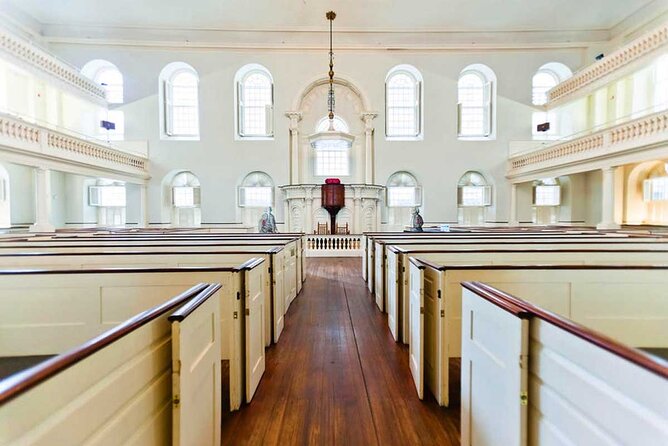
Boston’s Old State House and Old South Meeting House are not simply old buildings with glass cases inside. They are places where colonial Boston argued over power, law, taxes, religion, and loyalty to England.
The Old South Meeting House is tied to the public side of the story. The Old State House is tied to the official side. One was a vast meeting place for colonists, and the other was the center of royal government in Massachusetts Bay. Seeing both gives you a clearer sense of the conflict than visiting either one alone.
You can finish the visit in about 30 minutes if you move quickly through the displays. Give yourself closer to one or two hours if you want to read the exhibits, examine the artifacts, and take part in a talk or walking tour. The museums are close enough to combine with other Freedom Trail stops without making a special trip across town.
More museums and galleries in Boston:
- Boston Tea Party Ships and Museum Admission
★ 4.5 · 2,512 reviews - Boston: Boston Tea Party Ships and Museum Interactive Tour
★ 4.8 · 1,926 reviews - Plimoth Patuxet Museums
★ 4.5 · 463 reviews
Old South Meeting House: where Boston gathered to argue

Built in 1729, the Old South Meeting House was the largest building in colonial Boston. Its size mattered. This was not a small room for a private discussion. It could hold large public meetings, giving Boston residents a place to hear arguments and decide how to respond to events unfolding around them.
The building is especially important because meetings here helped lead to the Boston Tea Party. The connection is not just a broad link to the Revolution. The Old South Meeting House was part of the chain of public debate that shaped the decision to resist British authority.
Inside, pay attention to the scale of the meeting space and the parishioner boxes. These enclosed seating areas help you picture the building as an active church as well as a political forum. The architecture gives you a useful reminder that religious, civic, and political life were closely connected in colonial Boston.
The exhibits and displays explain the building’s place in the movement toward independence. I would start here if the Boston Tea Party is your main interest, since the meeting house helps explain the public pressure behind that event rather than presenting it as a sudden act of rebellion.
You can explore the Old South Meeting House in roughly 30 minutes, but that is only enough for a quick look. If you enjoy reading historical panels or want to join a talk or walking tour, allow more time.
The building is accessible, which makes it the easier of the two sites for visitors who need an accessible setting. Service animals are allowed, and the museum is near public transportation.
Old State House: royal power in the middle of Boston
Constructed in 1713, the Old State House was the center of royal government in the Massachusetts Bay colony. Its importance comes from the tension between what happened inside and what happened outside. Inside, government officials represented British authority. Outside, Boston’s residents increasingly challenged that authority.
The building is closely tied to the Boston Massacre, one of the events that pushed colonial anger toward open resistance. Displays and artifacts connect the site to the political events that led toward the American Revolution.
This stop works best after the Old South Meeting House. At the meeting house, you see how people gathered to debate and organize. At the Old State House, you see the government they were confronting. The short walk between the two buildings becomes part of the lesson.
The museum contains artifacts linked to the years before the Revolution. You can take photos of historical objects where permitted, and the displays provide visual material that helps bring the period into focus. The exhibits are designed for self-guided visits, so you do not have to keep pace with a group.
Allow about an hour here if you want to read carefully. You can spend less time, but a rushed visit may leave you with only a general impression of the building. The Old State House is currently not accessible, an important point to consider before booking. Plans are underway to make the building fully accessible in the future, but that work does not change the current limitation.
Why the self-guided format works here
This is not primarily a guided tour with a named guide leading you from room to room. The core experience is self-guided, supported by museum displays and historical material. That gives you freedom, but it also means you should take responsibility for setting your own pace.
I like this format for a pair of sites so close together. You can spend extra time on the Boston Tea Party story at the Old South Meeting House, then move on when you are ready. At the Old State House, you can slow down for the Boston Massacre displays and artifacts without worrying about holding up a group.
Talks and walking tours are also available, along with educational offerings and public programs. The supplied details do not give fixed schedules or names for guides, so check the current program information when planning if a guided element matters to you.
A previous Boston history tour can help place the museums in context, but it is not required. If you already know the basic story of the Boston Tea Party, the Stamp Act, and the Boston Massacre, you may get more from the small details and physical setting. If the period is new to you, allow extra time to read and connect the events.
Same city, a very different afternoon:
- History and Hauntings of Salem Guided Walking Tour
★ 5.0 · 14,564 reviews - Boston Duck Boat Sightseeing City Tour with Cruise Along Charles River
★ 4.5 · 9,378 reviews - Boston: Freedom Trail History Small Group Walking Tour
★ 5.0 · 6,450 reviews - Boston Hop-On Hop-Off Trolley Tour with 13 Stops
★ 4.5 · 5,576 reviews
A compact stop on the Freedom Trail
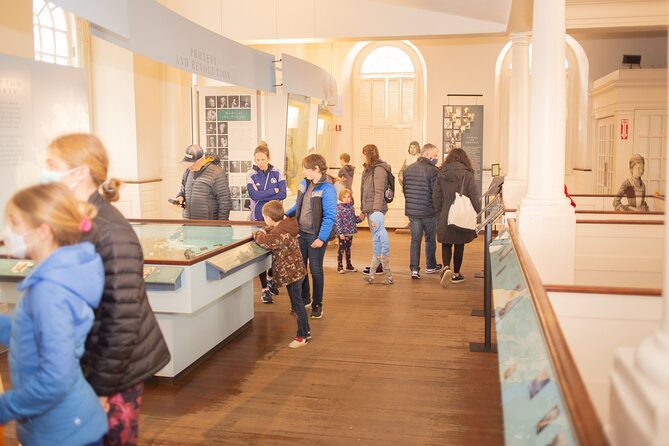
The Old South Meeting House and Old State House are only two blocks apart, right in the heart of downtown Boston. That makes them easy to add to a day of sightseeing, especially if you are already walking the Freedom Trail.
The location also helps you build a flexible schedule. You can visit one museum, walk to the other, and then continue through central Boston. You do not need to set aside a full day for these two buildings alone, although history fans may want up to two hours between them.
The short distance is useful for families and for anyone trying to reduce unnecessary walking. It also gives you a quick change of setting: from a large colonial meeting house to the former center of royal government.
The museums are near public transportation, so you can reach the area without relying only on a car. The information provided does not identify a dedicated parking arrangement, so public transportation or walking is the safer plan for a central Boston visit.
What the $15 price gives you
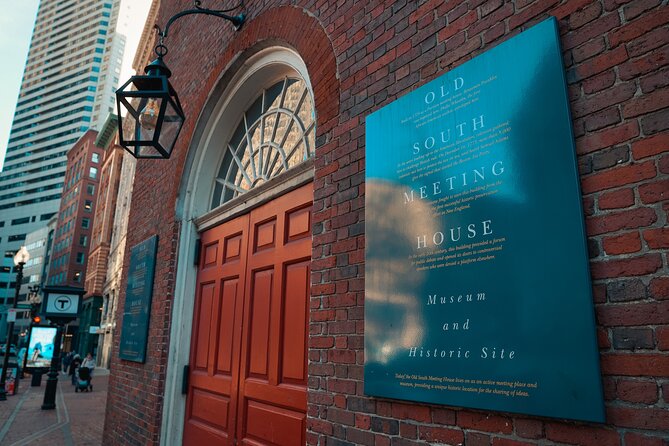
At $15 per person, this is a reasonably priced way to visit two significant Boston historic sites in one outing. The value comes from the connection between the buildings. You are not paying for two unrelated museums. You are following one developing story from public discussion to government conflict.
The price makes particular sense if you want more than an exterior photograph. The buildings themselves are meaningful, but the exhibits, artifacts, and explanatory material help show why they mattered. You also have the chance to join talks, walking tours, educational offerings, or public programs when scheduled.
The cost is less compelling if you plan only a very quick stop and do not intend to read the exhibits. In that case, you may see the interiors without getting the full value of the historical material. If you are already planning several Freedom Trail sites, however, these museums add useful depth without taking up most of your day.
The ticket is mobile, which is convenient when you are moving between downtown stops. Confirmation is provided at booking, and the experience is booked an average of 32 days ahead. That does not mean you must reserve exactly that far in advance, but it suggests that planning ahead is sensible during busy periods.
How long should you plan?
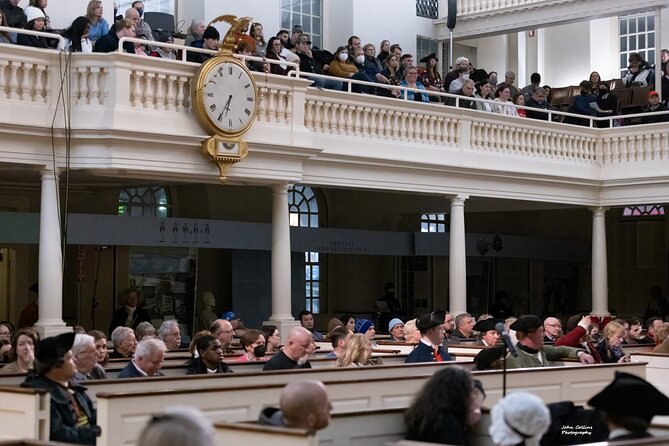
The stated visit range is about 30 minutes to two hours. Treat that as a guide rather than a strict schedule.
Plan around 30 minutes if you want a fast look at one or both buildings. This may suit you if you are following the Freedom Trail on a packed day and mainly want to see the interiors.
Plan about one hour if you want to visit the Old State House at a comfortable pace or spend time at the Old South Meeting House. This is enough for a useful visit, though you may need to skip some displays.
Plan closer to two hours if you want to see both museums properly, read the historical material, photograph artifacts where allowed, and allow time for a talk or walking tour. That longer visit is best for history lovers and for families who want to discuss the events rather than simply move through the buildings.
The museums are open daily from 10:00 a.m. to 5:00 p.m. for the stated period from January 1 through June 30, 2026. Since the two sites are nearby, you can begin at either one, though I would start at the Old South Meeting House for the strongest narrative flow.
Who will enjoy this visit most?

This experience is a good fit for history lovers who want to understand the chain of events leading to the American Revolution. It also suits anyone walking Boston’s Freedom Trail and looking for indoor stops with clear historical purpose.
Families can use the two museums to compare the people who challenged British rule with the officials who represented it. The displays and visual material give younger visitors something to look at, while the buildings provide a setting for simple questions: Who had power? Who could gather? What happened when public anger met government force?
The self-guided structure works well for mixed-interest groups. One person can read every panel while another makes a quicker circuit. Talks and public programs may add more structure if you prefer a guided experience.
You should think twice if accessibility at both sites is essential. The Old South Meeting House is accessible, but the Old State House is not currently accessible. That limitation is the clearest reason some visitors may choose to see only the Old South Meeting House or confirm current arrangements before booking.
Practical planning details
The experience includes a mobile ticket, and confirmation arrives at the time of booking. Service animals are allowed, and most people can participate.
The listed operating hours are 10:00 a.m. to 5:00 p.m., Monday through Sunday, from January 1 through June 30, 2026. Leave enough time before closing to visit both buildings rather than arriving late and trying to hurry through.
Free cancellation is available if you cancel at least 24 hours before the start time. Cancellations made within 24 hours are not refunded, and changes during that period are not accepted. The cut-off uses Boston local time.
I would pair these museums with other central Boston sights rather than treating them as a stand-alone excursion. Their location makes that easy, and the two-block walk between them keeps the plan simple.
Should you book the Old State House and Old South Meeting House?
Book this experience if you want a focused, affordable look at the arguments and conflicts that led to the American Revolution. The strongest reason to go is the pairing: the Old South Meeting House shows where public resistance gathered force, while the Old State House shows the authority that resistance challenged.
The visit is especially worthwhile for Freedom Trail walkers, first-time Boston visitors, families, and anyone interested in the Boston Tea Party or Boston Massacre. The self-guided format gives you control over the pace, and optional talks or tours can add structure.
Skip it, or confirm accessibility details first, if you need every site to be accessible. Also allow more than a quick photo stop if you want the $15 price to feel worthwhile. With about one to two hours, you can turn these two historic buildings into a clear, memorable lesson in how a city moved from debate to defiance.
FAQ
How much does admission cost?
The listed price is $15 per person.
How long does the experience take?
The visit can take about 30 minutes to two hours, depending on how carefully you explore the exhibits and whether you join a talk or walking tour.
What are the opening hours?
The museums are open daily from 10:00 a.m. to 5:00 p.m. for the stated period from January 1 through June 30, 2026.
Are the two museums close together?
Yes. The Old South Meeting House and Old State House are about two blocks apart in central Boston.
Is the experience guided?
The main visit is self-guided. Talks, walking tours, educational offerings, and public programs are also available.
Are the buildings accessible?
The Old South Meeting House is accessible. The Old State House is not currently accessible. Service animals are allowed.
Can I cancel for a refund?
Yes. You can cancel at least 24 hours before the experience start time for a full refund. Cancellations within 24 hours are not refunded.
Just added around Boston
- Day Trip from Boston: Explore Hammond Castle Museum★ 3.7 · 3 reviews
- Boston: WNDR Museum Entry Ticket★ 3.7 · 3 reviews
- The Boston Bash Scavenger Hunt★ 4.5 · 3 reviews
- Self-Guided Audio Tour of Boston North End★ 4.5 · 3 reviews
- Boston: Official Freedom Trail® Lantern Tour★ 4.7 · 3 reviews
- Boston: North End Walking Tour with Private Harbor Cruise★ 5.0 · 3 reviews
- Self Guided “The North End Pizza, Cannoli and Picnic” Solo Walking Tour★ 5.0 · 3 reviews
- Cambridge: Haunted Charles River Cruise★ 4.3 · 3 reviews
Museums, compared.


Boston Tea Party Ships and Museum Interactive Tour
Read our review →


Real Pirates Salem Museum General Admission Ticket
Read our review →
Museum of Fine Arts Boston General Admission Ticket
Read our review →
Pirate Museum with Authentic Treasures Entry Ticket
Read our review →
Lexington & Concord 250th Birthday Tour with Concord Museum Entry
Read our review →Browse the lists this tour appears in