
Reviewed · MUSEUMS
Boston Tea Party Ships and Museum Admission
The most memorable part of this Boston attraction is not looking at a display case. It is stepping onto a replica ship, joining the Sons and Daughters of Liberty, and throwing tea into Boston Harbor. The actors carry the story from the taxes of 1765 to the protest of December 16, 1773, then forward to the fighting at Lexington and Concord.
I like the live historical characters, who turn a familiar schoolbook event into a story with faces, jokes, and audience participation. I also like the Robinson Half Chest, one of only two known surviving tea chests from that night. The main drawback is that the experience is short, lasts about an hour, and some of it takes place outdoors and on stairs, so dress for the weather and plan around the pace.
In This Review
- Key points to know before you go
- Why the Boston Tea Party is more than a tea toss
- Meeting the Sons and Daughters of Liberty
- Boarding the Eleanor and Beaver
- Seeing the Robinson Half Chest
- From Paul Revere to the Shot Heard ’Round the World
- Abigail’s Tea Room and the finish
- Is $35 a fair price?
- Who will enjoy this most?
- Timing, check-in, and practical planning
- How it fits into a Boston day
- My verdict: book it for the experience, not just the museum
- FAQ
- How long does the Boston Tea Party Ships and Museum experience last?
- What is included in admission?
- Where does the tour begin and end?
- Do I need to arrive early?
- Is the museum wheelchair and stroller accessible?
- Can I cancel for a refund?
Key points to know before you go
- You throw tea from a replica ship: The hands-on moment gives children and adults a clear sense of the protest.
- The Eleanor and Beaver are restored replicas: You walk aboard both ships as part of the guided story.
- The Robinson Half Chest is genuinely rare: It is one of only two known surviving chests connected with the Boston Tea Party.
- The story reaches beyond the harbor: Multimedia scenes cover Paul Revere’s ride and the opening fighting of the Revolution.
- The actors are the main draw: Guides use period clothing, humor, role-play, and direct questions to keep the group involved.
- The $35 price buys an active hour: It is good value for families and history fans, but may feel high if you prefer quiet museum galleries.
Why the Boston Tea Party is more than a tea toss
The Boston Tea Party Ships and Museum works best when you treat it as a short live theater production with museum pieces and ships built into the set. You are not simply reading about an angry crowd. You are placed inside a sequence of events that shows how a tax dispute grew into open war.
The story begins before the harbor protest. The presentation covers the tensions that grew from 1765 onward, when British taxes and control angered many colonists. By the time you reach December 1773, the tea itself has become a symbol of who had the right to make laws and collect money.
That context matters. Without it, tossing tea can seem like a charming stunt. With it, the act becomes a public protest against a government many colonists still considered their own. The museum keeps the lesson accessible, but it does not stop at the most famous moment.
The experience is especially useful if your knowledge of the American Revolution begins and ends with Paul Revere and a picture of wooden crates in the harbor. You get a clearer link between protest, punishment, resistance, and the first shots of the war.
More museums and galleries in Boston:
- Boston: Boston Tea Party Ships and Museum Interactive Tour
★ 4.8 · 1,926 reviews - Plimoth Patuxet Museums
★ 4.5 · 463 reviews - Salem Witch Museum Admission Ticket
★ 3.9 · 417 reviews
Meeting the Sons and Daughters of Liberty
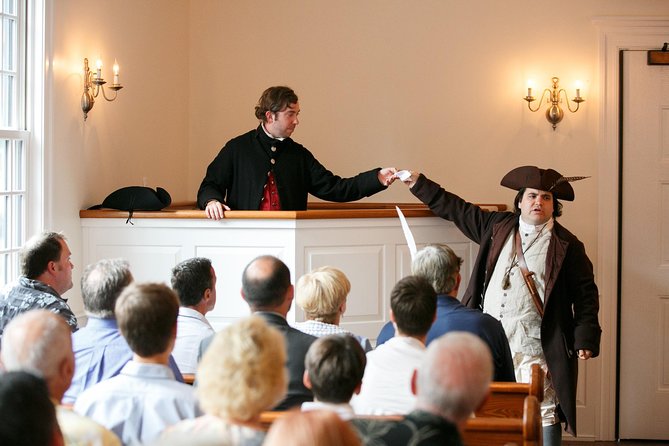
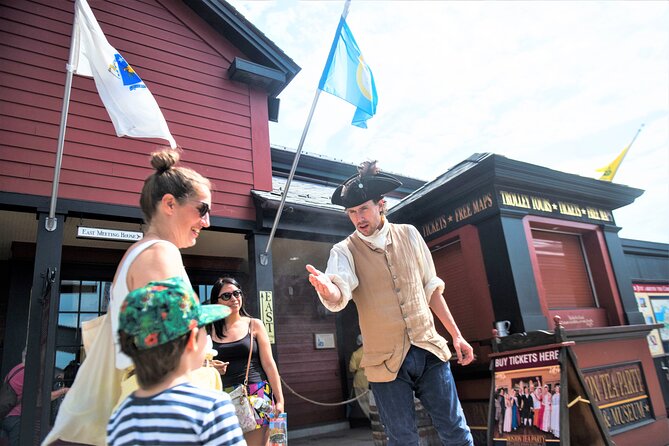
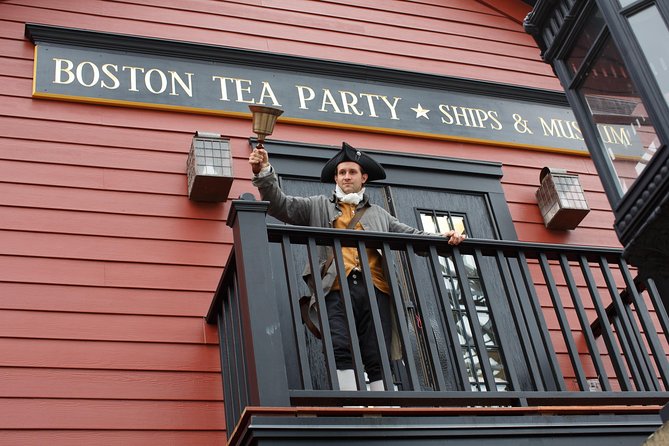
At the start, you join a guided group at 306 Congress Street. The live performers set the mood by taking on the roles of people connected with Boston in 1773. Names and roles can vary, but the cast includes characters such as Sam Adams and Peter, a rope maker’s apprentice.
The period clothing and role-play make the opening feel less like a standard museum welcome. Peter, for example, asks people where they come from and folds their answers into the performance. The humor is broad and playful. That helps children pay attention, though visitors seeking a quiet, scholarly tour may find the style a little theatrical.
The best performers stay in character while still answering questions and helping with photographs. Guides such as Oliver and Steve have been singled out for their energy and clear storytelling, and the cast generally carries the experience with confidence.
You should expect some audience participation. You may be asked to play a small role, respond to a question, or join the crowd’s growing anger. You do not need acting skills, and the staff works to keep participation light rather than embarrassing.
This format is one reason the attraction suits families. A child who might lose interest in a glass case has a reason to watch the next scene. Adults get the historical framework, while younger visitors get a clear job to do.
Boarding the Eleanor and Beaver
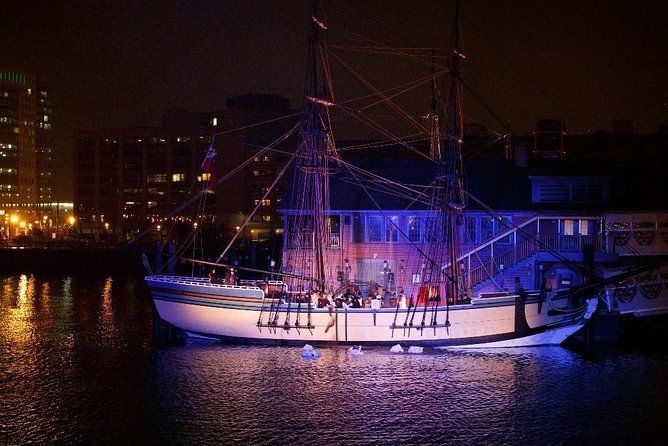
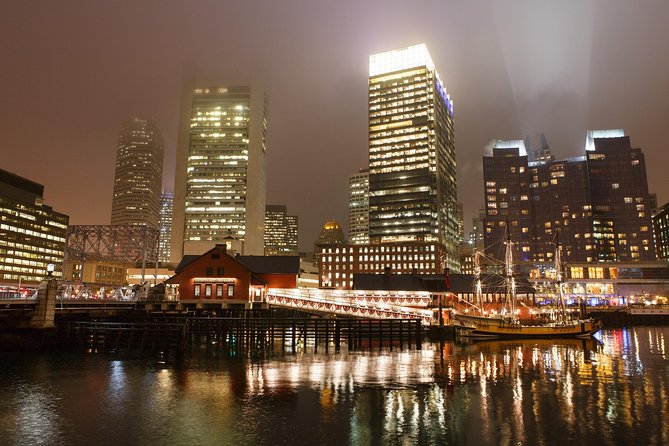
The central part of the visit takes place aboard the Eleanor and Beaver, two authentically restored replica tea ships. They recreate the setting in which tea was stored and handled before the famous protest.
You move through the ships with the guide rather than exploring them at your own pace. That is useful because the staff connects each physical space to the people and choices involved in the event. The ships give scale to the story too. A tea chest was not a tiny wooden box carried under one arm. It was cargo, packed for a long sea journey and tied to a major commercial system.
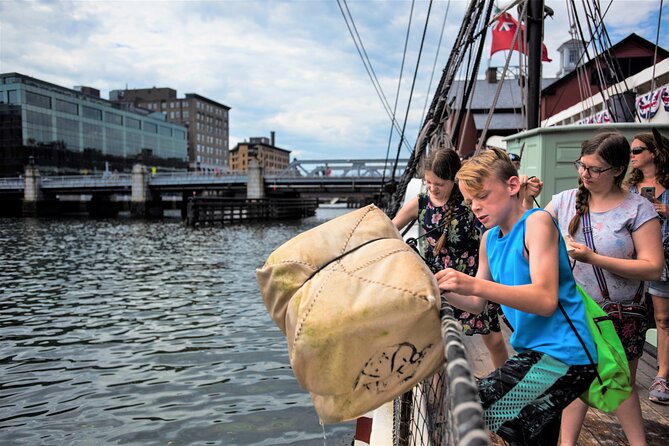
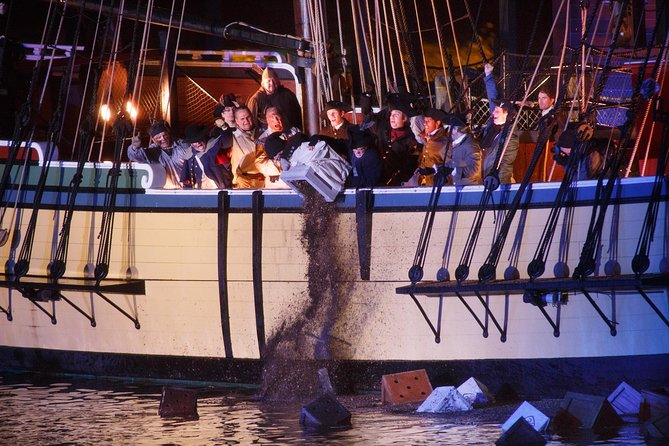
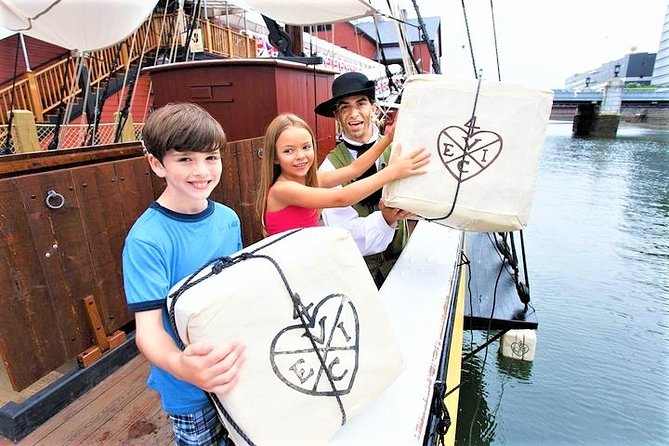
The most active moment comes when you toss tea into the water. It is a simple action, but it gives the event a physical punch. You hear the command, handle the tea, and take part in the same symbolic act that the performance has been building toward.
Families tend to get the most from this section. Children can remember throwing the tea long after they forget dates. Adults may appreciate that the action is framed as protest rather than harmless destruction.
There are practical limits. Ships have stairs, and one part of the visit is outside. The attraction states that it is wheelchair and stroller accessible, and service animals are allowed, but a separate experience note warns about lots of stairs. If you have limited mobility, ask the museum about the route and access arrangements before booking. The stated accessibility does not mean every surface feels effortless.
Seeing the Robinson Half Chest
Inside the museum, you see the Robinson Half Chest, one of only two known surviving tea chests dumped into Boston Harbor on that night. This is the quiet object at the center of a loud experience.
Do not expect a huge trunk. The surviving chest is a half-chest, roughly 10 inches high, 13 inches wide, and 12 inches deep. Its small size can surprise you, especially after hearing how much tea the full chests could hold.
Full tea chests were sturdy wooden containers made for sea travel. Some held 75 pounds of tea, while larger examples could hold more than 300 pounds. The exact size varied, but the key point is clear: the Robinson Chest is a partial-sized container, not a full cargo chest.
That detail makes the display more interesting, not less. The chest is a rare physical connection to a night usually known through paintings, speeches, and later retellings. You can look closely at an object that was actually present during the protest.
The museum combines this artifact with traditional exhibits and guided explanation. The result is stronger than either part alone. The actors supply the human story, and the chest gives you a real object to anchor it.
Same city, a very different afternoon:
- History and Hauntings of Salem Guided Walking Tour
★ 5.0 · 14,564 reviews - Boston Duck Boat Sightseeing City Tour with Cruise Along Charles River
★ 4.5 · 9,378 reviews - Boston: Freedom Trail History Small Group Walking Tour
★ 5.0 · 6,450 reviews - Boston Hop-On Hop-Off Trolley Tour with 13 Stops
★ 4.5 · 5,576 reviews
From Paul Revere to the Shot Heard ’Round the World
The museum does not end when the tea hits the harbor. A multimedia film called Let It Begin Here carries the story forward through Paul Revere’s midnight ride and the battle where the Shot Heard ’Round the World was fired.
The presentation also helps correct a common shortcut in American history. Paul Revere did not likely ride through the countryside shouting that the British were coming. Colonists still regarded themselves as British, and Revere is more likely to have warned that the Regulars were coming out.
That wording makes sense in context. His work depended on secrecy and clear identification of the approaching soldiers. The story also gives space to William Dawes and Samuel Prescott, riders who helped spread the warning but receive less attention in popular retellings.
This section is valuable because it shows the chain reaction. The tea protest took place on December 16, 1773. The fighting at Lexington and Concord followed on April 19, 1775. Those dates are close enough to show how quickly a political dispute hardened into war.
The multimedia element adds variety after the live scenes and ship visits. It can also feel a little dated to adults who prefer modern museum technology. Still, the mix of film, actors, sets, and physical participation keeps the hour moving.
Abigail’s Tea Room and the finish
The tour ends with a stop at Abigail’s Tea Room. Tea time gives the experience a gentler finish after the rebellion, ships, and harbor spectacle. You might choose tea and a scone, though food and drinks are not included in the admission price.
This final stop is optional in spirit, but it is a pleasant place to pause before moving on. The gift shop is another useful ending point, with historical souvenirs and Boston-themed items. If you are traveling with children, this can be a good moment to let them browse while you take stock of the story.
Do not confuse the tea room with a full meal stop. It is a small add-on to the museum visit, not a replacement for lunch. The attraction itself lasts about an hour, so you can fit it between other stops in the Congress Street area.
Is $35 a fair price?
Admission costs $35 per person. That is not bargain-basement pricing for an hour, but the ticket includes the live narrated tour, access to the ships, the museum displays, the tea toss, the Robinson Chest, and the multimedia presentation.
I think the price works best for families and visitors who want an experience rather than a quiet collection of objects. You receive a guided performance, several historical settings, and an activity that everyone in the group can remember. The actors are doing more than reciting dates, and the attraction makes a complicated period easy to follow.
The value is less certain for a serious museum specialist who wants hours of detailed reading and independent study. The tour is designed to move a group through a set route in about an hour. It gives you a strong introduction, but it will not replace a larger American Revolution collection or a full afternoon at a traditional museum.
The high booking demand also matters. The experience is often reserved about 26 days ahead, so you should not assume you can walk up at the last moment during a busy Boston visit. Online admission includes skip-the-line access, which can save time when your schedule is tight.
Who will enjoy this most?
I would recommend the museum most strongly to families with school-age children, first-time Boston visitors, and anyone who wants the Revolution explained without a long lecture. The actors make the story easy to follow, and the tea toss gives the visit a clear payoff.
History fans will enjoy the extra details about the Robinson Chest, the other midnight riders, and the wording of Revere’s warning. The attraction also works well for adults who do not consider themselves history specialists. You receive enough background to understand the stakes, but the tone stays lively.
The experience may be less satisfying if you dislike audience participation, period acting, or scripted humor. One part of the production can feel touristy or somewhat disjointed, especially if you expect a formal museum tour. The attraction is intentionally theatrical, and that style will either make the past easier to grasp or feel too light for your taste.
It is also not ideal for visitors who need a completely indoor, step-free experience unless access is confirmed in advance. Some of the route is outdoors, and one account specifically warns about stairs. Bring suitable clothing in cold or wet weather.
Timing, check-in, and practical planning
Arrive at least 15 minutes before your scheduled time. Anyone who has not checked in within that window may be treated as a no-show, and the museum can reassign the seats. That rule is worth taking seriously because the tour runs on scheduled groups.
The museum is closed on Thanksgiving and Christmas Day. It is also subject to closure for private events. A scheduled maintenance closure runs from January 27 through February 5, so check the date before you build the attraction into a winter itinerary.
The experience is offered in English. Most people can participate, and service animals are permitted. Wheelchair and stroller access is stated, but the presence of stairs means you should contact the museum ahead of time if your group has specific mobility needs.
Weather matters because part of the visit is outside. In poor weather, the activity may be canceled, with a different date or a full refund offered. For your own comfort, dress for the conditions even when rain is not in the forecast.
Free cancellation is available up to 24 hours before the start time. Cancel inside that window and you will not receive a refund, and changes are not accepted. Confirmation arrives within 48 hours of booking, subject to availability.
How it fits into a Boston day
The museum is at 306 Congress Street, so it is easy to treat as one stop in a day focused on Boston’s Revolutionary story. Since the visit lasts about an hour and ends back at the meeting point, you do not need to surrender an entire morning or afternoon.
I would schedule it early in your Boston sightseeing if you want the historical background before visiting other sites connected with the Revolution. You can also place it later in the day when children need something active and structured.
Allow extra time if you want tea, a scone, or a look through the gift shop. Those extras are not part of the one-hour guided duration, and the tea room can be a nice place to slow down after the performance.
My verdict: book it for the experience, not just the museum
You should book the Boston Tea Party Ships and Museum if you want history with movement, humor, actors, and a small role for yourself. The tea toss is memorable, the replica ships make the event easier to picture, and the Robinson Half Chest adds a real link to December 1773.
At $35, I see it as a fair purchase for families and first-time visitors, especially if you value a guided hour that holds everyone’s attention. I would be more cautious if you want a quiet, deep museum visit or dislike scripted participation.
Book ahead, arrive 15 minutes early, and dress for outdoor conditions. If those points suit your plans, this is a lively way to understand how a shipment of tea helped push Boston from protest toward revolution.
FAQ
How long does the Boston Tea Party Ships and Museum experience last?
The guided experience lasts approximately one hour. You may want extra time for Abigail’s Tea Room and the gift shop.
What is included in admission?
Admission includes the live narrated guided tour, access to the museum and replica tea ships, the interactive tea toss, the multimedia film, and the exhibits featuring the Robinson Half Chest.
Where does the tour begin and end?
The experience begins at 306 Congress Street, Boston, Massachusetts. It ends back at the same meeting point.
Do I need to arrive early?
Yes. All visitors must check in on-site 15 minutes before the scheduled tour time. People who miss that check-in window may be treated as no-shows, and their seats may be reassigned.
Is the museum wheelchair and stroller accessible?
The experience is listed as wheelchair and stroller accessible, and service animals are allowed. However, part of the visit includes stairs and some outdoor areas, so contact the museum ahead of time if you have specific access needs.
Can I cancel for a refund?
You can cancel at least 24 hours before the start time for a full refund. Cancellations or changes made less than 24 hours before the experience are not accepted for a refund. If poor weather causes the museum to cancel, you will be offered another date or a full refund.
Just added around Boston
- Day Trip from Boston: Explore Hammond Castle Museum★ 3.7 · 3 reviews
- Boston: WNDR Museum Entry Ticket★ 3.7 · 3 reviews
- The Boston Bash Scavenger Hunt★ 4.5 · 3 reviews
- Self-Guided Audio Tour of Boston North End★ 4.5 · 3 reviews
- Boston: Official Freedom Trail® Lantern Tour★ 4.7 · 3 reviews
- Boston: North End Walking Tour with Private Harbor Cruise★ 5.0 · 3 reviews
- Self Guided “The North End Pizza, Cannoli and Picnic” Solo Walking Tour★ 5.0 · 3 reviews
- Cambridge: Haunted Charles River Cruise★ 4.3 · 3 reviews
Museums, compared.

Boston Tea Party Ships and Museum Interactive Tour
Read our review →
Real Pirates Salem Museum General Admission Ticket
Read our review →
Museum of Fine Arts Boston General Admission Ticket
Read our review →
Pirate Museum with Authentic Treasures Entry Ticket
Read our review →
Lexington & Concord 250th Birthday Tour with Concord Museum Entry
Read our review →
Real Pirates Salem Museum with Guided Directors Tour
Read our review →Browse the lists this tour appears in