

Reviewed · MUSEUMS
Boston: Boston Tea Party Ships and Museum Interactive Tour
The most memorable part of this Boston attraction is not simply hearing about the Tea Party. You are handed a colonist’s role, march toward Griffin’s Wharf, and toss a covered crate into the harbor from a replica ship. Live actors stay in character, turning a familiar schoolbook story into a small piece of theater.
I especially like the way the tour combines participation and solid historical explanation. The replica vessels give you a feel for the event’s setting, while the holograms and wraparound film add context without relying on a long row of display cases. The main drawback is time: one hour moves quickly, and a large group may leave you wishing for longer with the museum artifacts.
In This Review
- Key points to know before you go
- Why the Boston Tea Party still matters
- Your first role begins in the meeting house
- Marching toward Griffin’s Wharf
- Throwing tea from the replica ships
- Holograms, artifacts, and the secret room
- The wraparound theater brings the conflict forward
- How the $35 ticket measures up
- Who will enjoy it most
- Should you book the Boston Tea Party Ships and Museum?
- FAQ
- Where does the Boston Tea Party Ships and Museum tour begin?
- How long does the tour last?
- Is the tour conducted in English?
- Do I really throw tea into Boston Harbor?
- Is food or drink included with admission?
- Is the attraction wheelchair accessible?
Key points to know before you go
- You receive a role at the start: A handbill and character assignment help you take part instead of simply watching.
- You throw a covered tea crate overboard: The activity uses a crate representing how tea was packed, not a loose bag of tea.
- Actors carry the story: Guides such as Mrs. Grant, Ebenezer McIntosh, and Chase have been praised for staying in character and involving the audience.
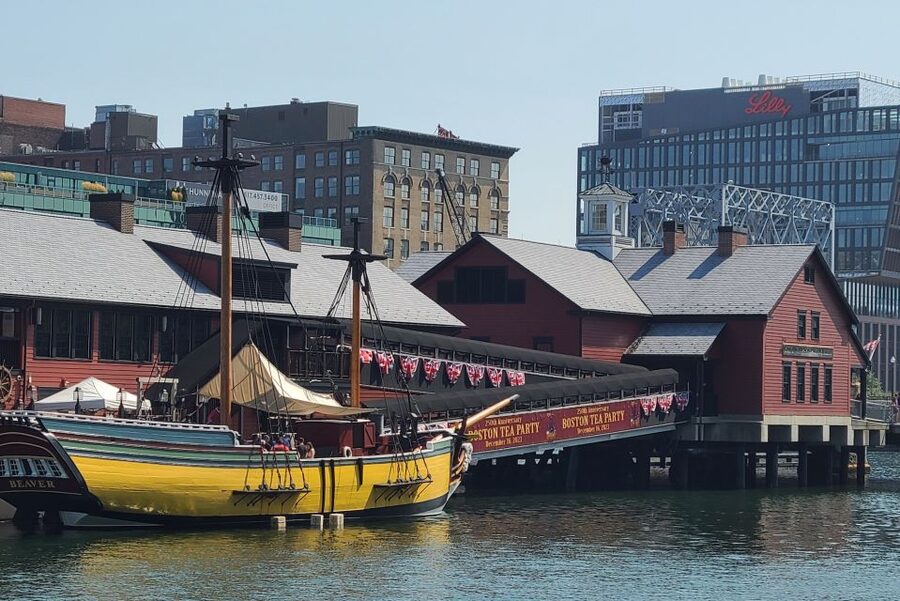
- Two replica ships anchor the experience: You can explore carefully recreated versions of the vessels linked to the 1773 protest.
- Technology fills in the wider story: Three-dimensional holographic characters, visual displays, and a wraparound theater explain the road to war.
- The tour is English-language and not wheelchair accessible: Printed museum guides are available in 14 foreign languages.
Why the Boston Tea Party still matters
The Boston Tea Party was not an isolated act of mischief. It grew from resistance in British America, where colonists objected to British taxation and the political power behind it. The protest on December 16, 1773, became one of the most recognizable steps toward the American Revolution.
This attraction focuses on that chain of events rather than treating the tea toss as a funny footnote. You hear about the people involved, the anger in Boston, and the choices facing colonists who had to decide how far to push back. That background gives the later ship activity more weight.
I appreciate that the tour makes room for different forms of learning. A live performer can explain the mood of a meeting, a hologram can stage an argument, and a film can show the conflict on a much larger scale. If you already know the basic story, these changes in format help keep the hour moving.
More museums and galleries in Boston:
- Boston Tea Party Ships and Museum Admission
★ 4.5 · 2,512 reviews - Plimoth Patuxet Museums
★ 4.5 · 463 reviews - Salem Witch Museum Admission Ticket
★ 3.9 · 417 reviews
Your first role begins in the meeting house
The tour starts at the Boston Tea Party Ships and Museum on the Congress Street Bridge. Present your timed ticket when you arrive, then join the group for the opening portion of the experience.
Inside the meeting house, a costumed character sets the scene for the night of December 16, 1773. You receive a handbill and learn what part you will play. The exact role varies, but the point is to give you a personal reason to pay attention to the events unfolding around you.
You also receive a mohawk disguise before the march to Griffin’s Wharf. This is a playful theatrical touch, especially for children, but it also connects to the way participants in the historical protest tried to conceal their identities. You are not asked to memorize a complicated script. The guides lead you through the action and invite the group to respond.
The acting is a major part of the attraction’s success. Several guides have been singled out for their commitment to character, including Mrs. Grant, Ebenezer McIntosh, and a performer playing Chase. You may get a guide with a different name on your visit, but you can expect the presentation to depend on live performance rather than a recorded audio tour.
That approach works best if you are willing to join in. You may be asked to react, follow instructions, or take part in the crowd’s mood. If you prefer to quietly read at your own pace, the format may feel a little forceful. Most people looking for a family activity will find the energy useful rather than tiring.
Marching toward Griffin’s Wharf

The group then moves toward Griffin’s Wharf, the setting associated with the destruction of the tea. This transition gives the tour a useful sense of progression. You begin with the political argument, move into the public meeting, and then reach the moment when protest becomes direct action.
The guides explain what happened that night while keeping the period setting alive. Their humor and old-fashioned speech help distinguish the experience from a standard museum talk. At its best, the performance lets you sense the uncertainty of the moment. The protest was bold, organized, and theatrical, but it also carried serious consequences.
The handbill and character assignment matter here. They give you something to do with the information. Instead of only hearing that colonists gathered and resisted, you take part in a simplified version of the gathering and march.
Large groups can affect this section. The tour is designed to work with a crowd, and the staging is well organized, but your personal interaction may be brief if many people are present. Arriving for a time that suits your schedule is helpful, especially on weekends when tickets can sell out.
Throwing tea from the replica ships
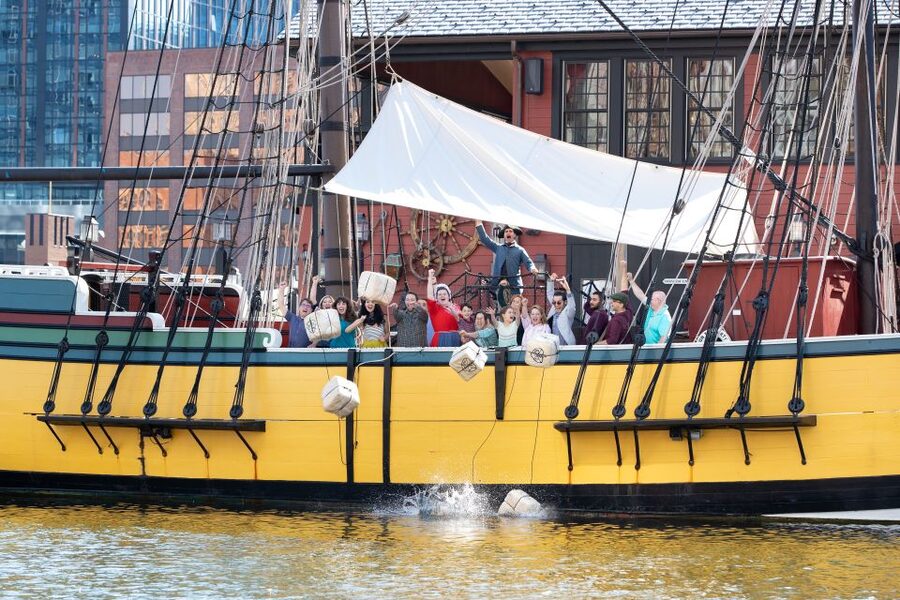
The centerpiece arrives when you board and explore a faithful replica of one of the tea party ships. The attraction includes replicas of two of the original vessels, giving you a chance to see the kind of setting in which the protest took place.
The famous tea toss is more practical than the wording may suggest. You do not throw a handful of loose tea into the harbor. You heave a covered milk crate representing the way the tea would have been packed. That detail makes the activity feel more grounded, and it is worth knowing in advance so you arrive with the right expectation.
For families, this is often the moment that turns a history lesson into a story children remember. You get a simple physical task, a clear historical purpose, and the theatrical pleasure of joining the crowd. Adults may find it amusing too, particularly because the act is presented with a sense of ceremony and group spirit.
The attraction does not ask you to handle anything valuable or fragile. The crate is a prop, and the experience is designed for participation. Still, listen carefully to the crew and follow directions around the ship.
The replica ships are worth more than a quick photo. They help you understand the scale and working environment of the event. Displays and explanations connect the vessels to the protest, while the performers explain the action as it unfolds. I would pay attention to the ship portion even if you are mainly interested in the museum because it gives the story a physical setting.
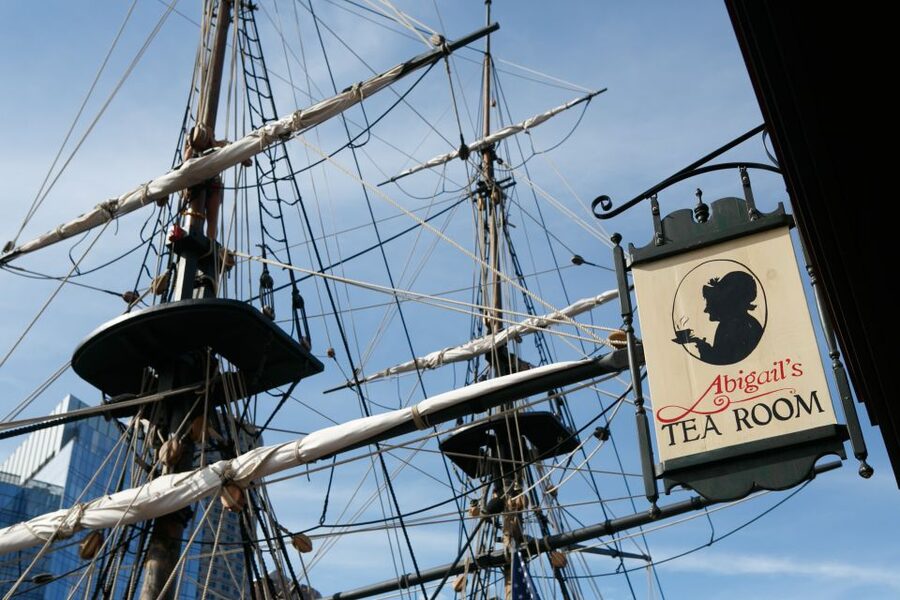
Some visitors also choose to try the types of tea connected with the event at Abigail’s Tea Room for an additional cost. Food and beverages are not included in the $35 admission, so treat this as an optional extra rather than part of the ticket.
Same city, a very different afternoon:
- History and Hauntings of Salem Guided Walking Tour
★ 5.0 · 14,564 reviews - Boston Duck Boat Sightseeing City Tour with Cruise Along Charles River
★ 4.5 · 9,378 reviews - Boston: Freedom Trail History Small Group Walking Tour
★ 5.0 · 6,450 reviews - Boston Hop-On Hop-Off Trolley Tour with 13 Stops
★ 4.5 · 5,576 reviews
Holograms, artifacts, and the secret room

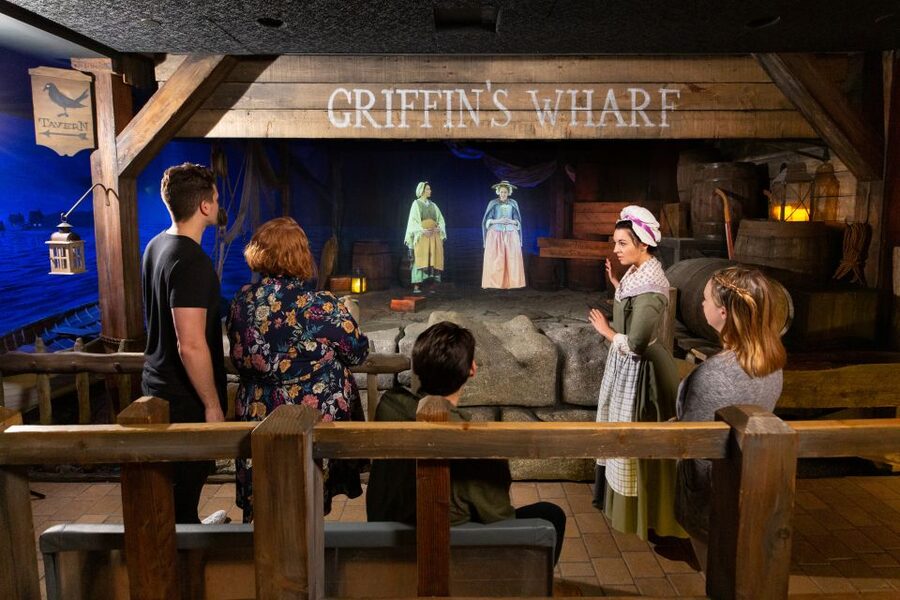
After the ship portion, you enter the museum area. Here, the attraction shifts from live theater to visual storytelling. Three-dimensional holographic characters appear and speak before you, staging arguments between British soldiers and colonial patriots.
This section helps explain that the Tea Party was part of a much wider dispute. You see opposing positions rather than one simple story of heroes and villains. The holograms are especially useful for younger visitors who may find conventional text panels hard to follow.
The museum also contains artifacts and information displays. One particularly interesting feature is a tea crate, which helps explain what was actually thrown overboard. You may want to set aside time to look closely at the objects, but the guided structure can limit how long you have in each area.
That is the attraction’s clearest compromise. The one-hour format keeps the group focused and prevents the experience from becoming exhausting, but it does not give you the freedom of a traditional museum visit. In a large group, you may move on before reading every label or examining every artifact in the secret room.
If artifacts are your main reason for visiting, plan your expectations carefully. This is first a guided theatrical tour, then a museum visit. You will receive historical information, but the pace is set by the group and the performance.
The wraparound theater brings the conflict forward
The final major presentation takes place in a giant wraparound theater. The film covers the battle and the wider story of the American Revolution, giving you a broader ending after the close focus on Boston Harbor.
This is a smart part of the sequence. Without it, the Tea Party could seem like the whole revolution rather than one event in a growing conflict. The film links the protest to what followed and gives you a clearer sense of how the dispute developed.
The visual scale also provides a change of pace. After standing in a meeting house and moving around the ships, you sit back and watch the story unfold around you. Some people are surprised to find a film included, since the main advertising emphasis is on the actors and ships. It is best thought of as the final chapter of the tour.
The presentation is educational but not dry. The attraction uses speeches, live action, technology, and film in a carefully timed hour. That variety is one reason the experience works for adults as well as children.
How the $35 ticket measures up

At $35 per person, this is not a quick stop for a single display. You are paying for a timed, guided production with actors, replica ships, museum access, holographic effects, and a wraparound theater.
I think the price makes sense if you want a structured introduction to Boston’s revolutionary story. The hour is packed, and you receive far more than a conventional exhibit visit. The personal role and tea toss also give the attraction a memory-making quality that is hard to reproduce with a standard walking route.
The value is less clear if you have very limited interest in staged activities. You may prefer walking Boston’s historic sites at your own pace, particularly if you want to spend a long time reading documents and examining objects. This attraction favors action, narration, and group participation over quiet study.
It fits well into a day that includes the Freedom Trail. The Freedom Trail gives you streets, churches, burial grounds, and other places tied to the city’s past. This museum provides a concentrated, theatrical account of one crucial episode. Together, they give you both the physical city and the performed story.
Book ahead if you are visiting on a weekend or during a busy period. Timed admission helps organize the experience, and popular start times can sell out. The ticket allows free cancellation up to 24 hours before the scheduled visit, and a reserve-now, pay-later option is available.
Who will enjoy it most

Families with school-age children are a natural match. The role cards, disguise, actors, ship visit, tea crate, and theater all offer something different. A ten-year-old may remember throwing the crate, while an older child may pay more attention to the political arguments and museum section.
First-time visitors to Boston can also get good value from the tour. It explains a major event without assuming that you already know every name or date. I would pair it with a Freedom Trail walk, since the two experiences approach the Revolution in different ways.
History students and adults who enjoy living-history programs should find plenty to appreciate. The performances stay focused on the event, and the presentation uses several teaching tools instead of one long speech.
You should think twice if you dislike audience participation or have mobility needs. The attraction is not suitable for wheelchair users, and the group format means you cannot control the pace. English is the tour language, though printed guides for the museum are available in 14 foreign languages upon request or for printing from the voucher.
Should you book the Boston Tea Party Ships and Museum?

I would book this tour if you want history presented with energy and a clear beginning, middle, and end. The actors are the heart of it, the replica ships give the story a physical setting, and the tea toss offers a simple but effective way to remember what happened.
Choose something else if your priority is a slow museum visit or a quiet examination of artifacts. You may not have enough time to explore every display, especially with a large group.
For most families, first-time Boston visitors, and anyone pairing it with the Freedom Trail, the $35 ticket is a fair buy. Arrive ready to take a role, follow the crowd, and give a hearty Huzzah when the moment calls for it.
FAQ
Where does the Boston Tea Party Ships and Museum tour begin?
The experience begins at the Boston Tea Party Ships and Museum on the Congress Street Bridge. Present your timed ticket when you arrive.
How long does the tour last?
The tour lasts one hour. Starting times vary, so check availability when choosing your visit.
Is the tour conducted in English?
Yes. The host or greeter and the tour experience are in English. Printed museum guides are available in 14 foreign languages upon request or for printing before arrival.
Do I really throw tea into Boston Harbor?
You throw a covered milk crate representing the tea crates used during the historical event. You do not throw loose tea bags into the water.
Is food or drink included with admission?
No. Food and beverages are not included. Abigail’s Tea Room offers tea connected with the event for an additional cost.
Is the attraction wheelchair accessible?
The activity is listed as not suitable for wheelchair users.
Just added around Boston
- Day Trip from Boston: Explore Hammond Castle Museum★ 3.7 · 3 reviews
- Boston: WNDR Museum Entry Ticket★ 3.7 · 3 reviews
- The Boston Bash Scavenger Hunt★ 4.5 · 3 reviews
- Self-Guided Audio Tour of Boston North End★ 4.5 · 3 reviews
- Boston: Official Freedom Trail® Lantern Tour★ 4.7 · 3 reviews
- Boston: North End Walking Tour with Private Harbor Cruise★ 5.0 · 3 reviews
- Self Guided “The North End Pizza, Cannoli and Picnic” Solo Walking Tour★ 5.0 · 3 reviews
- Cambridge: Haunted Charles River Cruise★ 4.3 · 3 reviews
Museums, compared.



Real Pirates Salem Museum General Admission Ticket
Read our review →
Museum of Fine Arts Boston General Admission Ticket
Read our review →
Pirate Museum with Authentic Treasures Entry Ticket
Read our review →
Lexington & Concord 250th Birthday Tour with Concord Museum Entry
Read our review →
Real Pirates Salem Museum with Guided Directors Tour
Read our review →Browse the lists this tour appears in