
Reviewed · HISTORIC TOURS IN BOSTON
Boston Untold History Walking Tour
Boston’s most familiar history follows the Freedom Trail. This tour takes a different route, linking strange true stories to the city streets: America’s first subway under Boston Common, Charles Ponzi’s former office, the Big Dig, and the Great Molasses Flood. You finish in the North End, where food recommendations can round out the day.
I like the small group, capped at 15, and the local focus. I also like the mix of famous names and overlooked subjects, from Dr. Martin Luther King Jr.’s Boston years to the complicated connection between Billy Bulger and Whitey Bulger. The main drawback is that this is a serious city walk, lasting about two and a half hours, so you need moderate fitness and decent weather.
- America’s first subway: Hear how the system beneath Boston Common was built and how it shaped city life.
- Unusual Boston characters: Learn about Charles Ponzi, Paul Revere, Billy Bulger, and Whitey Bulger.
- A city rebuilt: Follow the story of the old overhead highway and the Big Dig’s repair of the waterfront.
- A changing shoreline: Discover why about one-sixth of Boston’s land is artificial.
- A small local group: Walk with a guide such as Sam, with no more than 15 people.
- A North End finish: End near 521 Commercial Street, close to one of Boston’s best food neighborhoods.
In This Review
- A Different Boston Walk, Beyond the Freedom Trail
- Central Burying Ground and Boston Common
- Martin Luther King Jr. and Boston’s Less-Told Civil Rights Story
- The State House and Boston’s Complicated Bulger Story
- Old City Hall and the Charles Ponzi Connection
- Boston City Hall and the Argument Over Modern Architecture
- Faneuil Hall Marketplace and Boston’s Commercial Makeover
- The Big Dig and the Rose Fitzgerald Kennedy Greenway
- Boston Harborwalk and the City Built on Made Land
- The North End and the Real Story of Paul Revere
- The Great Molasses Flood, Boston’s Darkest Stop
- What You Get for the Tour Fee
- Practical Details Before You Book
- Who Will Enjoy This Boston History Tour?
- Should You Book the Boston Untold History Walking Tour?
- FAQ
- How long is the Boston Untold History Walking Tour?
- Where does the tour begin?
- Where does the tour end?
- Is the tour offered in English?
- How large is the group?
- Are food and drinks included?
- Do I need to be physically fit?
- What happens if the weather is poor?
A Different Boston Walk, Beyond the Freedom Trail
This is a tour for you if the usual Boston story feels too polished or familiar. Instead of focusing mainly on colonial heroes and revolutionary landmarks, the walk looks at the city’s odd turns, political characters, engineering mistakes, urban damage, and disasters.
The route covers about 2 hours and 30 minutes. It begins at 75 Boylston Street and ends at 521 Commercial Street in the North End. That point-to-point design is useful because you are not simply returning to the starting place, though you should plan your day around finishing in a different part of the city.
The guide leads a small group in English. The maximum group size is 15, which matters on a walking tour built around spoken stories. You should have an easier time hearing the guide and asking questions than you would in a large group.
Guide Sam is associated with the tour, and the walk depends heavily on storytelling. The subject matter is not a dry list of dates. It moves from graves and transit to political families, financial fraud, urban renewal, and disaster. That range keeps the pace varied.
Central Burying Ground and Boston Common
The first stop is Central Burying Ground, a historic graveyard holding graves from the earliest parts of Boston’s past. You spend about 10 minutes here, and admission is free.
This is a short stop, but it sets the tone. You are not just looking at another old Boston building. You are being reminded that the modern city sits on top of earlier generations, with the dead still part of the downtown story.
From there, the tour moves to Boston Common. The guide explains that America’s first subway lies beneath the Common, then tells how it was built and how the subway changed Boston’s culture.
The point is not simply that Boston has an old transit system. It is that transportation helped shape the city’s habits and identity. The Common is also a good place to hear this story because the open park hides a major piece of infrastructure below it.
The Common stop lasts about 10 minutes. Since the tour is outdoors, cold weather can affect your comfort. A February walk was completed successfully with warm clothing, but the experience requires good weather, and the operator may cancel for poor conditions.
More Historic Tours in Boston
- Boston: Freedom Trail History Small Group Walking Tour
★ 5.0 · 6,450 reviews - Tour of Historic Fenway Park, America’s Most Beloved Ballpark
★ 4.5 · 3,013 reviews - Boston Food & History: Pizza, North End & Freedom Trail
★ 5.0 · 1,772 reviews
Martin Luther King Jr. and Boston’s Less-Told Civil Rights Story
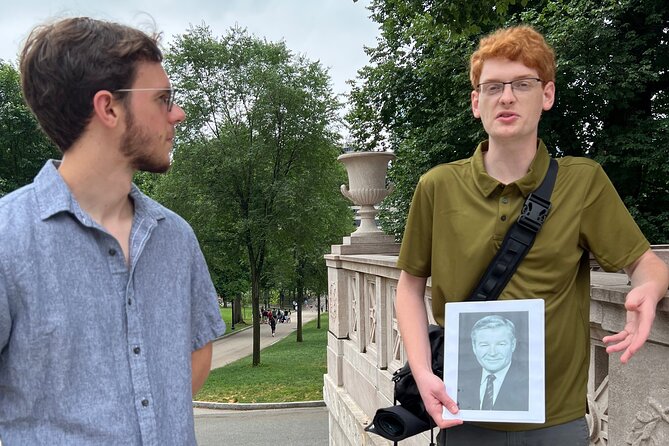
The route also includes the statue on Boston Common honoring Dr. Martin Luther King Jr. The guide explains that King spent many years in Boston and earned his PhD here.
This is an important change of pace. The tour is not only about old graves, mob figures, and engineering failures. King’s Boston years connect the city to a major American civil rights story, while the statue gives you a physical place to consider that part of his life.
The stop is especially useful if you know King mainly through his later work in the American South. Boston was part of his education and development, and this brief stop adds a personal connection to a city often presented mainly through colonial and Revolutionary history.
The State House and Boston’s Complicated Bulger Story
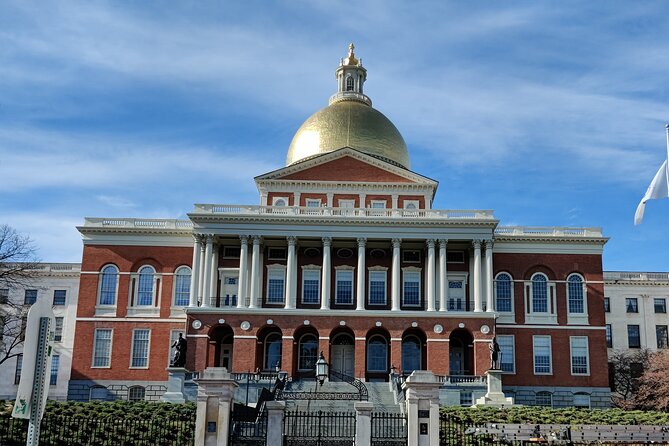
At the Massachusetts State House, the guide takes up the story of Billy Bulger, who served as president of the State Senate, and his complicated relationship with his brother Whitey Bulger, the infamous Irish mobster.
This stop works because it brings politics and crime into the same family story. You are not simply hearing about a government building or admiring its exterior. You are hearing how Boston’s political world and criminal underworld could overlap through family ties and local power.
The State House stop takes about 15 minutes. Admission to the building is not included, so you should treat this as an exterior storytelling stop unless you make separate plans to go inside.
This part will appeal to you if you enjoy modern Boston stories more than another round of Revolutionary War facts. It also shows why a local guide can add value: the most interesting material is often the connection between people, not the architecture alone.
Old City Hall and the Charles Ponzi Connection
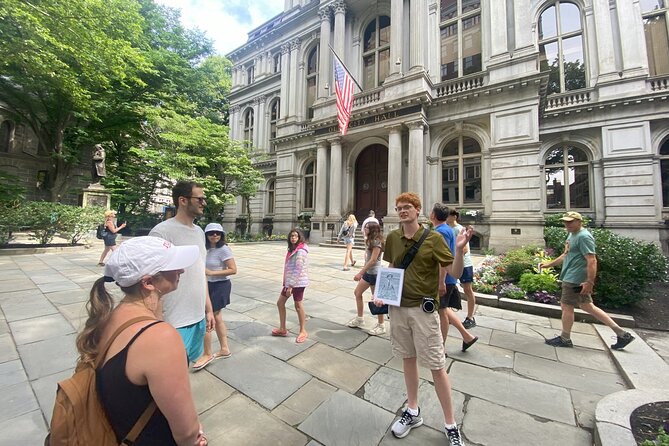
At Old City Hall, the tour turns to Charles Ponzi. His office was next door, and his financial fraud became so famous that the term Ponzi scheme was named after him.
You get about 20 minutes here, making it one of the longer stops. That extra time allows the story to move beyond a quick mention of a famous criminal. The guide can explain the setting, the person, and how a single fraud became part of everyday language.
For many people, this is one of the tour’s most memorable subjects because the phrase is familiar even when the Boston connection is not. Seeing the location near Old City Hall gives the story a clear sense of place.
Admission is not included, so again, the tour’s value comes from the guide’s explanation rather than entry into a paid site. If you prefer tours built around interiors, art, or formal exhibits, this experience may feel light on ticketed attractions.
More Walking Tours in Boston
- Harvard University Campus Guided Walking Tour
★ 4.5 · 3,632 reviews - Boston Freedom Trail Walking Tour with Costumed Guide
★ 4.5 · 2,531 reviews - The Full Revolutionary Story Epic Small Group Boston Walking Tour
★ 5.0 · 2,356 reviews - Boston’s Freedom Trail: A Revolutionary Walking Tour
★ 4.9 · 1,748 reviews
Boston City Hall and the Argument Over Modern Architecture
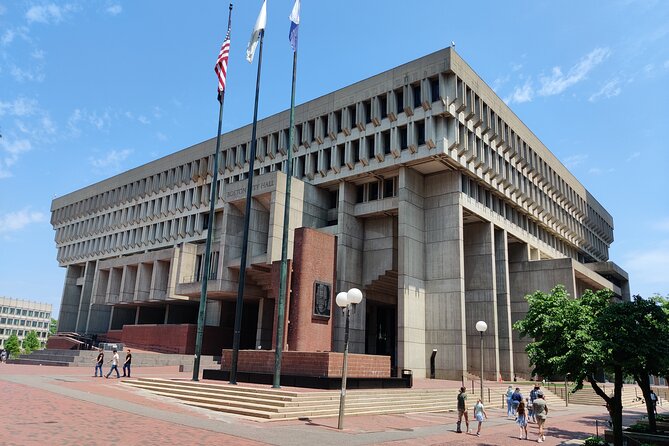
Boston City Hall brings the tour into a very different period. Your guide explains why the building is disliked by many Boston citizens yet admired by architects.
That disagreement is the heart of the stop. You get a quick lesson in how public buildings can work well for specialists while frustrating the people who use or encounter them every day. The building becomes a case study in taste, function, and civic identity.
The stop lasts about 10 minutes. It is a good example of the tour’s wider method: take a familiar place, then show why it is more complicated than it first appears.
No admission is included. You should expect an outdoor explanation rather than a full architectural visit.
Faneuil Hall Marketplace and Boston’s Commercial Makeover
At Faneuil Hall Marketplace, the guide explains the history of Faneuil Hall and how the area has changed over time. The stop lasts about 15 minutes.
The marketplace was built in 1826 and now serves as a food hall and commercial center. That contrast gives the guide a useful subject: how an old public marketplace can shift into a modern shopping and dining district while still trading on its historic identity.
Faneuil Hall is one of Boston’s busiest areas, so this stop may feel more crowded and commercial than Central Burying Ground or the waterfront. Still, it helps you see the city as a place that keeps recycling its old spaces for new purposes.
Food and drinks are not included. The practical upside is that the guide can offer recommendations for after the tour, and the walk ends near the North End, another strong place to eat.
The Big Dig and the Rose Fitzgerald Kennedy Greenway
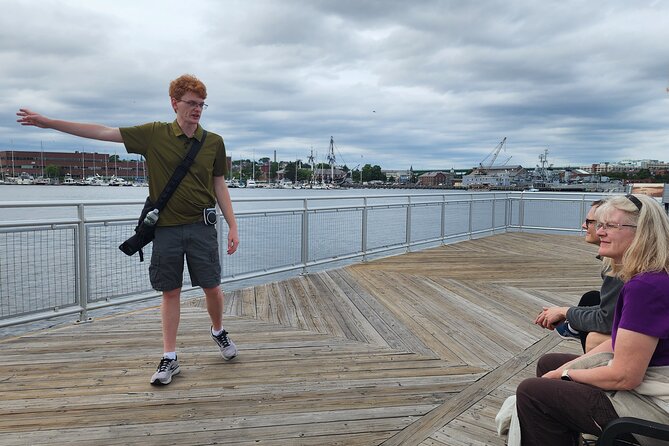
At the Rose Fitzgerald Kennedy Greenway, the tour explains how the old elevated highway ripped Boston apart and how the Big Dig helped stitch the city back together.
This stop gives you a clear before-and-after view of urban planning. Highways can move cars efficiently while cutting neighborhoods off from one another. The Greenway represents Boston’s attempt to repair that damage by replacing the old overhead road with a different kind of public space.
You spend about 10 minutes here. The stop is short, but it connects directly to the city around you. You can consider how road design affects walking, neighborhoods, views, and access to the waterfront.
Admission is free. The value comes from understanding why this corridor looks the way it does and what used to occupy it.
Boston Harborwalk and the City Built on Made Land
The Boston Harborwalk provides one of the tour’s strongest geographical ideas. You hear how Boston expanded its land area and why about one-sixth of the city is artificial.
That fact changes how you look at the waterfront. Boston is not simply a city that happened to grow beside the harbor. Parts of it were created by filling and reshaping the shoreline, allowing the city to spread beyond its earlier natural boundaries.
The stop lasts about 20 minutes, so you get more time here than at several downtown landmarks. It is also one of the places where the walking route feels most connected to the physical shape of Boston.
The Harborwalk stop is free, but the weather matters. Wind and cold can make waterfront walking less pleasant, and the experience requires good weather. Wear shoes suitable for a 2.5-hour city walk and dress for exposure near the harbor.
The North End and the Real Story of Paul Revere
The route passes through the North End, Boston’s historic Italian neighborhood, and finishes at the Paul Revere Statue. The North End is known for its food, so this is a natural place to continue your day after the tour.
At the statue, the guide explains the true story of Paul Revere’s ride and why his name became so famous. The stop lasts about 20 minutes.
This is a useful correction to the simplified schoolbook version. Revere is not just a statue and a famous midnight ride. His reputation grew through the way the event was remembered and retold, and the guide uses the statue as a starting point for that larger story.
The North End setting also adds contrast. You have moved from government buildings and engineered land to a neighborhood with a strong cultural identity and a clear food tradition. I would save a meal or snack for after the tour rather than expect food to be part of the experience.
The Great Molasses Flood, Boston’s Darkest Stop
The final major stop is the plaque marking the Great Molasses Flood. The guide gives the full story of how the flood happened and the damage and fallout it caused for Boston.
You spend about 20 minutes here, which gives the guide time to explain more than the strange headline. The event is memorable because it sounds absurd at first, yet it had serious consequences for the city and the people caught in it.
This stop captures what the tour does best. It takes a story that many people have never heard, places it on the street where its consequences matter, and connects it to questions of responsibility and public safety.
The plaque itself is free. As with the other outdoor stops, the guide’s explanation is the main reason to come.
What You Get for the Tour Fee
The supplied information does not state a ticket price, so I cannot judge the exact cost. You can judge the value by looking at what is included: a 2.5-hour guided walk, a small group of no more than 15, and a local guide.
There are no listed admission tickets included, and food and drinks are separate. That is not a problem if you want a story-focused walk rather than a package filled with entries and meals. It matters more if the price is close to that of a tour with museum admission or a larger number of paid attractions.
For me, the strongest value comes from the unusual links between places. The guide turns the city itself into the subject, so you are paying for interpretation, route design, and local storytelling. The tour is a good match for someone who has already seen the major colonial sights or wants a second look at Boston beyond the standard route.
The small group also helps justify a higher price than a large group walk. With up to 15 people, the guide can keep the group together and make the stories easier to follow.
Practical Details Before You Book
The walk is offered in English and uses a mobile ticket. Confirmation is received at booking, and the route stays near public transportation.
You begin at 75 Boylston Street and finish at 521 Commercial Street. Since the tour does not return to its starting point, check your plans for the rest of the day before booking. The North End ending is convenient for food, but it is not the same area as the starting point.
You need moderate physical fitness. The exact distance is not provided, but the experience lasts about two and a half hours and includes several outdoor stops. Plan on being on your feet for most of that time.
Service animals are allowed. Food and drinks are not included, though the guide can provide recommendations for after the walk.
Cancellation is free up to 24 hours before the start time for a full refund. Inside that 24-hour window, changes are not accepted and the payment is not refunded. If poor weather forces cancellation, you are offered another date or a full refund.
Who Will Enjoy This Boston History Tour?
I would choose this walk if you like history with a surprise in it. The subjects are unusual but still tied to places you can see: Ponzi’s office near Old City Hall, the subway beneath Boston Common, the Bulger family connection, the Big Dig, and the Molasses Flood plaque.
It also suits you if you have already done the Freedom Trail and want a different side of Boston. One review described it as a reason to skip the usual route, while another praised the unusual historical details and Sam’s storytelling on a cold February day. The strongest praise centers on the research, structure, and storytelling rather than on sightseeing alone.
I would think twice if you want lots of indoor time, a gentle pace, or a tour centered on entry to historic buildings. The outdoor format, weather requirement, and moderate fitness level are real considerations.
Should You Book the Boston Untold History Walking Tour?
Book it if you want Boston’s odd corners, modern controversies, disasters, and lesser-known characters. The route gives you a useful counterweight to the Freedom Trail, and the small group makes the storytelling more personal.
Skip it if you mainly want Revolutionary War landmarks, interior visits, or a short stroll. For everyone else, this is a smart way to spend an afternoon, especially if you finish hungry in the North End and ready to put the guide’s food advice to work.
FAQ
How long is the Boston Untold History Walking Tour?
The tour lasts approximately 2 hours and 30 minutes.
Where does the tour begin?
The meeting point is 75 Boylston Street, Boston, Massachusetts 02116.
Where does the tour end?
The tour ends at 521 Commercial Street in Boston’s North End.
Is the tour offered in English?
Yes. The experience is offered in English.
How large is the group?
The tour has a maximum of 15 people.
Are food and drinks included?
No. Food and drinks are not included, but the guide can offer recommendations for after the tour.
Do I need to be physically fit?
You should have a moderate level of physical fitness because this is an outdoor walking tour lasting about two and a half hours.
What happens if the weather is poor?
The experience requires good weather. If it is canceled because of poor weather, you will be offered another date or a full refund. You can cancel at least 24 hours before the start time for a full refund.
More Historical Tours in Boston
- History and Hauntings of Salem Guided Walking Tour
★ 5.0 · 14,564 reviews - Boston: City Cruises Historical Sightseeing Cruise
★ 4.6 · 1,771 reviews - Boston: Freedom Trail History Small Group Walking Tour
★ 4.9 · 1,590 reviews - City Cruises Boston Historic Sightseeing Harbor Cruise
★ 4.5 · 1,388 reviews
Just added around Boston
- Day Trip from Boston: Explore Hammond Castle Museum★ 3.7 · 3 reviews
- Boston: WNDR Museum Entry Ticket★ 3.7 · 3 reviews
- The Boston Bash Scavenger Hunt★ 4.5 · 3 reviews
- Self-Guided Audio Tour of Boston North End★ 4.5 · 3 reviews
- Boston: Official Freedom Trail® Lantern Tour★ 4.7 · 3 reviews
- Boston: North End Walking Tour with Private Harbor Cruise★ 5.0 · 3 reviews
- Self Guided “The North End Pizza, Cannoli and Picnic” Solo Walking Tour★ 5.0 · 3 reviews
- Cambridge: Haunted Charles River Cruise★ 4.3 · 3 reviews
Historic Tours in Boston, compared.
Freedom Trail History Small Group Walking Tour
Read our review →
Tour of Historic Fenway Park, America’s Most Beloved Ballpark
Read our review →
Boston Food & History: Pizza, North End & Freedom Trail
Read our review →
Freedom Trail History Small Group Walking Tour
Read our review →
City Cruises Boston Historic Sightseeing Harbor Cruise
Read our review →
Boston’s North End Food Tour: Italian Flavors & Heritage Walk
Read our review →
Boston Pizza Lovers Food and History Walking Food Tour
Read our review →Browse the lists this tour appears in