
Reviewed · BOSTON REVOLUTIONARY WAR TOURS
Small Group Revolutionary Tour of Lexington, Concord, and Boston
The first shot of the American Revolution makes more sense when you follow the story across the actual ground where it unfolded. This small-group tour links Boston’s North End with Lexington, Concord, Cambridge, and Bunker Hill, giving you a full day of connected places instead of isolated monuments.
I like the small group of nine or fewer, which should make questions and conversation easier. I also like the clear timeline, from Paul Revere’s warning to the opening battles and George Washington’s early command. The main drawback is the long 7 to 9-hour schedule, with a fair amount of driving and standing.
In This Review
- Key points to know before booking
- Why this tour works as a Revolutionary War introduction
- Paul Revere Mall and Old North Church
- Following Revere’s route to Lexington
- Lexington Green and Buckman Tavern
- The capture site and the road toward Concord
- Old Hill Burying Ground and Concord free time
- Concord Museum and the lantern from Old North Church
- Hartwell Tavern and the Battle Road Trail
- Thomas Nelson Jr. House Site and Munroe Tavern
- Cambridge Common and Washington’s first command
- Bunker Hill Monument and the final battle story
- What the $225 price includes
- Guide style and the importance of storytelling
- Who should book this full-day tour
- Should you book the Revolutionary Tour of Lexington, Concord, and Boston?
- FAQ
- Where does the tour start?
- What time does the tour begin?
- Where does the tour end?
- How long does the experience last?
- How large is the group?
- Is lunch included?
- Is transportation provided?
- Is bottled water included?
- Which admissions are included?
- Is the tour offered in languages other than English?
- Can I cancel for a full refund?
Key points to know before booking
- The tour follows a real historical sequence, beginning with Paul Revere’s signal and ending at Bunker Hill.
- Guide Jenny is specifically praised for her teaching, and the experience is built around explanation rather than quick photo stops.
- You visit both major battle areas, Lexington Green and the Old North Bridge at Concord.
- Admission is included at Old North Church and Concord Museum, while parking and bottled water are also covered.
- Lunch is on your own, with about 1 hour and 15 minutes in Concord for food and shopping.
- The group is capped at nine people, but you should still expect a busy full-day outing with moderate walking.
Why this tour works as a Revolutionary War introduction
Many Boston history tours stay within the city. This one reaches beyond the familiar Freedom Trail and takes you to the towns where the conflict turned from protest into armed rebellion. That wider view is the chief reason to book it.
You begin in the North End, where Paul Revere lived and worked, then travel west toward Lexington and Concord. Later, you return toward Cambridge and Charlestown, connecting the early battles with George Washington’s assumption of command and the fight at Bunker Hill.
I like this structure because the American Revolution can otherwise feel like a list of dates and famous names. Here, the sequence has a physical shape. You see where Revere’s warning began, where the British column met the militia, where supplies were hidden, and where the retreat became bloody.
The tour is also a good match for anyone who prefers a guide-led day over planning several suburban stops alone. Transport, fuel costs, and parking fees are included. That matters in Lexington and Concord, where the points of interest are spread across several communities and a rental car would add its own cost and planning work.
Still, this is not a light sightseeing loop. You will spend much of the day in a vehicle, and several stops involve standing outdoors. A moderate level of fitness is recommended. Wear practical shoes and be ready for changing conditions.
More Revolutionary War tours around Boston:
- 90-Min Narrated Trolley Tour of Lexington and Concord, MA
★ 4.5 · 358 reviews - Boston History & Highlights Tour: From Revolution to Today
★ 4.8 · 178 reviews - Boston: Full Revolution Story Epic Small Group Walking Tour
★ 4.9 · 132 reviews
Paul Revere Mall and Old North Church
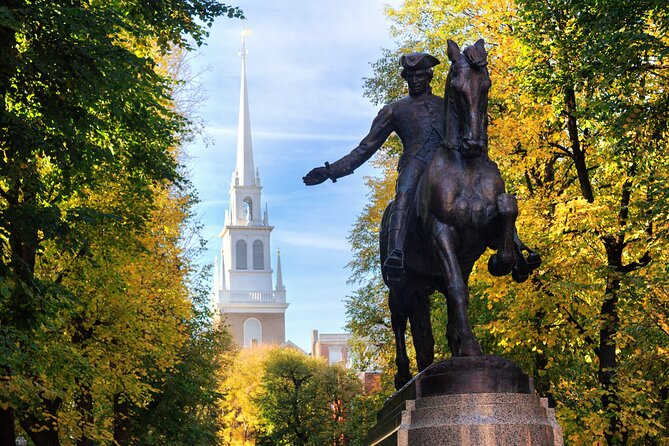
The day begins at 10:00 a.m. at the Paul Revere statue in Paul Revere Mall. The statue faces the Old North Church, giving you a useful first view of the neighborhood and the man whose midnight ride became one of the Revolution’s best-known stories.
The opening stop lasts about 15 minutes and is free. It is less about a long tour of the North End than about setting the scene. You learn about colonial life in the neighborhood on the eve of the war, when Boston was a crowded port town filled with political tension.
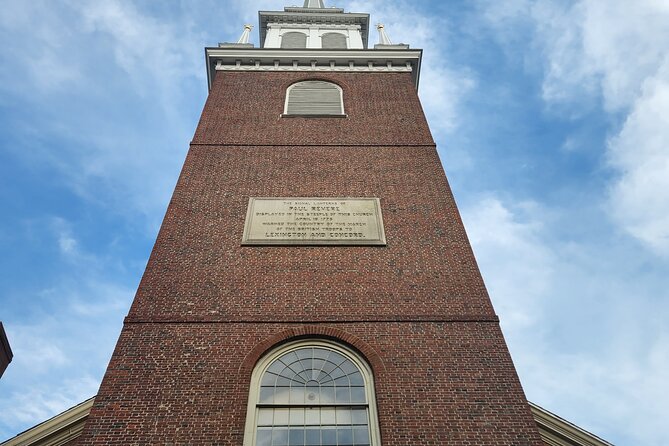
Next comes the Old North Church, Boston’s oldest church. You have about 25 minutes inside, with admission included. The famous lantern signal is tied to the night of April 18, 1775, when the lights were used to warn that British troops were moving by water rather than over land.
This is a short visit, so do not expect an extended church tour. Its value comes from placing a well-known event in the actual building connected to it. If you enjoy physical links to major events, this is a strong start.
Following Revere’s route to Lexington
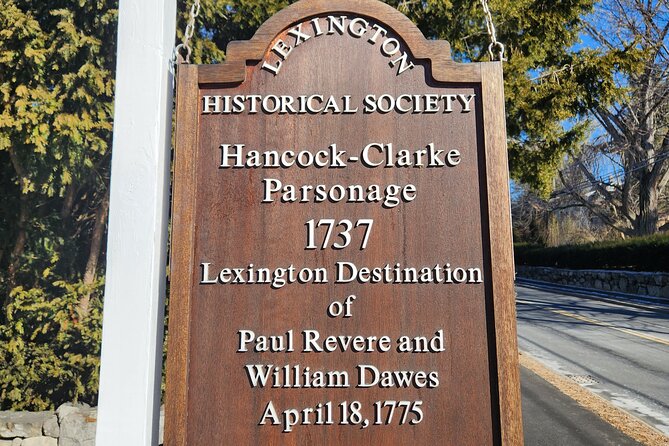
From Boston, the tour follows the route toward Lexington and the Hancock-Clarke House. This stop lasts about 40 minutes and is free of charge.
The house is important because Paul Revere and William Dawes arrived to warn John Hancock and Samuel Adams that British troops were approaching. You are not simply hearing about the ride in the abstract. You are seeing the house where the warning was delivered.
The title of the experience can make it sound like the whole day centers on Revere. In practice, the tour uses him as the opening thread, then broadens into the actions of local militia members, British regulars, political leaders, and Washington.
The route itself is part of the lesson. Revere did not ride through a movie set or a single compact historic district. The distance between Boston, Lexington, and Concord helps you understand the effort involved in spreading the alarm.
Lexington Green and Buckman Tavern
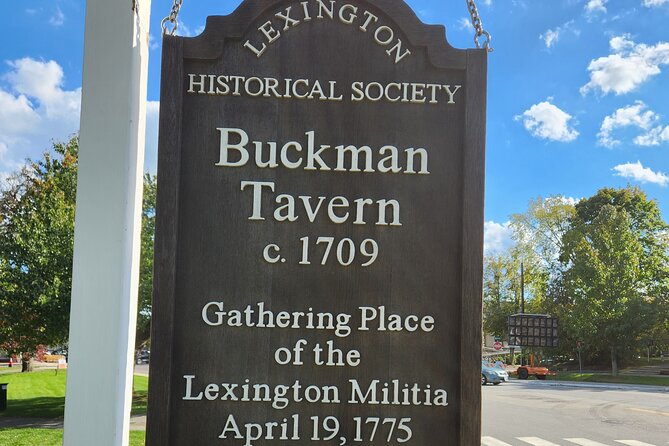
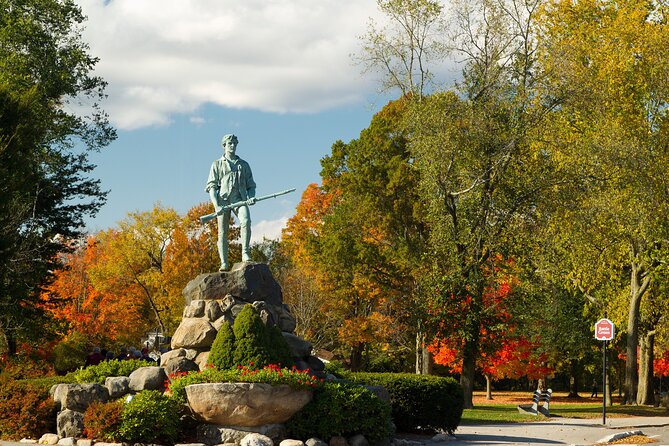
Lexington Green is where the first armed clash took place on April 19, 1775. You get about 25 minutes here, followed by a 10-minute stop at Buckman Tavern.
The green is open and easy to picture as a meeting place for local militia. The tour explains what happened on that morning, including the tense encounter between the colonial militia and British troops. The importance of this stop is not its size. It is the chance to see the ground where the conflict began.
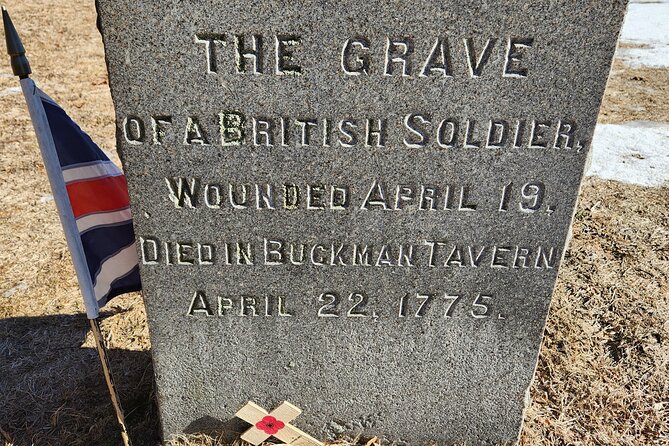
Buckman Tavern served as a gathering point for colonists waiting for the British arrival. The short visit is best understood as an extension of Lexington Green. Together, the two stops show the difference between a public meeting place and the nearby building where people waited, watched, and prepared.
You should keep your expectations realistic. These stops are not long museum visits, and the schedule moves at a steady pace. Their strength is the guide’s explanation and the setting itself.
Same city, a very different afternoon:
- History and Hauntings of Salem Guided Walking Tour
★ 5.0 · 14,564 reviews - Boston Duck Boat Sightseeing City Tour with Cruise Along Charles River
★ 4.5 · 9,378 reviews - Boston: Freedom Trail History Small Group Walking Tour
★ 5.0 · 6,450 reviews - Boston Hop-On Hop-Off Trolley Tour with 13 Stops
★ 4.5 · 5,576 reviews
The capture site and the road toward Concord
The next stop is the place where Paul Revere was captured by British soldiers. You spend about 20 minutes learning what actually happened during the midnight ride.
This is a useful correction to the simplified version many people learn as children. Revere did not complete the ride to Concord as a lone hero. His journey was interrupted, and the warning continued through the work of other riders and local residents.
That detail gives the story more weight. The Revolution was not created by one famous figure. It depended on a chain of people passing information through towns and farms.
The tour then continues to Concord, where the story shifts from warning to military confrontation. You visit the Old North Bridge for about 20 minutes. This is the site associated with the phrase the shot heard around the world, referring to the opening exchange between colonial militia and British troops.
At the bridge, the setting helps explain the military problem facing the British. They had marched out from Boston to seize colonial military supplies, but local resistance gathered quickly. The bridge became a key point in the fighting.
Old Hill Burying Ground and Concord free time
At Old Hill Burying Ground, you get about 15 minutes to consider the town from the British officers’ point of view. The stop also covers stories about how Concord residents hid war supplies.
This is one of the more unusual stops because it adds humor and local detail to a serious subject. Concealing supplies required practical tricks, and the guide uses those stories to show how ordinary residents took part in the resistance.
After that, you get about 1 hour and 15 minutes in Concord for lunch and shopping. Lunch is not included, so bring money for your meal and snacks. This break is welcome in a day that includes many short stops, and it gives you time to pause rather than absorb one historical episode after another.
The exact restaurant choices are not specified, so you should treat this as independent free time, not a planned group meal. Concord is also a useful point to buy a snack if you did not bring one.
Concord Museum and the lantern from Old North Church
The Concord Museum visit lasts about 45 minutes, and admission is included. One especially notable object is the actual lantern associated with the Old North Church signal on the night of April 19, 1775.
The museum also displays preserved artifacts from the Revolution. This indoor stop gives you something the outdoor sites cannot: direct contact with objects from the period. After seeing battlefields and roads, you can look at material evidence connected to the people who lived through the events.
I consider this one of the best value points in the tour. Museum admission is already covered, and the visit adds depth to the earlier church stop. The lantern links Boston and Concord in one object.
The 45-minute time limit also keeps the visit focused. If you are the sort of museum visitor who wants to read every label, you may wish for more time. For a day with 16 stops, though, the schedule has to keep moving.
Hartwell Tavern and the Battle Road Trail
Hartwell Tavern is reached after the museum. The visit lasts about 20 minutes and includes the best-preserved stretch of the Battle Road Trail, along with the historic tavern.
This section focuses on the British retreat from Concord. By this stage, the British expedition had failed to secure the colonial supplies and faced growing resistance on the return to Boston. The road helps you picture the pressure of that retreat better than a city monument can.
The stop is partly outdoors and may involve walking on an uneven historic path. Comfortable shoes matter here. The tour asks for moderate physical fitness, and this is one reason why.
Hartwell Tavern also adds a domestic setting to the military story. Taverns were gathering places, and buildings like this help you think about the Revolution as something that passed through ordinary communities, not only battlefields.
Thomas Nelson Jr. House Site and Munroe Tavern
The Thomas Nelson Jr. House Site is a 15-minute stop in a forested area. The guide explains how the colonists later took revenge for earlier casualties on Lexington Green.
The wooded setting offers a change from the more open green and bridge areas. It also gives you a feel for how visibility, cover, and distance affected movement during the fighting. Since the stop is outdoors, conditions underfoot may matter more than at the town-center sites.
You then drive by Munroe Tavern, used by the British as a field hospital and headquarters on April 19, 1775. George Washington later stayed there during a commemorative tour of Lexington.
This is a drive-by stop of about 10 minutes, so you should not expect a full interior visit. Its value is in connecting the battle day with the later way Americans remembered it. Washington’s connection also prepares you for the final Cambridge stops.
Cambridge Common and Washington’s first command
At Cambridge Common, you spend about 20 minutes seeing the spot where George Washington first assumed command of the Continental Army.
This is an important shift in the story. Lexington and Concord show the opening of the conflict. Cambridge shows the beginnings of a more organized colonial military effort under Washington.
The common is also a useful place to slow down and consider the practical problem facing the new army. The colonies had resisted British troops, but resistance needed leadership and structure if it was going to continue.
Next, you drive by Wadsworth House, where Washington lived for six months while commanding the colonial army from Harvard University. The stop lasts about 15 minutes and is viewed from outside.
The house is not presented as a long interior visit. Instead, it completes the Cambridge chapter by showing where Washington lived during the early command period.
Bunker Hill Monument and the final battle story
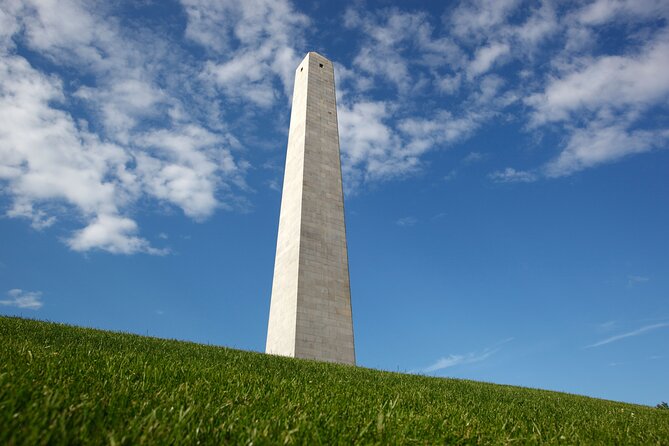
The final major stop is Bunker Hill Monument, where you spend about 45 minutes. This site introduces the first official battle of the American Revolution and the famous order commonly phrased as don’t fire until you see the whites of their eyes.
The monument provides a strong ending because it takes the story from scattered local clashes to a recognized military battle. You can connect the opening events in Lexington and Concord with the larger conflict that followed around Boston.
The stop is free, but the experience remains guide-led rather than a separate paid monument tour. You should confirm how much time is available for looking around on your own, since the supplied schedule gives 45 minutes for the site.
The tour ends at 600 Commercial Street in Boston. Your guide can drop you in the North End or at a hotel within 1.5 miles of the North End. That is convenient if you are staying nearby, though it is worth checking the final drop-off details before booking if you are lodging farther away.
What the $225 price includes
At $225 per person, this is not the cheapest way to see Boston and its surrounding historic towns. The value depends on how much planning and driving you want to avoid.
The price includes an air-conditioned vehicle, fuel surcharge, parking fees, bottled water, and admission to Old North Church and Concord Museum. Parking alone can be a nuisance and an added expense around popular historic sites, so the included fees have real value.
You are also paying for a full day of transportation between widely separated places. Reproducing the route independently would require a car, careful timing, parking research, and your own historical guidebook or audio plan.
Lunch and snacks are not included. Plan for those separately, and use the Concord break to eat. The tour is offered in English, and the group maximum is nine, a useful size for asking questions without the feel of a large coach outing.
The tour is booked, on average, 47 days ahead. That suggests you should reserve early if your Boston dates are fixed, particularly if you want a specific day.
Guide style and the importance of storytelling
The strongest praise attached to this experience concerns the teaching. Jenny is singled out by name for making the full timeline meaningful and for explaining the Revolution from beginning to end.
That is the right skill for this route. You are not visiting one famous site and leaving. You are moving through many short stops, so the guide needs to connect them clearly. Without that thread, Lexington, Concord, Cambridge, and Bunker Hill could feel like separate points on a map.
The tour has a top rating from five submitted reviews, which is a small sample. I would treat that as encouraging but not as proof that every departure will feel identical. The guide’s ability to explain events, answer questions, and manage the long schedule will shape your day.
Who should book this full-day tour
I would choose this experience if you want a focused introduction to the American Revolution and prefer transport with a guide. It suits first-time visitors who want Boston context but also want to see Lexington and Concord without arranging a car.
It is especially useful for families and students who learn better from a connected story than from reading separate plaques. The lantern, battlefields, taverns, roads, and Washington sites give the subject variety.
You should think twice if you prefer a slow pace. Sixteen listed stops in 7 to 9 hours means most visits are short. You will see many places, but you will not have long free periods at each one.
The tour also may not suit anyone who dislikes outdoor walking or long vehicle days. A moderate fitness level is advised, and the route includes historic paths, open sites, and repeated stops.
Service animals are allowed, and the meeting point is near public transportation. Confirmation arrives when you book. Free cancellation is available if you cancel at least 24 hours before the start time. Changes or cancellations made later are not accepted for a refund.
Should you book the Revolutionary Tour of Lexington, Concord, and Boston?
Book it if you want the broad story in one day, value a tiny group, and do not want to drive between Boston, Lexington, Concord, Cambridge, and Bunker Hill. The included transport, parking, water, and museum admissions make the $225 price easier to justify.
I would be most likely to recommend it to a history-minded visitor with limited time in Boston. Guide Jenny’s praised storytelling is a plus, and the route gives you the meaningful sequence from Paul Revere’s warning to Washington’s command.
Skip it if you want a relaxed day with long museum visits or plenty of unplanned time. This is a packed, guide-led tour. Bring comfortable shoes, plan for lunch, and expect the greatest value to come from the connections between the stops.
FAQ
Where does the tour start?
The tour starts at the Paul Revere statue in Paul Revere Mall, Boston, Massachusetts.
What time does the tour begin?
The scheduled start time is 10:00 a.m.
Where does the tour end?
The tour ends at 600 Commercial Street in Boston. Your guide can drop you in the North End or at your hotel within 1.5 miles of the North End.
How long does the experience last?
The tour lasts approximately 7 to 9 hours.
How large is the group?
The activity has a maximum of nine travelers.
Is lunch included?
No. Lunch and snacks are not included. You have about 1 hour and 15 minutes of free time in Concord for lunch and shopping.
Is transportation provided?
Yes. The tour includes an air-conditioned vehicle, fuel surcharge, and parking fees.
Is bottled water included?
Yes. Bottled water is included.
Which admissions are included?
Admission to Old North Church and the Concord Museum is included. The other listed stops have no admission charge.
Is the tour offered in languages other than English?
The tour is offered in English.
Can I cancel for a full refund?
Yes, if you cancel at least 24 hours before the experience start time. Cancellations or changes made less than 24 hours before the start time are not accepted for a refund.
Just added around Boston
- Day Trip from Boston: Explore Hammond Castle Museum★ 3.7 · 3 reviews
- Boston: WNDR Museum Entry Ticket★ 3.7 · 3 reviews
- The Boston Bash Scavenger Hunt★ 4.5 · 3 reviews
- Self-Guided Audio Tour of Boston North End★ 4.5 · 3 reviews
- Boston: Official Freedom Trail® Lantern Tour★ 4.7 · 3 reviews
- Boston: North End Walking Tour with Private Harbor Cruise★ 5.0 · 3 reviews
- Self Guided “The North End Pizza, Cannoli and Picnic” Solo Walking Tour★ 5.0 · 3 reviews
- Cambridge: Haunted Charles River Cruise★ 4.3 · 3 reviews
Boston Revolutionary War Tours, compared.
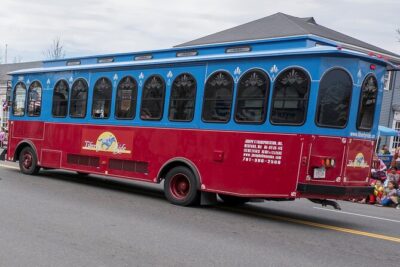
90-Min Narrated Trolley Tour of Lexington and Concord, MA
Read our review →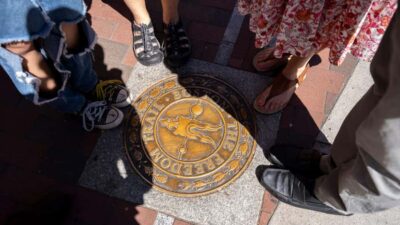
Boston History & Highlights Tour: From Revolution to Today
Read our review →
Full Revolution Story Epic Small Group Walking Tour
Read our review →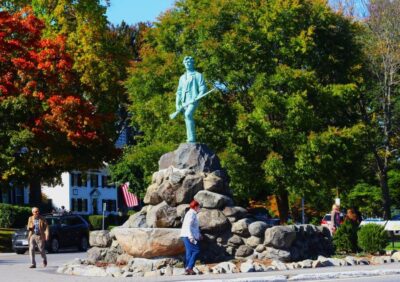
Lexington & Concord 250th Birthday Tour with Concord Museum Entry
Read our review →
Lexington & Concord Self-Guided Driving & Walking Audio Tour
Read our review →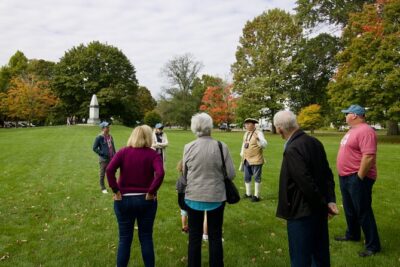
Lexington, MA Battle Green Walking Tour with Costumed Guide
Read our review →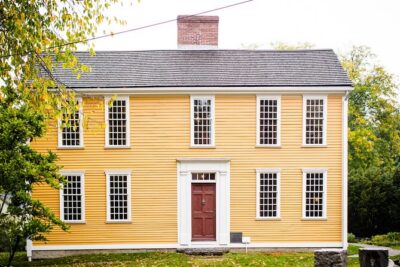
Browse the lists this tour appears in