
Reviewed · HISTORIC TOURS IN BOSTON
Relive 1776: See Boston’s History in Augmented Reality (AR)
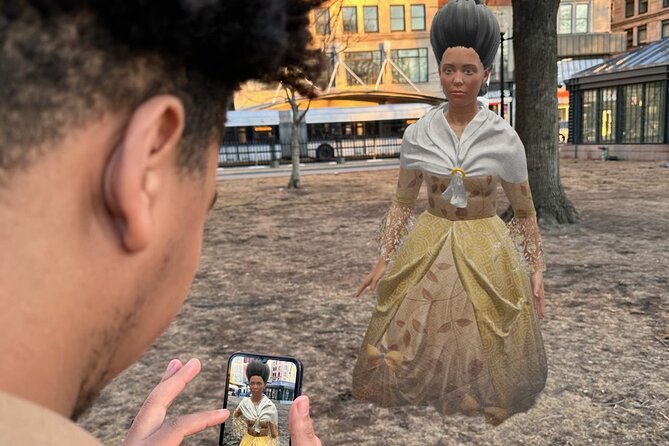
Boston’s Freedom Trail is already a fine walk, but Relive 1776 adds a playful twist: scenes from the Revolutionary era appear at the very places where the events unfolded. You may find yourself watching the Boston Massacre take shape at its historic location, trying on colonial clothing, or handling a historically accurate field cannon.
I like two things in particular. First, the tour keeps you moving through Boston’s real streets instead of trapping you in a theater or museum. Second, the small group, limited to eight people, gives the guide room to help with the equipment and answer questions. Guides named Tommy and Dylan have earned special praise for making the technology easy to use.
The main consideration is that this is not a traditional history lecture. Much of the learning happens inside the AR scenes, and the experience works best when you take time with the audio and video. On a hot day, the walk can also become tiring, especially if you cut short the final section.
In This Review
- Key points before you book
- Starting under Boston Common’s Great Elm
- Granary Burying Ground and the cost of a short stop
- Benjamin Franklin, the Old Corner Bookstore, and Boston’s street life
- The Old State House and the Boston Massacre
- Faneuil Hall and the road toward rebellion
- Paul Revere’s House and the final stretch
- Bunker Hill and an ending with energy
- Why the AR equipment matters
- Is $30 a fair price?
- Who will enjoy Relive 1776 most?
- Should you book this Boston AR tour?
- FAQ
- How long does Relive 1776 last?
- Where does the tour begin?
- Where does the tour end?
- Is this a VR tour?
- Is the tour offered in languages other than English?
- What is the cancellation policy?
Key points before you book
- Five AR scenes along the full Freedom Trail: Each experience lasts about 5 to 15 minutes and includes a one-minute video.
- Real places, digital history: You see Boston Common, the Old State House, Faneuil Hall, Paul Revere’s House, and other landmarks as you walk.
- Small groups of up to eight: This makes it easier to handle the equipment and stay connected with your guide.
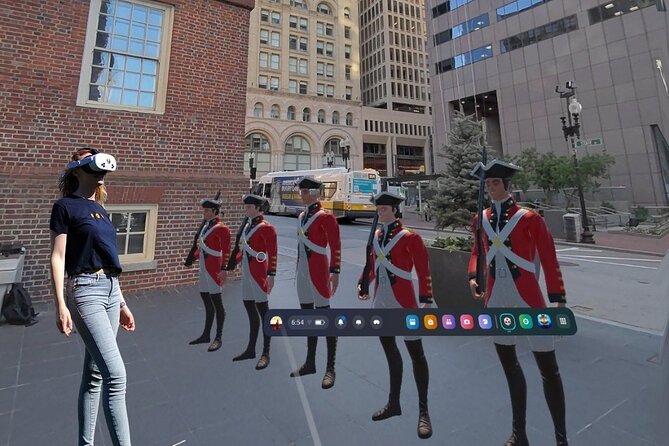
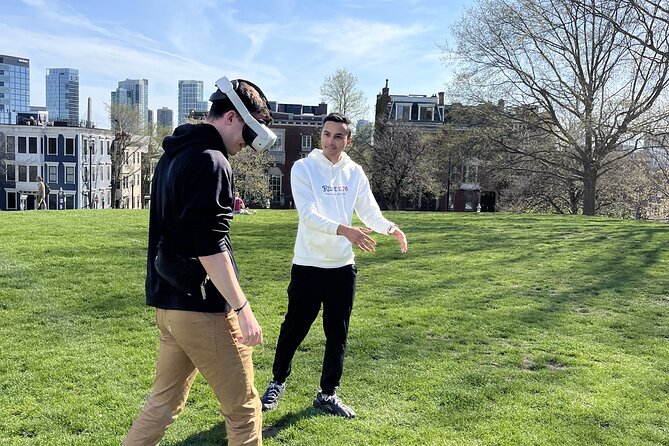
- Headsets and tablets are provided: Meta Quest AR headsets are available, with tablets for people who prefer not to use a headset.
- More playful than a standard walking tour: Activities include colonial fashion, a horse and cart scene, and operating a field cannon.
- Two hours and $30 per person: The price is reasonable if you want both a Freedom Trail walk and hands-on technology rather than a basic guided stroll.
Starting under Boston Common’s Great Elm
Meet at the Boston Common Visitors Center at 139 Tremont Street. This is a practical starting point, since Boston Common is easy to reach by public transportation and gives you a clear place to get organized before the walk.
The tour begins with the Great Elm Tree, where Paul Revere, John Hancock, and Samuel Adams enter the story. The exact tree that witnessed colonial Boston’s political debates is gone, but the location remains a useful place to set the stage. You are not simply looking at a marker and hearing dates. The AR format places historical figures into the setting around you.
That is the basic strength of this experience. The digital material comes to you while the city remains visible, so you can keep your bearings on sidewalks and streets. This is augmented reality, not virtual reality. You are not shut away from the world, and the experience is designed to avoid the nausea and safety concerns some people associate with VR.
The first five-part sequence covers events from 1765 to 1775, leading toward the creation of the United States. The story is built around participation, so you may be asked to look, listen, or interact rather than simply stand still while a guide talks.
More Historic Tours in Boston
- Boston: Freedom Trail History Small Group Walking Tour
★ 5.0 · 6,450 reviews - Tour of Historic Fenway Park, America’s Most Beloved Ballpark
★ 4.5 · 3,013 reviews - Boston Food & History: Pizza, North End & Freedom Trail
★ 5.0 · 1,772 reviews
Granary Burying Ground and the cost of a short stop
Granary Burying Ground brings the tour into one of Boston’s most important colonial burial grounds. The stop is brief compared with a full cemetery visit, but its location matters. You are walking through a compact part of central Boston where the names connected to the Revolution are close together.
This is also a good place to understand the tour’s limits. A two-hour walk covering the full Freedom Trail cannot give every site a long, quiet examination. If you want detailed information about every gravestone, building interior, and political debate, you will need a conventional walking tour or extra time on your own.
The AR scenes are meant to add a strong visual memory to the basic facts. They work best when you listen to the narration and watch the full sequence instead of treating the headset as a quick novelty. One critical experience found the material less informative after skipping much of the narration, so I would not rush through the audio and video.
Benjamin Franklin, the Old Corner Bookstore, and Boston’s street life
The stop at the statue of Benjamin Franklin gives the tour a chance to connect famous people with the working city around them. Franklin was a printer, writer, and political figure, and the statue sits along a route where Boston’s commercial and political worlds overlap.
Next comes the Old Corner Bookstore, one of the city’s oldest commercial buildings. You will not be spending a long time inside each landmark, but the walk between stops is part of the experience. Boston’s Freedom Trail is not a museum corridor. It is a city route, with modern traffic, shops, and ordinary street life mixed with colonial buildings.
That mix can help the AR format. A scene appearing over a real street or building makes the past feel connected to the present. One particularly memorable effect places a horse and cart moving through the viewer’s body. It is strange, quick, and more amusing than solemn, which gives the tour a lighter tone than a standard battlefield program.
The guide remains important here. The technology can show you something, but the guide controls the pace and explains what you are seeing. Tommy and Dylan were specifically praised for helping people use the equipment, and that practical support matters more than fancy hardware.
The Old State House and the Boston Massacre
The Old State House is one of the most valuable stops on the route because it sits at the center of Boston’s revolutionary conflict. Here, the AR material brings the Boston Massacre into view at the place connected to the event.
The scene is designed to be educational without gore. That makes it suitable for families who want to discuss the Revolution without exposing younger children to graphic violence. The action is still serious, but the presentation stays within the bounds of a family-friendly activity.
I like this part because the technology has a clear purpose. Instead of watching a generic historical clip in a visitor center, you see the event tied to a particular corner of Boston. Place and story reinforce each other, which can make the names and dates easier to remember.
Still, do not expect an in-depth legal or political lecture. The stop is part of a fast-moving sequence, and the full experience aims to entertain as well as teach. You will get the larger meaning of the conflict, but you may want to read more later if the Boston Massacre sparks your interest.
More history walks around Boston:
- History and Hauntings of Salem Guided Walking Tour
★ 5.0 · 14,564 reviews - Boston: City Cruises Historical Sightseeing Cruise
★ 4.6 · 1,771 reviews - Boston: Freedom Trail History Small Group Walking Tour
★ 4.9 · 1,590 reviews - City Cruises Boston Historic Sightseeing Harbor Cruise
★ 4.5 · 1,388 reviews
Faneuil Hall and the road toward rebellion
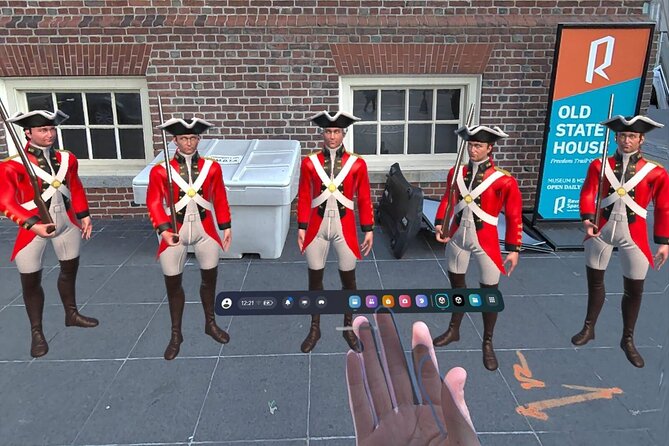
Faneuil Hall Marketplace brings you into another busy section of the Freedom Trail. The setting is especially fitting for a story about protest, trade, taxation, and colonial resistance. The walk does not isolate you from the modern marketplace, so you should expect a public city setting rather than a quiet historical site.
The tour’s souvenir, an Illegal Tea reusable tea bag with a discount card, fits the theme. It is a small extra, but it gives the experience a bit of character and connects with one of the best-known symbols of colonial resistance.
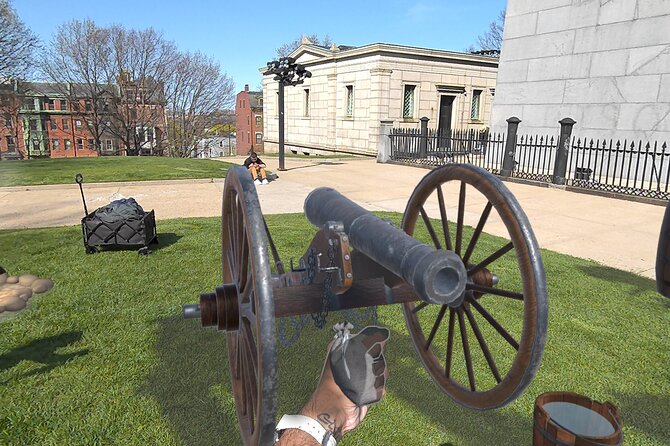
The AR activities become more hands-on as the story moves toward open rebellion. The tour can include colonial clothing and the operation of a field cannon. These moments give children a role beyond listening, but adults are not left out. The feedback shows that the playful sections appeal to both middle-school-age children and grown-ups.
If you are bringing children, the suggested age from the experience is roughly eight and older. That is not a strict rule, but younger children may struggle with a two-hour walk, the historical narration, or the patience needed to use the equipment properly.
Paul Revere’s House and the final stretch

Paul Revere’s House is one of the most recognizable stops on the Freedom Trail. It gives the story a personal face after the tour has introduced major public figures and political conflict. At this point, the narrative turns toward the planning and execution of Paul Revere’s Midnight Ride.
This final section matters because it connects the earlier arguments and protests with the first fighting of the Revolution. The walk continues toward the events at Lexington and Concord, leading to the last AR experience at Bunker Hill.
The advertised walking time is about two hours, and each AR scene lasts 5 to 15 minutes. That leaves a fair amount of time for moving between locations, getting settled with the equipment, and receiving live explanation from the guide. Wear comfortable shoes and plan for an active walk, especially in warm weather.
A very hot day can affect the experience. One person left before the final third because of extreme heat, so take the weather seriously. You can see the central sights early in the tour, but the last section carries the story toward its military climax. If you want the complete narrative, avoid booking a time when heat or fatigue is likely to cut the walk short.
Bunker Hill and an ending with energy

Bunker Hill provides the final setting and the tour’s biggest sense of action. The experience moves from political tension to the planning and fighting that helped shape the country’s founding.
The tone stays non-graphic, but the ending is meant to be lively. You may find the field cannon activity especially memorable because it turns a military event into something you can operate rather than merely hear about.
The route description identifies Bunker Hill as the end of the walking tour, while the meeting information says the activity ends back at the meeting point. Since those details do not line up perfectly, ask your guide at the start how the return arrangement will work. Do not assume you will finish at the same place where you began without checking.
Why the AR equipment matters
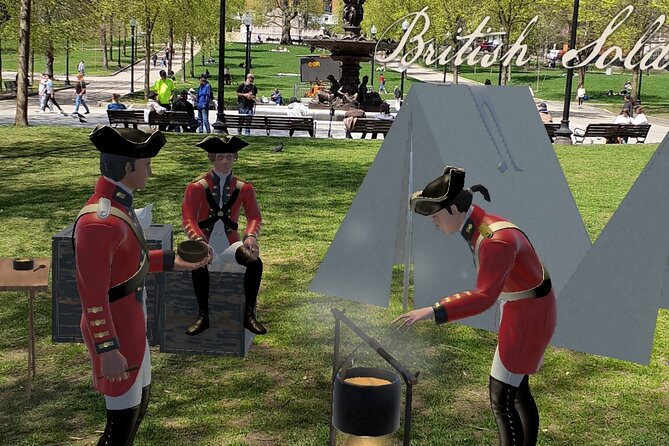
The tour supplies Meta Quest AR headsets and tablets. The headsets offer the most dramatic effect, while tablets give you another way to take part without wearing one. Since the real world remains visible, you can still see the sidewalk and your surroundings during the scenes.
That distinction is important. You are not entering a fully artificial world, so the experience feels more like historical figures and events have been placed into Boston. The format also avoids the isolated feeling of wearing a normal VR headset.
The equipment is not the whole tour, though. The strongest moments come when three things line up: the actual site, the guide’s explanation, and the digital scene. If one of those pieces is missing, the experience may feel like a short technology demonstration rather than a history tour.
The group limit of eight helps. A large crowd would make it harder to see the same scene, hear instructions, or get help when the equipment needs adjusting. Here, the guide can keep the group together and make the experience more personal.
Is $30 a fair price?
At $30 per person, this costs more than simply walking the Freedom Trail with a map. It costs less than many longer sightseeing activities, and it combines a guide, equipment, several AR scenes, and a full route through central Boston.
I consider it a fair price if you want an activity with a strong family or group component. The value is not just in the landmarks. You are paying for the guide, the technology, and the chance to participate in events such as the Boston Massacre scene, colonial dress, and the field cannon.
The value is weaker if you mainly want detailed historical instruction. The tour is designed to be fun and educational, but it does not replace a serious lecture, museum visit, or long-form walking tour. You should also make full use of the narration and video. Skipping the educational material removes a large part of what you paid for.
The small group improves the deal. With no more than eight participants, you are less likely to feel lost in a crowd, and the guide can spend time helping you use the AR equipment.
Who will enjoy Relive 1776 most?
I would choose this for families with children around eight and older, adults who like new ways to see familiar sights, and anyone who finds ordinary walking tours too passive. It is also a good option if you are visiting Boston for the first time and want to cover the Freedom Trail while adding something beyond plaques and dates.
It may not suit you if you dislike wearing headsets, want a quiet and scholarly tour, or have difficulty with a two-hour walk. The tour is offered in English only, and the experience depends on your willingness to listen, watch, and take part.
The activity is accessible to most people according to the supplied information, and service animals are allowed. It is near public transportation, but transportation to Boston Common is not included.
You can cancel for a full refund if you do so at least 24 hours before the start time. Cancellations or changes made within 24 hours are not accepted for a refund.
Should you book this Boston AR tour?
Book Relive 1776 if you want the Freedom Trail to feel active, visual, and a little unusual. The best reason to choose it is the combination of real Boston locations and short scenes that let you see the Revolution at the place where it unfolded.
I would especially recommend it to families and mixed-age groups. Children get hands-on activities, while adults still see the main landmarks and receive a useful outline of the events leading to the Revolution. Just give yourself enough time, use the narration, wear comfortable shoes, and check the weather.
Choose a traditional walking tour instead if detailed historical explanation matters more to you than participation. But for $30, a small group, and five AR experiences along the full Freedom Trail, this is a memorable way to put some action back into Boston’s famous past.
FAQ
How long does Relive 1776 last?
The tour lasts approximately two hours. Each of the five AR experiences lasts about 5 to 15 minutes and includes a one-minute video.
Where does the tour begin?
The meeting point is the Boston Common Visitors Center at 139 Tremont Street in Boston.
Where does the tour end?
The walking route is described as ending at Bunker Hill, while the meeting information says the activity ends back at the meeting point. Ask the guide at the start to confirm the exact return arrangement.
Is this a VR tour?
No. It uses augmented reality, so you can see the real world around you. Meta Quest AR headsets and tablets are provided, and the experience is designed to avoid VR nausea and safety issues.
Is the tour offered in languages other than English?
No. The guide service and activity are offered in English only.
What is the cancellation policy?
You can cancel at least 24 hours before the start time for a full refund. Cancellations or changes made less than 24 hours before the experience are not refunded or accepted.
Just added around Boston
- Day Trip from Boston: Explore Hammond Castle Museum★ 3.7 · 3 reviews
- Boston: WNDR Museum Entry Ticket★ 3.7 · 3 reviews
- The Boston Bash Scavenger Hunt★ 4.5 · 3 reviews
- Self-Guided Audio Tour of Boston North End★ 4.5 · 3 reviews
- Boston: North End Walking Tour with Private Harbor Cruise★ 5.0 · 3 reviews
- Self Guided “The North End Pizza, Cannoli and Picnic” Solo Walking Tour★ 5.0 · 3 reviews
- Boston: Official Freedom Trail® Lantern Tour★ 4.7 · 3 reviews
- Cambridge: Haunted Charles River Cruise★ 4.3 · 3 reviews
Historic Tours in Boston, compared.
Freedom Trail History Small Group Walking Tour
Read our review →
Tour of Historic Fenway Park, America’s Most Beloved Ballpark
Read our review →
Boston Food & History: Pizza, North End & Freedom Trail
Read our review →
Freedom Trail History Small Group Walking Tour
Read our review →
City Cruises Boston Historic Sightseeing Harbor Cruise
Read our review →
Boston’s North End Food Tour: Italian Flavors & Heritage Walk
Read our review →
Boston Pizza Lovers Food and History Walking Food Tour
Read our review →Browse the lists this tour appears in