
Reviewed · HISTORIC TOURS IN BOSTON
Boston: Votes for Women History Tour of Back Bay
Boston’s Back Bay looks like a polished district of brownstones, broad avenues, shops, and grand civic buildings. On this tour, those familiar streets become a map of the fight for women’s voting rights, linking figures such as Pauline A. Shaw, Julia Ward Howe, Blanche Ames, and Lucy Stone to the places where they lived, worked, organized, or argued.
I like the small group limit of 15, which gives you a better chance to ask questions, and I like the way the route connects suffrage history with ordinary city landmarks. Guide Maura has been praised for making the subject lively and inspiring. The main drawback is physical: you will be on your feet for roughly two and a half hours, with no indoor museum admissions included.
In This Review
- Key points to know before booking
- Why Back Bay tells a bigger suffrage story
- Starting beside Make Way for Ducklings
- Pauline Shaw and the machinery behind the movement
- Homes that reveal disagreement inside Boston society
- The College Club and women building their own networks
- Copley Square and the public face of reform
- The Boston Public Library and the power of print
- From the Boston Marathon to Newbury Street
- Ending with Abigail Adams, Phillis Wheatley, and Lucy Stone
- What $35 gets you
- Practical details for a comfortable walk
- Who will get the most from this tour
- Should you book the Votes for Women tour?
- FAQ
- How long is the Votes for Women History Tour?
- How much does the tour cost?
- Where does the tour begin?
- Where does the tour end?
- What time does the tour start?
- How large is the group?
- Is admission to museums included?
- Can I cancel for a full refund?
Key points to know before booking
- The route covers about 0.8 miles: You walk from the Make Way for Ducklings sculpture near the Public Garden to the Boston Women’s Memorial on Commonwealth Avenue.
- Pauline A. Shaw gets a central place in the story: Her former home helps explain how money, organization, and local leadership supported the suffrage cause.
- The tour presents both sides of the debate: You hear about pro-suffrage figures such as Blanche Ames and anti-suffragists such as Mary Shreve Ames and Elizabeth Putnam.
- Maura is a guide to seek out: Her storytelling and willingness to take questions have drawn especially strong praise.
- The $35 price buys focused local context: You are paying for a small-group history walk, not entry to museums or a costumed performance.
- The finish is useful for sightseeing: The Boston Women’s Memorial is close to Downtown Boston and within a short walk of the Fenway area.
Why Back Bay tells a bigger suffrage story
Boston’s part in women’s voting rights is easy to miss if you stick to the Freedom Trail. The trail rightly focuses on the city’s revolutionary past, but the Votes for Women tour shifts your attention to the late 19th and early 20th centuries, when women were organizing, publishing, fundraising, speaking in public, and challenging the limits placed on them.
The setting matters. Back Bay was built as a prestigious residential and cultural district, and its streets bring together homes, clubs, libraries, churches, schools, and public spaces. These were not distant battlefields. They were the places where women built networks and made arguments that reached far beyond Boston.
You also get a more honest picture than a simple parade of famous suffragists. The route includes women who opposed extending the vote, including Elizabeth Putnam and Mary Shreve Ames. That contrast helps you understand that women were not united on the issue, and that the debate involved questions about citizenship, social order, education, family life, and political power.
More Historic Tours in Boston
- Boston: Freedom Trail History Small Group Walking Tour
★ 5.0 · 6,450 reviews - Tour of Historic Fenway Park, America’s Most Beloved Ballpark
★ 4.5 · 3,013 reviews - Boston Food & History: Pizza, North End & Freedom Trail
★ 5.0 · 1,772 reviews
Starting beside Make Way for Ducklings
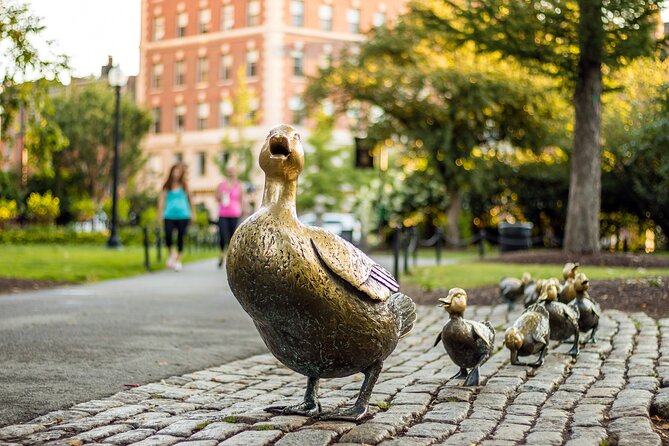
The meeting point is the Make Way for Ducklings sculpture by Nancy Schön, based on Robert McCloskey’s beloved children’s book. It is at 4 Charles Street, near the Boston Public Garden, with a 10:00 a.m. start.
This is a pleasant place to begin, but give yourself time to arrive. The tour is a walking experience from the first minute, and the opening location can be busy with people enjoying the Public Garden and nearby streets. A mobile ticket makes entry simple, though you should have your confirmation available.
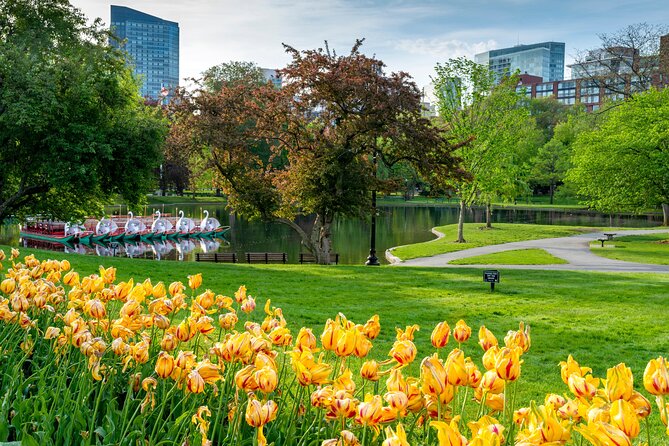
The Boston Public Garden itself provides an elegant opening setting. Created in 1837, it was the first public botanical garden in the United States. You will spend about 10 minutes here, with the garden’s paths, plantings, and open space offering a calm contrast to the arguments and political work that follow.
The route also takes in the equestrian statue of George Washington by Thomas Ball, commissioned in 1859. It is a useful reminder of which figures traditionally receive public honor, setting up the tour’s larger question: where do women appear in the city’s monuments, institutions, and official memory?
Pauline Shaw and the machinery behind the movement
At 6 Marlborough Street, you see the former home of Pauline A. Shaw, a financier of Boston’s women’s suffrage movement. She also founded the Boston Equal Suffrage Association for Good Government.
This stop lasts only about five minutes, but its subject is important. Movements need more than speeches. They need offices, printed material, fundraising, committees, and people who can keep work moving when public attention fades. Shaw represents that practical side of reform.
The tour also points to the former site of Chauncy Hall, where several pro-suffrage organizations had offices. These included the Massachusetts Woman Suffrage Association and The Women’s Journal. You get a sense of the movement as an organized campaign, not just a collection of famous names.
That is one of the strongest features of this walk. Instead of treating suffrage as a single event that happened in 1920, it shows the long local effort that came before the constitutional amendment. The buildings may look like ordinary Back Bay addresses, but their former uses give them a political charge.
Homes that reveal disagreement inside Boston society
The route passes the former homes of several important women, and these residential stops add texture to the public story.
You learn about Elizabeth Putnam, an anti-suffragist who was the first woman to preside over a state electoral college. Her presence complicates the common assumption that women who entered public life naturally supported the vote. A woman could gain a public role and still oppose broader political rights for women.
The tour then reaches the former home of Julia Ward Howe, a major name in Boston’s reform circles. Another stop concerns Blanche Ames, a pro-suffrage cartoonist and early advocate for birth control. Her work shows how political campaigns used images and public argument, not only formal speeches and meetings.
The Ames family story is particularly useful because it brings opposing views into one household. The Ames Mansion was tied to the family fortune and to political involvement through both Mary Shreve Ames, an anti-suffragist, and Blanche Ames, a suffragist. You do not need a long lecture on political theory to see the point: women in the same family could take sharply different positions.
Mary Shreve Ames later served as president of the Massachusetts Anti-Suffrage Association. Including her in the walk makes the tour more balanced and gives you a clearer view of the social debate. If you prefer history with some friction and contradiction, this section should appeal to you.
More history walks around Boston:
- History and Hauntings of Salem Guided Walking Tour
★ 5.0 · 14,564 reviews - Boston: City Cruises Historical Sightseeing Cruise
★ 4.6 · 1,771 reviews - Boston: Freedom Trail History Small Group Walking Tour
★ 4.9 · 1,590 reviews - City Cruises Boston Historic Sightseeing Harbor Cruise
★ 4.5 · 1,388 reviews
The College Club and women building their own networks
The College Club of Boston is another brief stop, lasting about 10 minutes. It was the first women’s college club in the United States.
That fact matters because clubs offered women a place to meet, exchange ideas, build friendships, and take part in civic life at a time when many formal institutions limited their access. A college club was not simply a social gathering. It could help create the confidence and connections needed for reform work.
You will see the club from the outside, since admission inside buildings and museums is not included. That is worth remembering when you compare this tour with a museum visit. The value here comes from the guide’s explanation and the way the locations fit together, not from entering historic rooms.
The tour also references a former MIT laboratory where Katherine McCormick protested against popular fashion as part of the suffrage movement. This is one of the route’s more unusual details. It shows how suffrage activism could appear in unexpected forms, including public challenges to clothing and the way women were expected to present themselves.
Copley Square and the public face of reform
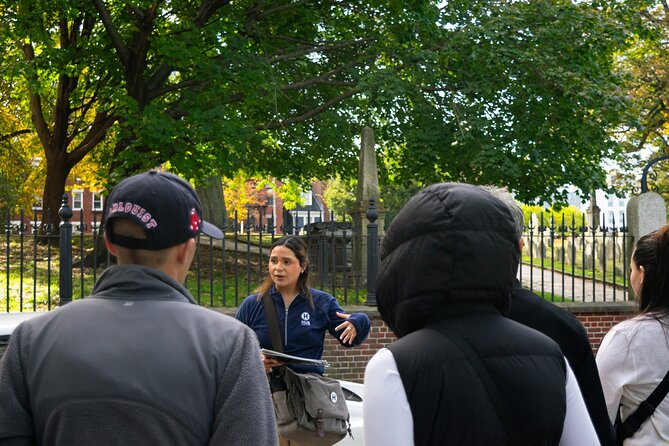
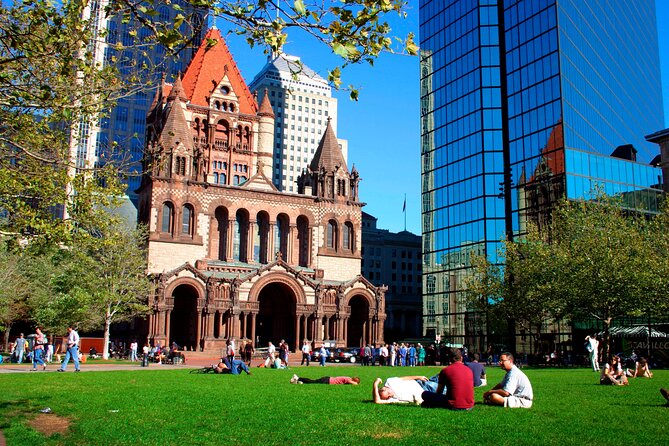
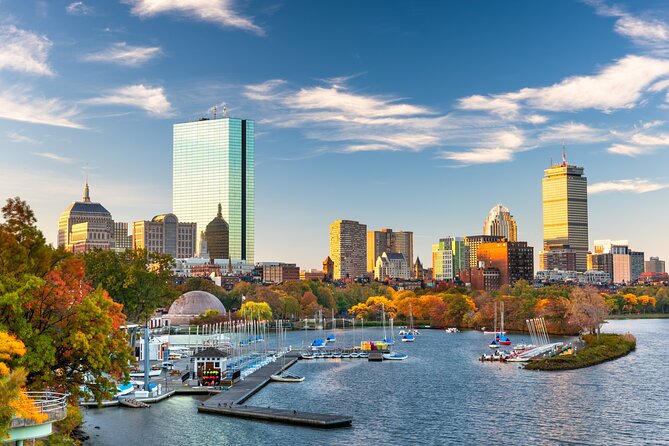
At Copley Square, you spend about 10 minutes in one of Boston’s best-known civic spaces. The square was created as a cultural center, and the surrounding buildings make it an ideal place to discuss how women sought a public voice.
A nearby building, constructed in 1877, was considered by members of the American Association of Architects one of the top 10 buildings in the country. The tour uses architectural landmarks like this as more than scenery. They show you the setting in which reformers spoke, organized, and tried to gain attention.
Copley Square is also a practical point to understand the city’s scale. Boston’s Back Bay is compact, but its grand architecture can make the distances feel larger. The route is not a marathon, yet you should expect frequent standing while the guide explains each location.
If you have trouble standing for extended periods, this may not be the right choice. The tour requires a moderate level of physical fitness, and the description specifically advises against booking if prolonged standing is difficult.
The Boston Public Library and the power of print
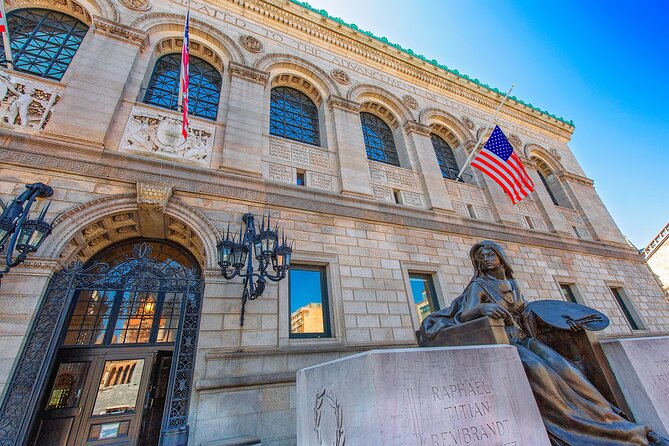
The Boston Public Library receives another 10-minute stop. Founded in 1848, it is now the third-largest public library in the United States.
For the suffrage story, the library represents access to knowledge, public debate, and printed ideas. The tour also points to The Women’s Journal, one of the pro-suffrage organizations connected with the former Chauncy Hall offices. Publications allowed reformers to share arguments and maintain a movement across meetings and neighborhoods.
You should not expect a library tour or indoor admission as part of this experience. The emphasis is on the outside setting and the role it played in the city’s intellectual and political life.
The route also includes the former site of the Kensington Building, demolished in 1967. It once held the offices of the Massachusetts Association Opposed to Further Extension of Suffrage to Women. This is a valuable reminder that urban change can erase physical evidence. Without a guide to identify the site, you would have little reason to know what once happened there.
From the Boston Marathon to Newbury Street
The walk continues past the finish line of the Boston Marathon and along a popular shopping and dining street known for luxury brands. These stops may seem less directly tied to suffrage, but they help you see the modern city layered over its political past.
The marathon finish line gives you a familiar public landmark. The shopping street shows how Back Bay functions today, with restaurants, stores, and heavy foot traffic. Between these modern uses are traces of earlier civic life, including a former Spiritualist Temple where women were allowed to lead public meetings.
That temple stop is especially telling. A place associated with spiritualism could provide women a platform at a time when many conventional public forums restricted their participation. The detail shows how women sometimes used less formal institutions to practice public speaking and leadership.
This section may feel less tightly arranged than the stops focused on named suffragists. Still, it gives the walk a useful rhythm. You are not moving through a preserved museum district. You are walking through a living neighborhood where old political stories sit beside present-day commerce.
Ending with Abigail Adams, Phillis Wheatley, and Lucy Stone
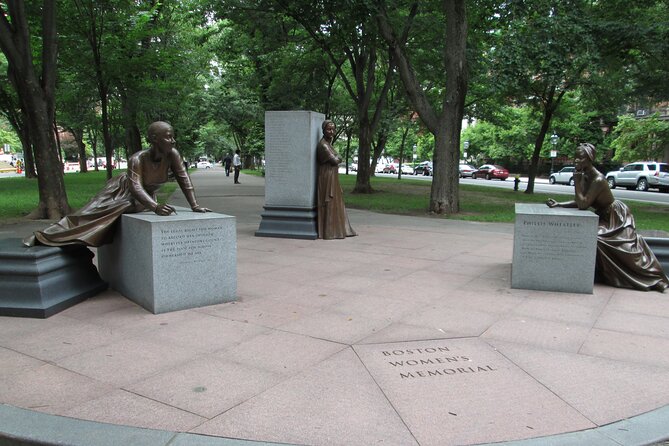
The final stop is the Boston Women’s Memorial on Commonwealth Avenue. The memorial depicts Abigail Adams, Phillis Wheatley, and Lucy Stone, three figures whose lives represent different eras and paths in the struggle for women’s voice and equality.
The tour ends on the Commonwealth Avenue Mall, about 0.8 miles from its starting point. The memorial is a fitting conclusion because it shifts from private homes and former offices to a place designed for public remembrance.
You finish near the center of Back Bay, with Downtown Boston to the east and the Fenway neighborhood to the west. That makes the end point useful for continuing your day. You can walk onward rather than backtracking to the Public Garden.
The memorial also helps tie the tour together. You have seen where women organized, argued, published, protested, and opposed the vote. Now you see how the city chooses to honor several of them.
What $35 gets you
At $35 per person, this is reasonably priced for a two-and-a-half-hour small-group walking tour in central Boston. You are paying for a focused subject, a planned route, and a guide who can connect scattered addresses into a clear story.
The maximum group size is 15. That is large enough to keep the tour affordable but small enough for questions and direct contact with the guide. I would value that especially on a history walk, where a good question can turn a short stop into a much more useful explanation.
The price does not include museum entry, and the tour does not use guides in period costume. That keeps the focus on interpretation rather than staged presentation. If you want elaborate interiors or theatrical reenactment, this is not that kind of experience.
The strongest value comes if you already enjoy walking tours and want a subject beyond the usual Revolutionary Boston route. You could see many of these buildings on your own, but you would miss the connections between them. The tour turns addresses into evidence.
Practical details for a comfortable walk
The tour is offered in English and uses a mobile ticket. Service animals are allowed, and the route is near public transportation.
Wear comfortable shoes and plan for outdoor conditions. The experience requires good weather, and poor weather can lead to a different date or a full refund. It also requires a minimum number of participants, so cancellation for that reason can result in a new date, another experience, or a full refund.
You can cancel for a full refund up to 24 hours before the start time. Changes or cancellations inside that 24-hour window are not accepted for a refund. A gratuity for the guide is optional.
The route is accessible in the sense that it moves through public streets and outdoor spaces, but the walking and standing requirement is real. If you need frequent seating or find two hours and 30 minutes on foot difficult, think carefully before booking.
Who will get the most from this tour
I would recommend it to anyone who wants Boston history beyond Paul Revere and the Freedom Trail. It is also a strong choice for readers, students, and families with older children who want to connect national women’s rights history with actual city addresses.
It suits you especially well if you enjoy asking questions. Maura has been singled out for welcoming questions and telling these stories with energy. One especially good sign is that the tour can send you home with a longer reading list. That means it works as a starting point for further study, not only as a two-hour diversion.
You should skip it if you want a mostly seated activity, extensive indoor access, or a broad survey of all Boston history. The subject is specific, and the route is conducted outdoors. You will see buildings and memorials, but you will not go inside museums as part of the $35 ticket.
Should you book the Votes for Women tour?
Book it if you want a focused, thoughtful walk through Boston’s role in women’s suffrage. The mix of pro-suffrage and anti-suffrage voices is a real strength, as is the attention paid to organizers, publishers, financiers, and public meeting places rather than only celebrity names.
I would make this a good companion to a Freedom Trail tour, not a replacement for it. You get a different Boston here, one built around women’s political work and the overlooked clues in Back Bay. The only serious caution is the time spent standing outdoors.
If that physical demand works for you, $35 is a fair price for a small group, an expert guide such as Maura, and a route that helps familiar streets make sense in a new way.
FAQ
How long is the Votes for Women History Tour?
The tour lasts approximately 2 hours and 30 minutes.
How much does the tour cost?
The listed price is $35 per person.
Where does the tour begin?
The tour begins at the Make Way for Ducklings sculpture by Nancy Schön, at 4 Charles Street in Boston.
Where does the tour end?
The tour ends at the Boston Women’s Memorial at 256 Commonwealth Avenue, on the Commonwealth Avenue Mall.
What time does the tour start?
The listed start time is 10:00 a.m.
How large is the group?
The tour has a maximum of 15 participants.
Is admission to museums included?
No. Admission inside museums is not included in the tour price.
Can I cancel for a full refund?
Yes. You can cancel at least 24 hours before the experience start time for a full refund. Cancellations made less than 24 hours before the start time are not refunded.
Just added around Boston
- Day Trip from Boston: Explore Hammond Castle Museum★ 3.7 · 3 reviews
- Boston: WNDR Museum Entry Ticket★ 3.7 · 3 reviews
- The Boston Bash Scavenger Hunt★ 4.5 · 3 reviews
- Self-Guided Audio Tour of Boston North End★ 4.5 · 3 reviews
- Boston: Official Freedom Trail® Lantern Tour★ 4.7 · 3 reviews
- Boston: North End Walking Tour with Private Harbor Cruise★ 5.0 · 3 reviews
- Self Guided “The North End Pizza, Cannoli and Picnic” Solo Walking Tour★ 5.0 · 3 reviews
- Cambridge: Haunted Charles River Cruise★ 4.3 · 3 reviews
Historic Tours in Boston, compared.
Freedom Trail History Small Group Walking Tour
Read our review →
Tour of Historic Fenway Park, America’s Most Beloved Ballpark
Read our review →
Boston Food & History: Pizza, North End & Freedom Trail
Read our review →
Freedom Trail History Small Group Walking Tour
Read our review →
City Cruises Boston Historic Sightseeing Harbor Cruise
Read our review →
Boston’s North End Food Tour: Italian Flavors & Heritage Walk
Read our review →
Boston Pizza Lovers Food and History Walking Food Tour
Read our review →Browse the lists this tour appears in