
Reviewed · CAMBRIDGE TOURS
Public Innovation Trail Tour in Cambridge
Cambridge’s Kendall Square is a place where the future is being built in office towers, research labs, and old industrial buildings. This 90-minute walking tour links modern breakthroughs, from gene editing and modified RNA to robotics and internet speed, with earlier Cambridge inventions such as the microwave oven and woven fire hoses.
I like two things here: the route puts big scientific ideas into a walkable city setting, and the guide turns company names into human stories. Julia, one of the guides, has been praised for her energy and clear storytelling, especially when explaining robotics pioneer Hugh Herr. The main drawback is that you do not enter the active labs, and some public displays may be closed on Sundays.
In This Review
- Key points to know before you book
- Why Cambridge is the right place for an innovation walk
- Starting at the Entrepreneur Walk of Fame
- CIC Cambridge and the business of starting up
- The MIT Museum and the challenge of showing technology
- Google at 355 Main Street and the age of everyday technology
- The Stata Center: robotics, artificial intelligence, and MIT hacks
- Broad Institute and Whitehead Institute: from genes to patients
- Biogen at 225 Binney Street and Cambridge’s biotech roots
- Akamai at 145 Broadway and the internet made faster
- Draper Labs and the software that reached the moon
- Moderna and LabCentral: the newest work on the route
- Tootsie Brands at 810 Main Street and Cambridge candy history
- What the $20 price really gets you
- Practical advice for making the walk work
- Who should book the Cambridge Innovation Trail
- Should you book it?
- FAQ
- How long does the Public Innovation Trail Tour last?
- Where does the tour begin and end?
- What time does the tour start?
- Can I enter the laboratories and company buildings?
- Is the tour suitable for someone with limited fitness?
- What happens if the weather is poor or the minimum group size is not met?
Key points to know before you book
- Modern science takes center stage: Learn how Cambridge companies and institutes are working in genetics, medicine, artificial intelligence, robotics, and software.
- The route covers 13 stops: You’ll walk from 50 Broadway to the MIT Media Lab at 75 Amherst Street.
- Expect a guide-led outdoor experience: Most stops are viewed from public streets, courtyards, or building exteriors.
- Julia is a memorable guide: Her enthusiastic explanations have made the robotics and biomedical stories especially engaging.
- The tour costs $20 per person: That is fair value if you enjoy ideas, city walking, and behind-the-scenes context more than formal museum access.
- Plan for a moderate walk: The tour runs at 2 p.m., lasts about an hour and a half, and requires a moderate level of fitness.
Why Cambridge is the right place for an innovation walk
Many city tours look backward. This one asks you to look at places where the next chapter may already be taking shape.
Kendall Square is especially suited to that idea. Within a relatively compact area, you pass MIT facilities, major technology companies, biomedical institutes, start-ups, and buildings with earlier industrial lives. The result is not a single story about one invention. It is a chain of ideas, people, funding, laboratories, and companies.
That chain matters. A start-up hub can help turn a research concept into a business. A university lab can produce a new computer system or medical technique. A company such as Akamai can change how information reaches your screen. Even a candy factory can show how manufacturing traditions survive beside cutting-edge research.
Your guide helps connect those dots. The tour is not just a procession of company names. It is a practical introduction to how innovation happens, who supports it, and why Cambridge has become such a productive place for scientific and technical work.
Other Cambridge tours people pair with this one:
- Cambridge: Harvard University Student-Guided Walking Tour
★ 4.6 · 3,931 reviews - MIT Campus Guided Walking Tour
★ 4.5 · 175 reviews - Illustrious Schools: Group Tour of MIT And Harvard
★ 5.0 · 107 reviews
Starting at the Entrepreneur Walk of Fame
The meeting point is 50 Broadway in Cambridge, and the tour begins at 2 p.m. The first stop is the Entrepreneur Walk of Fame, where you get acquainted with several names and stories that return later on the route.
This is a useful opening because it gives the walk a human scale. Scientific breakthroughs can feel remote when you hear only about institutions. Focusing first on entrepreneurs and their stories makes the later stops easier to follow.
The opening stop is brief, about five minutes, so do not expect a long orientation. It is more of a quick introduction before the group begins moving through Kendall Square.
The tour allows up to 25 people. That is large enough to create a social group, but still small enough for a guide-led walk. One especially large group was able to hear the stories clearly, which suggests that the guide makes a real effort to keep the group together and audible.
CIC Cambridge and the business of starting up
At 245 Main Street, you visit CIC Cambridge, formerly known as the Cambridge Incubator. It was founded by Tim Rowe, a graduate of MIT’s business school, and functions as a start-up hub.
This stop gives you an important piece of the innovation story. Breakthroughs do not move directly from a laboratory to the public. They need work space, funding, advice, equipment, and people who know how to turn an idea into an operating company.
You spend only about five minutes here. The value comes from the explanation rather than a long building visit. Access inside buildings is not included, so think of CIC as a place you learn about, not a working office you tour.
The MIT Museum and the challenge of showing technology
The MIT Museum reopened in October 2022 and presents the institute’s role in current technological progress. The group spends about ten minutes at this stop.
This is one of the more obvious museum opportunities along the route, but the tour does not include admission or an interior visit. Instead, your guide uses the museum as a way to frame MIT’s place in the story of science and technology.
That distinction is important. If you want galleries and hands-on exhibits, you may want to return to the MIT Museum on your own. The walking tour gives you context and direction, but it is not a substitute for museum time.
I like this arrangement because it keeps the tour moving. You get the broad idea of MIT’s influence without spending the whole afternoon indoors. If you have limited time in Cambridge, you can decide later if the museum deserves a separate visit.
Same city, a very different afternoon:
- Boston: Charles River Sunset and Cocktail Cruise
★ 4.4 · 50 reviews - Delicious Donuts of Harvard Square: A Historical Walking Tour
★ 5.0 · 31 reviews - From Boston: Guided Bike Tour of Cambridge
★ 4.9 · 23 reviews - Boston: Harvard & Cambridge Walking Food Tour
★ 5.0 · 18 reviews
Google at 355 Main Street and the age of everyday technology
At 355 Main Street, the route reaches Google’s Cambridge office. The guide explains the city’s relationship with major technology companies and points to creative work associated with these offices, including Android.
This is a good reminder that innovation is not only about rare scientific discoveries. It also changes the tools you use every day. A phone operating system, a search service, or an online platform can affect millions of people even when the work itself happens behind office walls.
The stop lasts about five minutes. You will not take a corporate tour or see private work spaces. The appeal is the connection between a familiar global brand and Cambridge’s local technology community.
The Stata Center: robotics, artificial intelligence, and MIT hacks
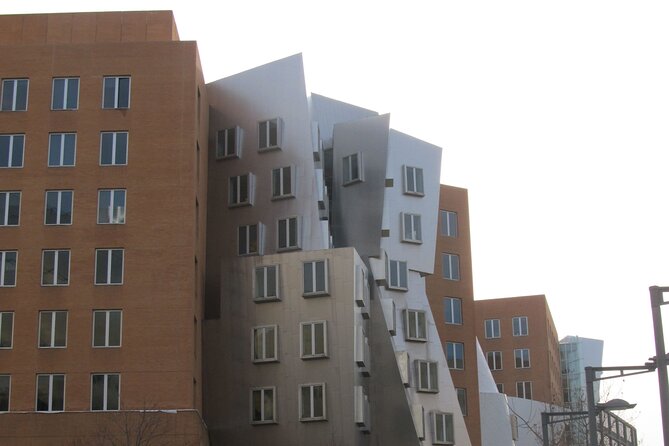
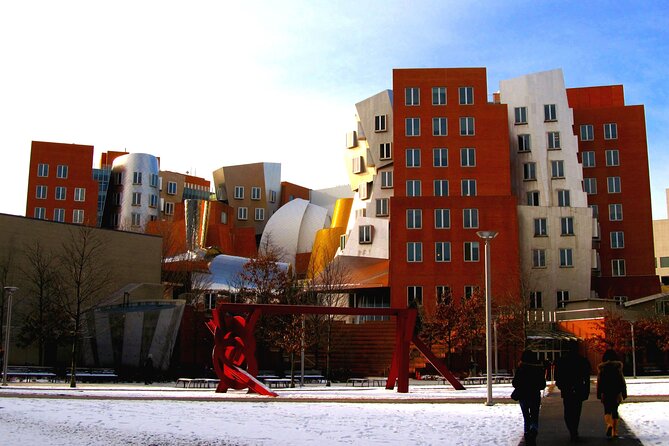
The Stata Center is one of the most interesting stops for anyone who likes computers, robots, or unusual architecture. Inside are labs focused on computer science, artificial intelligence, and robotics.
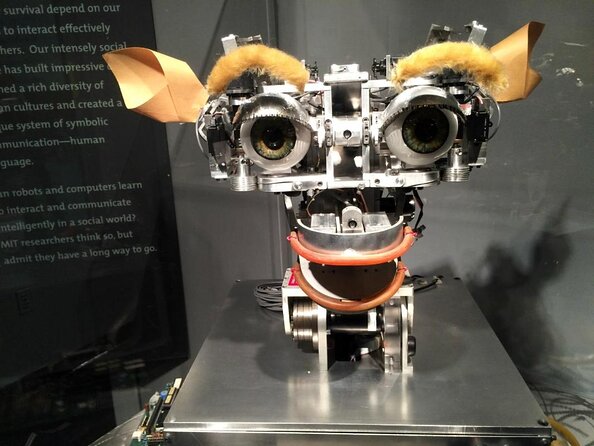
Those labs helped give rise to iRobot Corporation, known for the Roomba robotic vacuum cleaner. The stop also connects to Hugh Herr, whose robotics story was singled out by one participant as a particularly inspirational part of Julia’s presentation.
That detail gives the stop more emotional weight. Robotics here is not presented only as machines and code. It also relates to the human body, mobility, and the effort to solve difficult physical problems.
On the ground floor, there is a small exhibit about MIT student hacks, the school’s term for elaborate pranks and practical jokes. It offers a lighter counterpoint to the serious research. You may find the contrast useful: MIT’s culture includes both advanced technical work and playful experimentation.
The group spends about ten minutes at the Stata Center. Public access can vary, so treat the stop as an explanation of the building and its work, not a guaranteed lab visit.
Broad Institute and Whitehead Institute: from genes to patients
The Broad Institute of MIT and Harvard focuses on understanding the roots of disease and narrowing the gap between biological discoveries and patient care. This is one of the tour’s strongest science stops.
Your guide explains the basic purpose in accessible terms: researchers study the causes of disease, then work toward applying those findings in medicine. You do not need a technical background to appreciate the central question, which is how a better understanding of biology can lead to better treatment.
The route then turns to the Whitehead Institute and the Human Genome Project. The institute was created in 1982 by philanthropist Jack Whitehead and David Baltimore, an MIT professor and Nobel Prize winner. Its original vision involved bringing leading biomedical researchers into one building, with strong funding, advanced equipment, and as little bureaucracy as possible.
That story adds useful context. Research depends on more than bright ideas. It also depends on how an institute is organized and supported. The Whitehead model was designed to remove obstacles so scientists could focus on discovery.
The two stops take about 15 minutes combined. They are best for you if you enjoy learning how science is organized, not just hearing a list of famous discoveries.
Biogen at 225 Binney Street and Cambridge’s biotech roots
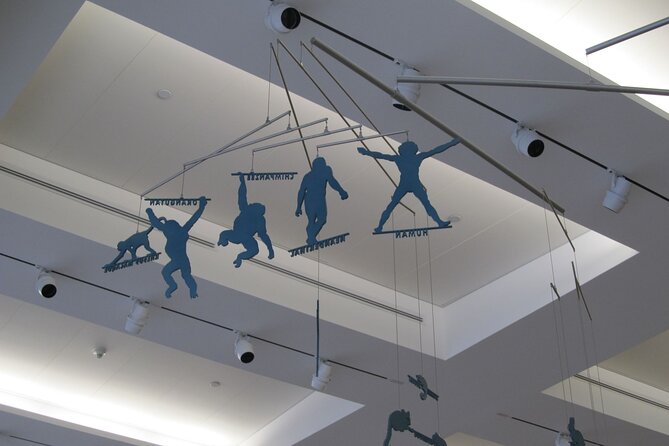
At 225 Binney Street, you hear about Biogen, one of the area’s major biotechnology companies. It was founded by two Nobel Prize winners, and its story adds another chapter to Cambridge’s role in biomedical innovation.
The guide uses Biogen to show how academic science and private companies can work in the same local network. You see how a research idea may move toward treatments, commercial development, and wider public use.
Again, this is not an inside-the-lab visit. The building is a setting for the story. That may disappoint anyone hoping to see equipment or research in action, but it also keeps the experience focused on ideas and people rather than restricted access.
Akamai at 145 Broadway and the internet made faster
At 145 Broadway, you meet Akamai, described as an internet accelerator. Its original idea was simple but powerful: place servers around the world so online content could be stored closer to the people requesting it.
That approach helped web pages and other digital material appear faster. Early large-scale demonstrations included delivery of a Star Wars: The Phantom Menace movie trailer and ESPN’s March Madness coverage in 1999.
This is a particularly effective stop because it connects an invisible service to familiar moments. You may never think about where online content is stored, yet Akamai’s system helped shape the speed and reliability of the modern web.
The stop lasts about five minutes. It is short, but the example makes the technical concept easy to grasp.
Draper Labs and the software that reached the moon
The walk continues down Broadway and turns onto Technology Square, where Draper Labs is located at 555. A giant moon hangs in the lobby, a fitting symbol for the company’s most famous work.
Draper helped create the guidance computers that allowed Apollo spacecraft to travel to and land on the moon. The story also includes Margaret Hamilton, one of the software developers who wrote the code for those computers.
Hamilton later founded two companies and is credited with helping define software engineering as a field. Her inclusion is valuable because early spaceflight stories often focus on astronauts and rockets. This stop reminds you that software was just as important to the mission.
You spend about ten minutes here. Since most spaces are active workplaces, interior access is not guaranteed. The moon display and the story of the Apollo guidance system still make this one of the route’s most memorable points.
Moderna and LabCentral: the newest work on the route
Moderna was founded in 2010 to explore modified RNA molecules. The name comes from mod-RNA, and the company’s work has involved using modified RNA to treat disease or serve as a vaccine.
This stop brings the tour firmly into the present. Unlike the Apollo story, which has already entered history books, Moderna represents research whose long-term impact is still being measured.
LabCentral offers another look at how modern science gets started. The building has housed Davenport Car Works, Walworth Manufacturing Company, Polaroid, and now LabCentral. Few buildings have hosted such different kinds of innovators over time.
That sequence is worth noticing. Cambridge innovation is not limited to purpose-built research campuses. Old industrial and manufacturing spaces can take on new roles as technology changes.
Tootsie Brands at 810 Main Street and Cambridge candy history
The final stop at 810 Main Street provides a welcome change of pace. Cambridge once had 66 candy companies, producing items such as Valentine candy hearts, Squirrel Nut Zippers, and lemon drops.
The Fig Newton was also invented in Cambridge in 1891, even though it was named for nearby Newton. The building is now home to the last operating candy factory in Cambridge, owned by Tootsie Brands.
The factory does not offer tours, partly because candy companies closely guard their equipment and production methods. That makes the stop more of an exterior story, but the scale is striking: about 26 million pieces of candy are made there each day.
This is a smart final stop because it widens your idea of innovation. Scientific research gets the most attention on the route, but food manufacturing also depends on specialized machinery, efficient processes, and careful protection of trade secrets.
What the $20 price really gets you
At $20 per person, the tour is reasonably priced for a 90-minute guided walk. You are paying for interpretation, route planning, and access to a connected story rather than for admissions or private building tours.
That distinction affects the value. If you want to enter labs, explore every lobby exhibit, or spend time inside the MIT Museum, the price will not cover those extras. You may need to return to certain places independently.
If you enjoy science, business, medicine, technology, or local history, I think the cost is easy to justify. You get 13 stops and a guide who can explain why the buildings matter. The tour also helps you decide which sites deserve a longer visit.
The mobile ticket is convenient, and confirmation arrives when you book. Free cancellation is available up to 24 hours before the 2 p.m. start. Poor weather or failure to reach the minimum group size can lead to a new date or a full refund.
Practical advice for making the walk work
Wear comfortable shoes and allow for a moderate level of physical activity. Private transportation is not included, so you move between stops on foot.
The tour begins at 50 Broadway and ends at the MIT Media Lab at 75 Amherst Street. It is near public transportation, which makes the start and finish easier to manage, but you should still plan your onward route from the end point.
The tour requires good weather. A Sunday booking may mean some lobby exhibitions are closed, so weekday timing could be preferable if seeing public interior displays matters to you.
Service animals are allowed. The maximum group size is 25, and the guide-led format means you should stay close enough to hear the explanations at each stop.
Who should book the Cambridge Innovation Trail
I would choose this tour if you like learning how ideas move from university research to companies, products, and public use. It suits adults, older children, students, engineers, science fans, and anyone curious about what makes Cambridge more than a college town.
The tour is also a good fit if you want a compact introduction before exploring Kendall Square on your own. The route includes enough subjects to keep things varied: robotics, software, genetics, biotechnology, internet infrastructure, space travel, start-ups, and candy.
You may want to skip it if you prefer historic houses, long museum visits, or guaranteed indoor access. Much of the experience happens outside, and several stops are viewed from public areas because the buildings contain active labs and workplaces.
Should you book it?
Book the Public Innovation Trail Tour if you want a lively, idea-filled walk through Cambridge’s working present. The strongest parts are the clear links between places, the human stories behind technical work, and the range of subjects covered in only 90 minutes.
Julia’s storytelling has been especially effective for the robotics material, while the Apollo, Akamai, and candy-factory stops give the route memorable variety. Just keep your expectations practical: this is a guided outdoor tour, not a series of private facility visits.
At $20, it offers good value for curious minds. Pick a dry day, wear walking shoes, and consider visiting the MIT Museum or public lobby displays separately if you want more time indoors.
FAQ
How long does the Public Innovation Trail Tour last?
The tour lasts approximately one hour and 30 minutes.
Where does the tour begin and end?
It starts at 50 Broadway, Cambridge, Massachusetts, and ends at the MIT Media Lab at 75 Amherst Street, Cambridge.
What time does the tour start?
The scheduled start time is 2 p.m.
Can I enter the laboratories and company buildings?
No. Access inside buildings is not included. Most locations are active labs or workplaces, so the guide explains their importance from public areas.
Is the tour suitable for someone with limited fitness?
The tour requires a moderate level of physical fitness. It is a walking experience, and private transportation is not included.
What happens if the weather is poor or the minimum group size is not met?
If poor weather or an insufficient number of participants causes cancellation, you will be offered another date or experience, or a full refund. You can cancel up to 24 hours before the start time for a full refund.
Just added around Cambridge
- Harvard’s Secret Society: Exploration Game and Tour★ 4.0 · 3 reviews
- Union Square, Somerville Neighborhood Food Tour★ 5.0 · 4 reviews
- Boston: Private City Tour of Boston & Cambridge★ 5.0 · 5 reviews
- Harvard Square Cambridge Food & Walking Tour★ 5.0 · 5 reviews
- Harvard: America’s oldest university – walking tour in French★ 4.9 · 10 reviews
- Harvard Square Chocolate Tour★ 4.5 · 14 reviews
- Boston: Harvard & Cambridge Walking Food Tour★ 5.0 · 18 reviews
- From Boston: Guided Bike Tour of Cambridge★ 4.9 · 23 reviews
Cambridge Tours, compared.
Harvard University Student-Guided Walking Tour
Read our review →
Illustrious Schools: Group Tour of MIT And Harvard
Read our review →

Delicious Donuts of Harvard Square: A Historical Walking Tour
Read our review →


Browse the lists this tour appears in