
Reviewed · SALEM TOURS
Salem Bewitched Tour With Tarot Reading
Salem’s past and its pop-culture present meet on this compact tour, which moves from the Witch Trials Memorial and an old cemetery to the Bewitched statue of Elizabeth Montgomery. The final twist is a 15-minute tarot reading with Cynthia, the multilingual guide, who also practices numerology and palmistry.
I like the way the route gives you a quick look at several important Salem sites without making you commit to a full day. I also like the small maximum of six people, which should make it easier to ask questions and hear the stories. The main consideration is time: two to three hours is enough for an overview, but not enough for long visits inside Salem’s museums and historic buildings.
In This Review
- Key points to know before booking
- A compact introduction to Salem’s witch trial story
- Pickman House and the Witch Trials Memorial
- Old Burying Point Cemetery and Salem’s early public life
- The Bewitched statue brings a lighter Salem
- The Witch House and Jonathan Corwin
- Bridget Bishop’s property and the former Salem Jail
- Roger Conant and Salem’s early settlement
- Tarot and palm reading at the Peabody Essex Museum
- Timing, group size, and physical demands
- Languages and the guide’s role
- Value, admissions, and cancellation
- Who should book this Salem experience?
- Should you book the Salem Bewitched Tour?
- FAQ
- Where does the tour begin?
- Where does the tour end?
- How long does the tour last?
- Is the tarot reading included?
- Who provides the tarot reading?
- What languages are available?
- Is admission to the Witch House included?
- Is Peabody Essex Museum admission included?
- How large is the group?
Key points to know before booking

- The tour ends with tarot and palm reading: Cynthia provides a 15-minute reading at the Peabody Essex Museum meeting point.
- You see eight Salem locations: Highlights include the Witch Trials Memorial, Old Burying Point Cemetery, the Witch House, and Bridget Bishop’s former property.
- Pickman House adds an unusual opening stop: You hear stories about one of Salem’s oldest houses before reaching the memorial.
- The group is limited to six people: This suits you if you prefer a personal tour over a large crowd.
- The route mixes solemn history with pop culture: The Bewitched statue offers a lighter photo stop after the witch trial sites.
- Some admissions are separate: The Witch House and Peabody Essex Museum stops are marked as not included, while the outdoor sites are free.
A compact introduction to Salem’s witch trial story
The tour begins at the Peabody Essex Museum on Essex Street and returns there at the end. From that central point, you visit a string of downtown landmarks connected to Salem’s 1692 witch trials, early settlement, local government, and modern identity.
The opening focus is serious. You hear about the Pickman House, one of Salem’s oldest houses, then continue to the Witch Trials Memorial. Later, the route shifts tone with Elizabeth Montgomery’s Bewitched statue and finishes with a personal tarot reading.
I see this as an orientation tour rather than a complete study of Salem. You get the names, places, and basic context you need to understand the city, then you can choose which sites deserve a longer visit.
Other Salem tours people pair with this one:
- History and Hauntings of Salem Guided Walking Tour
★ 5.0 · 14,564 reviews - Salem’s Best Ghost Tour
★ 4.5 · 4,186 reviews - Salem Voodoo, Vampires, and Ghosts Guided Walking Tour
★ 5.0 · 1,931 reviews
Pickman House and the Witch Trials Memorial
Before entering the memorial, you stop at Pickman House for stories about the building and its place in Salem. The supplied details do not specify an interior visit, so you should think of this as a storytelling stop rather than a full house tour.
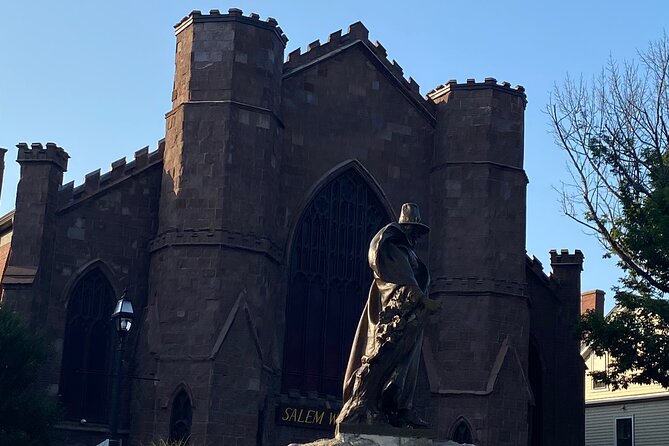
The Witch Trials Memorial is the emotional center of the experience. A handcrafted granite wall surrounds the site on three sides. The stone threshold carries the victims’ protests of innocence, while benches inside bear the names and execution dates of the 20 people who were killed.
That design matters. It keeps the memorial quiet and spare, with the names doing most of the work. You do not need a long lecture to understand the weight of the site. The brief 15-minute stop gives you time to read the inscriptions and pause, though anyone wanting a more detailed account of each person will need another visit or a longer museum program.
The memorial is appropriate for all ages, but the subject is grave. I appreciate that this stop treats the events as a human tragedy rather than turning the suffering into a Halloween prop.
Old Burying Point Cemetery and Salem’s early public life
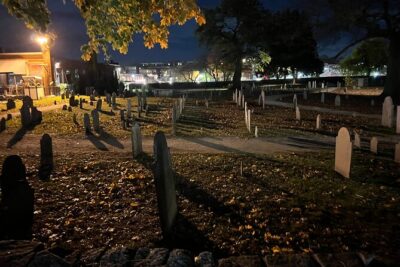
A short visit to Old Burying Point Cemetery follows the memorial. Also called Charter Street Cemetery, it opened in 1637 and is Salem’s oldest maintained cemetery. It is also among the oldest maintained burial grounds in the United States.
The listed time here is only five minutes. That is enough to see the setting and hear why it matters, but it is not enough to inspect many markers or absorb the cemetery at a slow pace. If you enjoy old graveyards, you will want to return independently.
The cemetery is also the final resting place of several Salem notables. The tour’s value here is the connection between the burial ground and the city’s long civic story. Salem is not only the place of the 1692 accusations. It is also an old settlement with centuries of local figures, public buildings, and changing traditions.
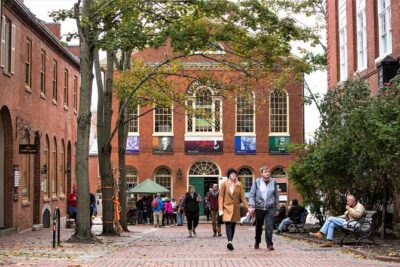
Next comes Salem Old Town Hall, built in 1816 in the Federal style. The two-story brick building has Palladian windows, carved wood details, antique chandeliers, decorative columns, and hardwood floors. It no longer serves as a municipal office, but it remains a cultural and rental space for the community.
Again, the stop lasts about five minutes and is primarily an exterior look unless conditions permit something more. The building gives you a useful visual break from the cemetery and memorial. Its formal design also helps show how Salem’s public identity developed long after the witch trials.
The Bewitched statue brings a lighter Salem
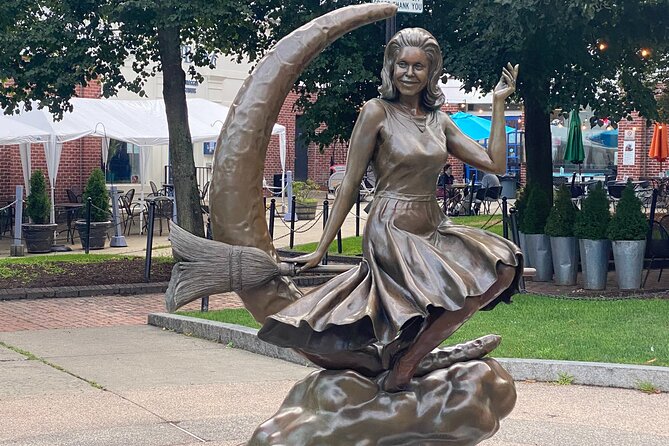
The bronze statue of Elizabeth Montgomery is one of the route’s easiest photo stops. Montgomery played Samantha Stephens in the 1960s television show Bewitched. The six-foot statue shows Samantha sitting sidesaddle on a broom beside a crescent moon.
Several episodes of the show were filmed in Salem in 1970, and the city has embraced that connection. The statue is a reminder that Salem today lives in two worlds. One is tied to documented colonial events and painful court proceedings. The other is built around television, popular imagination, and visitors looking for a playful picture.
You get about 10 minutes here. That is a sensible amount of time for photographs and a short explanation. I like this change of mood, since a tour focused only on executions and imprisonment could feel heavy. The stop may feel less important if you came strictly for colonial history, but it is part of how Salem presents itself now.
Same city, a very different afternoon:
- Bewitched Walking Tour of Salem
★ 5.0 · 1,895 reviews - Satanic Salem Walking Tour
★ 5.0 · 1,635 reviews - Mysteries and Murders of Salem Guided Night-Time Walking Tour
★ 5.0 · 1,488 reviews - The Salem Witch Walk
★ 4.5 · 1,301 reviews
The Witch House and Jonathan Corwin
The Witch House is the only surviving building in Salem with direct ties to the witch trials. It was the home of Jonathan Corwin, who served on the Court of Oyer and Terminer that convicted people accused of witchcraft. Corwin was also the uncle of High Sheriff George Corwin.
The house has another notable connection. Roger Williams lived there before founding Providence Plantation in Rhode Island. The building was moved 11 meters in the 1940s to make room for road widening, a small detail that shows how modern city changes can affect old places.
The stop is listed at about 10 minutes, and admission is not included. That means you should decide in advance if you want to pay for entry and spend more time inside. A quick exterior stop works well for a short overview, but the building’s importance is best understood with time to examine its rooms and displays.
The practical point is simple: do not assume the tour ticket covers admission here. If the house is a priority, ask how the visit is handled and allow extra time beyond the scheduled stop.
Bridget Bishop’s property and the former Salem Jail
Turner’s Seafood at Lyceum Hall marks the location of the former property of Bridget Bishop. Bishop was the first person executed for witchcraft during the Salem witch trials, on June 10, 1692.
The present-day setting is a useful reminder that historic sites are often woven into ordinary city blocks. You may be standing near a restaurant or commercial building while hearing about a property tied to one of Salem’s darkest episodes. That contrast can feel jarring, but it is also honest. The past has not been sealed away from daily life.
After this stop, you hear about the site of the infamous Salem Jail. People accused of witchcraft were arrested and imprisoned there before being hanged. The listed time for this portion is about 15 minutes, including the Bridget Bishop location and jail story.
There is no surviving jail building included in the supplied details, so this part is best understood as a location-based history stop. I would not book this tour expecting a jail interior. Its value comes from connecting the names and accusations to physical points in the city.
Roger Conant and Salem’s early settlement
The Roger Conant statue provides another shift in subject. Sculptor Henry Hudson Kitson created it in 1913. Kitson is also known for the Lexington Minuteman Memorial.
Conant founded the English settlement in Salem, so the statue reaches further back than the witch trials. This is a helpful part of the route because it places 1692 within a larger story. Salem was already an established community before the trials, and its story continued through the eighteenth, nineteenth, and twentieth centuries.
The stop lasts about five minutes. You will hear the essential point and have time to look at the monument, but this is not a long art or settlement-history lecture. The short visit works because the tour has several stops and needs to keep moving.
Tarot and palm reading at the Peabody Essex Museum
The experience ends where it begins, at the Peabody Essex Museum. Here, Cynthia provides the included 15-minute tarot reading. The tour information also identifies her as an experienced tarot reader, numerologist, and palmistry practitioner.
This is not presented as a separate museum tour. The Peabody Essex Museum stop is the setting for the reading, and admission to the museum is not included in the listed activity details. If you want to visit the galleries, plan that as a separate part of your Salem day.
The reading gives the tour a distinctive finish. Instead of ending with another plaque or monument, you get a personal, interpretive experience. Cynthia’s cheerful manner and multilingual ability were singled out in the written feedback, along with her tarot and palm readings. One person described the reading as surprisingly accurate, while another praised the different angle she brought to Salem’s past.
You should treat the reading as entertainment and personal reflection rather than a substitute for historical evidence. That does not make it pointless. For many people, it will be the most memorable part of the afternoon. For others, it may feel less appealing than an extra half-hour at a museum or historic house.
Timing, group size, and physical demands
The advertised duration is about two to three hours. The schedule includes several five to 15-minute stops, so the experience moves at a steady pace. You should be ready to listen while standing and to move between downtown locations.
Private transportation is not included. The tour begins and ends at 161 Essex Street, outside the Peabody Essex Museum, and the route includes multiple central Salem sites. The information provided does not promise a private vehicle, so you should plan around the meeting point and expect to manage your own transportation to and from it.
A moderate level of physical fitness is requested. Service animals are allowed, and the meeting area is near public transportation. The group maximum is six people, a useful limit in a historic downtown where narrow spaces and crowded sidewalks can make large groups awkward.
The small size is one of the strongest practical features. You can ask about a building, clarify a name, or request a little more context without trying to catch a guide’s attention from the back of a large group. The tradeoff is that the tour may not suit you if you want long, unhurried visits at every stop.
Languages and the guide’s role
The experience is offered in English, French, Spanish, and Italian. That makes it more flexible for couples or families who are most comfortable in one of those languages. Confirm your preferred language when booking, since the tour summary also describes English as an available language.
Cynthia is the guide name connected with the written feedback. Her role is broader than simply leading you from marker to marker. She explains Salem’s sites, offers a personal reading, and brings a cheerful tone to a subject that can become grim.
That combination is central to the tour’s character. You are not booking a strict academic walk, and you are not booking only a supernatural-themed activity. You are getting a small historical overview with a modern Salem twist.
Value, admissions, and cancellation
No tour price is provided here, so I cannot judge the exact dollar value. I can judge what the package includes: the guided route, the 15-minute tarot reading, and visits to several free outdoor locations. The Witch House and Peabody Essex Museum are marked as not included, so set aside extra money only if you want entry to those places.
For a first look at Salem, the value is strongest if you want several landmarks explained in one outing and you enjoy the unusual tarot finish. It is weaker if you prefer to spend an hour or more inside each historic building, since the schedule is designed for breadth.
Free cancellation is available when you cancel at least 24 hours before the start time. Changes or cancellations made within 24 hours are not accepted for a refund, and the cut-off uses Salem’s local time.
Who should book this Salem experience?
I would recommend it to you if this is your first visit and you want a quick sense of Salem’s major witch trial sites. It also suits couples, families, and small groups who like a personal guide and do not mind mixing solemn history with a playful television reference.
The tour is especially appealing if you want a tarot or palm reading built into your sightseeing. Cynthia’s language options may also help you choose this experience when another member of your group prefers French, Spanish, or Italian.
I would choose something else if you want extensive museum time, a long examination of the Witch House, or a fully focused account of colonial law and religion. The short stop lengths make this a sampler. Use it to get your bearings, then return to the places that catch your interest.
Should you book the Salem Bewitched Tour?
Book it if you want a small, varied introduction to Salem with a memorable personal reading at the end. The route covers important outdoor landmarks, offers useful context, and avoids the feel of a large group outing.
Think twice if the tarot element does not interest you, since it is a notable part of the experience rather than a minor extra. Also remember that some admissions are separate and that the two to three-hour schedule favors a broad overview over lengthy site visits.
For many people, the best plan is to use this tour early in a Salem visit. You get the memorial, cemetery, historic buildings, Bridget Bishop’s site, and the Bewitched statue in one compact route. Then you can spend the rest of your day at the Witch House, the Peabody Essex Museum, or another place that deserves more time.
FAQ
Where does the tour begin?
It begins at the Peabody Essex Museum, 161 Essex Street, Salem, Massachusetts 01970.
Where does the tour end?
The activity ends back at the Peabody Essex Museum meeting point.
How long does the tour last?
The tour lasts approximately two to three hours.
Is the tarot reading included?
Yes. A 15-minute tarot reading with the host guide is included.
Who provides the tarot reading?
The tour guide, Cynthia, provides the tarot reading. She is also identified as a numerologist and palmistry practitioner.
What languages are available?
The tour is available in English, French, Spanish, and Italian.
Is admission to the Witch House included?
No. Admission to the Witch House is not included.
Is Peabody Essex Museum admission included?
The Peabody Essex Museum stop is marked as not included. The 15-minute tarot reading takes place there, but museum admission is separate.
How large is the group?
The activity has a maximum of six people.
Just added around Salem
- Pirates and Privateers Walking Tour with Real Pirates Admission★ 4.5 · 3 reviews
- Private Walking Salem Legends Tour Professional Guide★ 5.0 · 3 reviews
- Salem Village Witch Hunt Walking Tour★ 5.0 · 3 reviews
- Salem: Spanish-Speaking Witch Trials Walking Tour★ 5.0 · 3 reviews
- Discover Salem’s History & Practice Authentic Witchcraft★ 4.1 · 4 reviews
- The Ghost Walk. Tortured Souls of Salem★ 5.0 · 4 reviews
- Cemetery and Witchcraft Trials Tour★ 5.0 · 4 reviews
- [ESP] History of Salem Witch Trials★ 4.0 · 5 reviews
Salem Tours, compared.
History and Hauntings of Salem Guided Walking Tour
Read our review →

Mysteries and Murders of Salem Guided Night-Time Walking Tour
Read our review →
Wicked Awesome Tours: Witch Trial History and Salem Haunts!
Read our review →Browse the lists this tour appears in